
Efforts to overcome diffusional limitation in microporous zeolites have been directed towards the design of hierarchical structures in said zeolites. Hierarchical zeolites contain highly interconnected networks of zeolitic micropores combined with meso- and/or macropores. Interest in these materials stems from the higher reaction rates,1,2 improved selectivity,3 resistance to deactivation,4 and novel adsorption behavior5 that they exhibit in comparison to the typical zeolites that only have micropores. Among the synthesis approaches, repetitive branching by rotational intergrowth2,6Ð9 holds promise for industrial implementation due to its simplicity and lower cost as it is a one-step synthesis which uses simple structure-directing agents or additives compared to hard and dual-soft templating approaches.
As an important component of fluid catalytic cracking (FCC) catalysts, Faujasite is one of the most widely used zeolites. It consists of two polymorphs: FAU (cubic) and EMT (hexagonal), which share the same periodic building unit (PBU) known as the Faujasite sheet. The intergrowth of FAU and EMT in the same material results in the development of hierarchical FAU/EMT materials grown in a house-of-card assembly of nanosheets. Such materials have been reported using either organosilane surfactants7,9 or Lithium or zinc salts.8 However, both FAU and EMT can nucleate from inorganic sols containing only sodium ions, hence, the development of a house-of-card assembly of Faujasite sheets from sodium aluminosilicate mixtures is in principle possible thus avoiding extra costs of additional additives.
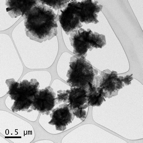
Earlier findings by Khaleel et.al10 demonstrate the use of pre- and post-nucleation trajectories in the synthesis of high FAU content Faujasite nanocrystals. The aim of the present work is to gain further insight and extend this principle into designing house-of-card assembly of Faujasite nanosheets from organic-free sodium aluminosilicate sols. The effect of combining different synthesis trajectories was investigated and materials were characterized by high resolution transmission electron microscopy and X-ray diffraction. Such materials are type X (Si/Al < 1.5) FAU/EMT intergrowths that reduce the diffusion path length perpendicular to the sheets (ca. 200 nm) and also provide extra meso/macro-porosity between the sheets enhancing diffusion. Preliminary results indicate that different hierarchal zeolite materials can be designed by proper adjustment of the synthesis conditions. Findings demonstrate that it is possible to combine the effects of pre-and post-nucleation sol composition to steer crystal size and crystal structure, respectively. The initial sol preserves the original trajectory towards large crystals after composition change. Despite this memory effect, the sol at this stage is still agnostic towards FAU or EMT formation, the relative content of which is dominantly determined by the final composition. This expands the spectrum of hierarchical materials that can be designed. After optimizing the hierarchal zeolite structure, the performance of the prepared materials can be tested in catalytic applications such as n-butane cracking
References
(1) van Donk, S.; Broersma, A.; Gijzeman, O. L. .; van Bokhoven, J. .; Bitter, J. .; de Jong, K. . J. Catal. 2001, 204 (2), 272Ð280.
(2) Zhang, X.; Liu, D.; Xu, D.; Asahina, S.; Cychosz, K. A.; Agrawal, K. V.; Wahedi, Y. Al; Bhan, A.; Hashimi, S. Al; Terasaki, O.; Thommes, M.; Tsapatsis, M. Science (80-. ). 2012, 336 (6089), 1684Ð1687.
(3) Christensen, C. H.; Johannsen, K.; Schmidt, I.; Christensen, C. H. J. Am. Chem. Soc. 2003, 125 (44), 13370Ð13371.
(4) Choi, M.; Na, K.; Kim, J.; Sakamoto, Y.; Terasaki, O.; Ryoo, R. Nature 2009, 461 (7261), 246Ð249.
(5) Xu, D.; Swindlehurst, G. R.; Wu, H.; Olson, D. H.; Zhang, X.; Tsapatsis, M. Adv. Funct. Mater. 2014, 24 (2), 201Ð208.
(6) Chaikittisilp, W.; Suzuki, Y.; Mukti, R. R.; Suzuki, T.; Sugita, K.; Itabashi, K.; Shimojima, A.; Okubo, T. Angew. Chemie Int. Ed. 2013, 52 (12), 3355Ð3359.
(7) Inayat, A.; Knoke, I.; Spiecker, E.; Schwieger, W. Angew. Chemie Int. Ed. 2012, 51 (8), 1962Ð1965.
(8) Inayat, A.; Schneider, C.; Schwieger, W. Chem. Commun. 2015, 51 (2), 279Ð281.
(9) Khaleel, M.; Wagner, A. J.; Mkhoyan, K. A.; Tsapatsis, M. Angew. Chemie - Int. Ed. 2014, 53 (36), 9456Ð9461.
(10) Khaleel, M.; Xu, W.; Lesch, D. A.; Tsapatsis, M. Chem. Mater. 2016, 28 (12), 4204Ð4213.
See more of this Group/Topical: Materials Engineering and Sciences Division