
Probing the Site-Pairing Preference of Framework Aluminum in ZSM-5 with Ga(CH3)3
Kyle Grodena, Zachary Jonesb, Renqin Zhanga, Susannah Scottb, Jean-Sabin McEwena
a Washington State University, WA, 99164;
b University of California, Santa Barbara, CA, 93106;
Figure 1. Comparison of the computed and the simulated XANES for methylene bridged Ga and how the Al distribution influences the Ga-Ga distance within a zeolite framework. The computed Ga-Ga distance is 2.96 Å, in strong agreement with experimental findings. |
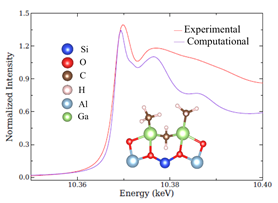
ZSM-5 is a zeolite catalyst marked with great versatility in catalytic application as a result of its flexibility in cation incorporation. Due to this property, the structure of ZSM-5 has been under question for its ability to accept divalent cations, implying that the substituted aluminum sites exist in paired configurations at specific locations within the zeolite framework. Trimethylgallium was used to probe these sites, as the dimethyl gallium fragments that exist in these locations following impregnation were thought to bind to nearby fragments via terminal methyl groups. Experimental extended x-ray absorption fine structure (EXAFS) spectroscopy data supports this “bridging” configuration due to the presence of potential gallium-gallium scattering signals. Zeolite cluster models were created containing potential sites for aluminum pairings with dimethyl gallium fragments, with optimized geometrical conformations obtained from first principles calculations based on density functional theory (DFT) implemented in the VASP program.1,2 As methyl-bridged structures were unfavorable, additional cluster and periodic models were constructed to explore the possibility of carbon-hydrogen bond cleavage due to the reactivity of the methyl groups bound to the gallium centers. This reaction results in a methylene (CH2) group joining the gallium centers in contrast with the methyl bridges previously hypothesized. X-ray absorption near edge spectra (XANES) were computed using CASTEP3, another DFT program, for many of these configurations examined, which allows for a direct comparison with the synchrotron-based experimental results. As can be seen from Figure 1, the agreement between the gallium-gallium bond distances and spectral results from our calculations and those measured experimentally imply that paired aluminum sites are indeed present within the ZSM-5 architecture.
References:
[1] Kresse, G.; Furthmüller, J.Phys. Rev. B 1996, 54 (16), 11169.
[2] Kresse, G.; Hafner, J. Phys. Rev. B 1993, 47 (1), 558.
[3] Clark, S. J.; Segall, M. D.; Pickard, C. J.; Hasnip, P. J.; Probert, M. I. J.; Refson, K.; Payne, M. C. Zeitschrift fur Krist. 2005, 220 (5-6), 567–570.
See more of this Group/Topical: Catalysis and Reaction Engineering Division