
Cold model study of hydro-dynamic parameters affecting the performance of Re-circulating fluidized bed
Nitin Lokachari a,*, Sachin Tomar a, Raman Sharma b
a Department of chemical engineering - Birla institute of technology and sciences (BITS), Pilani - 333031, Rajasthan, India.
b Senior scientist, CSIR – National environmental engineering research institute, Delhi zonal centre, New Delhi-110028, India.
* E-mail: n.lokachari1@nuigalway.ie | Tel: +353-892361399
The current average global temperature is 0.85 0C higher than the pre-industrialization period, and ever since is increasing in an alarming rate. As a result of industrialization, concentration of CO2 in the atmosphere today is 40% higher. The recent Paris climate conference has set some ambitious targets for the researchers’ world-wide, to limit the global average temperature rise to well below 2 0C, which is considered to be the threshold limit before which the catastrophic effects in the atmosphere are visible. Development of low carbon technologies are required in-order to meet these objectives as well as to regulate the increasing CO2 emissions.
Chemical Looping Combustion (CLC) is a novel oxy-combustion CO2 capture technique. In CLC, the fossil fuel combustion is separated into two parts using metal oxide as the catalyst/ bed material. Firstly, the metal oxide is oxidized with air in an air reactor (AR), followed by the reduction of metal oxide using the fuel, in a fuel reactor (FR). To fulfil this criteria of combustion for CLC, some researchers have tested interconnected reactors arrangement i.e., oxidation and reduction in two separate reactors and some have used single reactor which can act as both AR and FR.
In our study, Re-circulating fluidized bed (RCFB) is proposed to carry out fuel combustion by adapting CLC technique. RCFB is a spouted fluidized bed with a central draft tube to induce higher circulation rates of the bed material. Design and operation of RCFB is simple as it does not contain cyclone separator and complex loop seal arrangement which are considered as the main sites for heat loss and particle attrition.
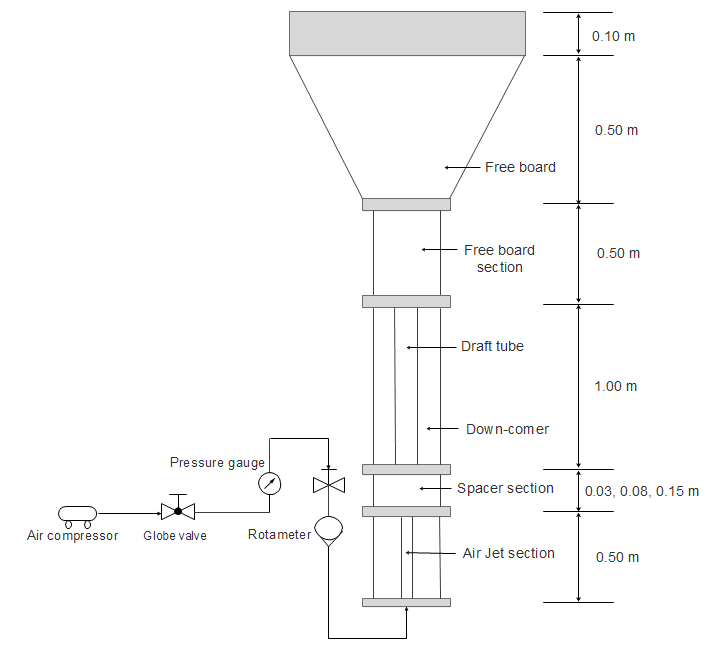
RCFB has mainly 4 sections fig 1, starting from the bottom air jet section, spacer section, draft tube section and free board section. In the present study, a Perspex made, transparent, concentric and semi-circular RCFB setup has been fabricated and hydrodynamic parameters like pressure drop, operating bed voidage, solid circulation rate and suspension density were studied as they influence the performance of a RCFB reactor. CLC can be adapted in a RCFB reactor, where draft tube acts as AR and down-comer as FR.
Fig 1. Schematic representation of cold model RCFB setup at Bits pilani (Pilani campus), India.
For this study three grades of Indian standard sand has been used as bed inventory and variables considered are air flow rate, bed inventory, bed particle size, spacer length between bottom of air jet section and top of draft tube section. Minimum re-circulating air velocity has been studied for various operating conditions for the RCFB setup. An already proposed model for gas bypassing has been used for our study to analyze the gas bypassing trends for different operating regimes. Gas bypassing increased with increase in the spacer length but decreased with bed inventory and particle size. Pressure drop increases with increase in bed inventory and spacer section. Hence there is always a trade-off between the parameters with the operating conditions. Solid circulation rate and suspension density depend on operating bed voidage and are found to increase with decreasing bed voidage and with increase in bed inventory and particle size both are found to increase.
References:
Climate science/Greenhouse gasses. Retrieved April 15, 2017, from
http://climatica.org.uk/climate-science-information/greenhouse-gases
B. Metz, O. Davidson, H. de Coninck, M. Loos, L. Meyer, Carbon dioxide capture and storage, Cambridge University Press: New York, (2005).
T. Mattisson, G.F. Labiano, B. Kronberger, A. Lyngfelt, J. Adánez, H. Hofbauer, Chemical looping combustion using syngas as fuel, International Journal of Greenhouse Gas Control, (2007), 1:158–169.
E. Kimball, A. Lambert, A. Fossdal, R. Leenman, E. Comte, W.A.P. van den Bos, R. Blom, Reactor choices for chemical looping combustion (CLC) - Dependencies on materials characteristics, Energy Procedia, 37 (2013), 567–574.
M.K. Chandel, B.J. Alappat, Pressure drop and gas bypassing in recirculating fluidized beds, Chemical Engineering Science, 61 (2006), 1489–1499.
See more of this Group/Topical: Process Development Division