
The reaction mechanism of Fischer-Tropsch (FT) synthesis is a continual source of intrigue and debate. While two classes of mechanisms have been proposed (namely, carbide vs. CO-insertion), the composition and configuration of the catalytically active phase has received a comparatively small amount of attention. Chemical transient kinetic (CTK) experiments performed in our group on model Co FT catalysts have yielded evidence for a CO-insertion mechanism, but just as importantly, these experiments have also provided evidence for a "crowded" reactive surface, where oxygen, hydrogen, and carbon bind to the surface of the catalyst in quantities exceeding the monolayer limit [1]. Because of the considerable delay in water formation in CTK experiments it is considered likely that the catalytically active phase contains substantial amounts of surface hydroxyl (OH). Such OH may therefore be considered a candidate precursor for constructing the "most abundant surface intermediate" ("masi") necessary for inducing hydrocarbon chain lengthening. Irrespective of what the mechanistic pathway for constructing the "masi" looks like, we present here a DFT-based investigation of an OH-rich surface, anticipating that such information will provide guidance for more complete mechanistic studies addressing chain lengthening initiation and growth.
By utilizing the Alloy Theoretic Automated Toolkit (ATAT) [2,3] to generate a large variety of extended Co (111) surfaces with different coverages and configurations of OH, we constructed a large library of OH/Co(111) structures. The face centered cubic facet is chosen because we wish to model smaller particle size Co, which typically transitions from its native hcp phase to the fcc phase. From this library we find that proximal OH have a large tendency to hydrogen bond as seen in Figure 1. These structures are quite common in the calculations, which suggests they are likely relevant to their stable surface phases. However, to actually test this notion, a corresponding lattice gas (LG) model using these structures will be constructed and subsequent grand canonical Monte Carlo simulations will be performed. In this way, we will elucidate the nature of OH patches on Co catalysts under FT synthesis conditions and their susceptibility to an interaction with CO molecules. A prevalence of surface OH was previously considered key in the CO dissociation on Co catalysts during FT [4], but may also react with CO molecules to provide an oxygen- and hydrogen containing C1 "masi". Perhaps more importantly, however, this result, combined with our previous CTK evidence [1], suggests that modeling the FT reaction over purely metallic Co—a common practice—is ill-advised if one wishes to properly test the mechanism of the reaction
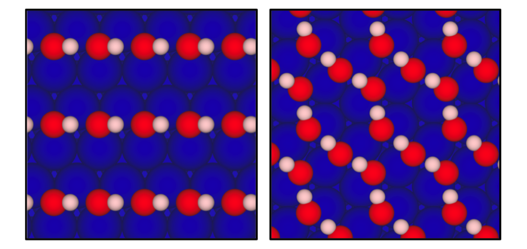
Figure 1. Example of predicted ground state structures of OH on Co(111) at 0.5 ML (left panel) and 0.75 ML (right panel). All ground state structures below 0.5 ML do not exhibit hydrogen bonding and compression like that seen above. However, all ground state structures above 0.5 ML do. Blue spheres are Co, red spheres are O, and white spheres are H.
CITATIONS
1. Schweicher, J., A. Bundhoo, and N. Kruse, Hydrocarbon Chain Lengthening in Catalytic CO Hydrogenation: Evidence for a CO-Insertion Mechanism. Journal of the American Chemical Society, 2012. 134(39): p. 16135-16138.
2. van de Walle, A., M. Asta, and G. Ceder, The Alloy Theoretic Automated Toolkit: A User Guide. Calphad - Computer Coupling of Phase Diagrams and Thermochemistry, 2002. 26: p. 539-553.
3. van de Walle, A. and G. Ceder, Automating First-Principles Phase Diagram Calculations. Journal of Phase Equilibria, 2002. 23: p. 348.
4. Gunasooriya, G.T.K.K., et al., Key Role of Surface Hydroxyl Groups in C–O Activation during Fischer–Tropsch Synthesis. ACS Catalysis, 2016. 6: p. 3660-3664.
See more of this Group/Topical: Catalysis and Reaction Engineering Division