
N-butane partial oxidation in a fixed bed:
A local selectivity study by detailed numerical simulations
Behnam Partopour, Anthony G. Dixon
Department of Chemical Engineering, Worcester Polytechnic Institute,
Worcester, MA, USA, 01609
Maleic
anhydride (MA) is one of the most important chemical intermediates which is
mainly produced by partial oxidation of n-butane over VPO catalyst. The
reaction is fast and highly exothermic and therefore, a highly diluted inlet
flow (n-butane < 2%) is used to avoid the reaction runaway limit. Likewise,
unreacted n-butane is not recycled. The fixed bed process is carried out in
multitubular reactors with narrow tubes ( <
6) cooled in a molten salt bath. All these factors lead to a non-optimal
process with an overall yield less than 65%.1
Recent studies on MA production have been mostly focused on the catalyst active phase nature while there are few reactor scale investigations. Therefore, we have conducted a multi-scale CFD simulation of a packed bed of 807 spherical particles to investigate the interactions of the fixed bed configuration with the reaction, transport and the flow field. In this study a semi-empirical surface kinetics2 is coupled with the transport and momentum equations in both the fluid and solid phases. It is shown that the temperature increases very rapidly along the tube while due to the cooled tube wall a strong radial temperature gradient forms in the bed. The particles are mainly isothermal and the temperature gradient has the most significant impact on species and reaction profiles along the bed. However, it could be observed that compared to the species mass fractions, the weakly adsorbed oxygen surface coverage is highly affected by the cooled tube wall, and a strong gradient is formed inside each particle. Furthermore, the local selectivity patterns in the bed follow similar patterns to the weakly adsorbed oxygen coverage. These trends are shown in Figure 1.
A statistical approach shows that the correlation is not an injective function and there are more factors contributing to the local selectivity. A similar study for the surface oxygen shows that reduced catalyst (higher surface oxygen coverage) contributes to a lower local MA selectivity as is extensively discussed in the literature, but again that is not the only contributor. Therefore, it could be concluded that while the 3D detailed numerical simulation of the bed shows that all local reaction conditions and particle positions are affecting the local MA selectivity in the bed, temperature and weakly adsorbed oxygen are the dominant factors in shaping the local selectivity patterns.
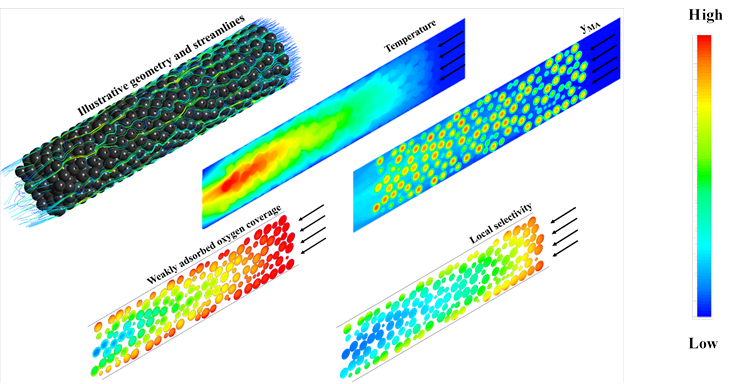 |
Figure 1. Contours are shown on a mid-tube plane along the fixed bed
References
1- Trifirò, F., Grasselli, R.K. How the yield of maleic anhydride in n-butane oxidation, using VPO catalysts, was improved over the years. Top. Catal. 2014; 57 (14): 1188–1195.
2- Gascon, J., Valenciano, R., Tellez, C., Herguido, J., Menendez, M. A generalized kinetic model for the partial oxidation of n-butane to maleic anhydride under aerobic and anaerobic conditions. Chem Eng Sci. 2006; 61:6385-6394
See more of this Group/Topical: Catalysis and Reaction Engineering Division