
An integrated workflow for numerical generation and meshing of packed beds of non-spherical particles
Behnam Partopour, Anthony G. Dixon
Department of Chemical Engineering, Worcester Polytechnic Institute,
Worcester, MA, USA, 01609
Packed beds are widely used in different areas of the chemical industry such as reaction engineering and separation processes, and researchers from different disciplines such as chemical and mechanical engineering and material science are interested in studying them. Therefore, along with experimental methods, the numerical generation of these beds is extensively investigated. Unlike packed beds of spherical particles, the contacts between non-spherical particles could include lines and surfaces. Therefore, collision detection and subsequent meshing in those areas can computationally be challenging.
In this work we introduce the automated packed bed generator (PBG) package for spherical and non-spherical particles based on the Bullet physics library. The library includes a robust collision detection module which uses the impulse based collision detection method1. The package gets the user input for parameters such as shape, dimensions and number of particles, as well as friction and restitution factors, etc., and returns an STL file of the constructed geometry along with the bed properties (e.g. void fraction and angle distributions).
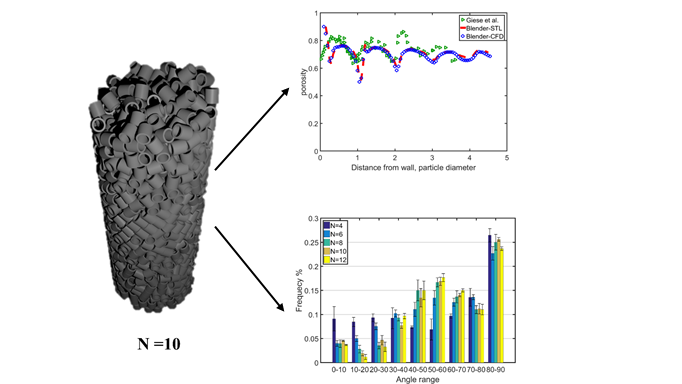
The constructed packed bed STL file then is imported to meshing software and a 3-dimensional mesh is generated based on the shrink-wrap method. The bed properties for packed beds of different shapes of particles are validated against existing experimental and computational data in the literature. The meshed geometries are imported to CFD software, and momentum and heat transfer simulations are carried out. Velocity and temperature profiles are validated against the experimental data, and previous CFD simulations, respectively. The package has shown to have two important advantages over similar tools such as the Discrete Element Method (DEM). First, the PBG simulation time is significantly lower than DEM tools (~1 hour for a packed bed of 1500 particles). Second, Bullet physics uses direct mesh representations of the original objects to detect the collisions and contact points while DEM tools use multi-spherical approximate shapes to detect the contact points and then replace them by the original representations of the particles (e.g. cylinders or rings). Several studies have raised concerns about the accuracy as well as computational cost of such methods2, 3. Finally, for the first time the generated and meshed geometries are successfully used for resolved particle fixed bed CFD simulations.
References
1- Pytlos M, Gilbert M, Smith CC. Modelling granular soil behaviour using a physics engine. Géotechnique Letters 2015; 5:243–249
2- Marigo M, Stitt EH. Discrete element method (DEM) for industrial applications: comments on calibration and validation for the modelling of cylindrical pellets, KONA Powder & Particle J 2015; 32:236-252.
3- Guo Y, Wassgren C, Ketterhagen W, Hancock B, Curtis J. Some computational considerations associated with discrete element modeling of cylindrical particles. Powder Technol 2012; 228;193–198.
See more of this Group/Topical: Particle Technology Forum