
Abstract
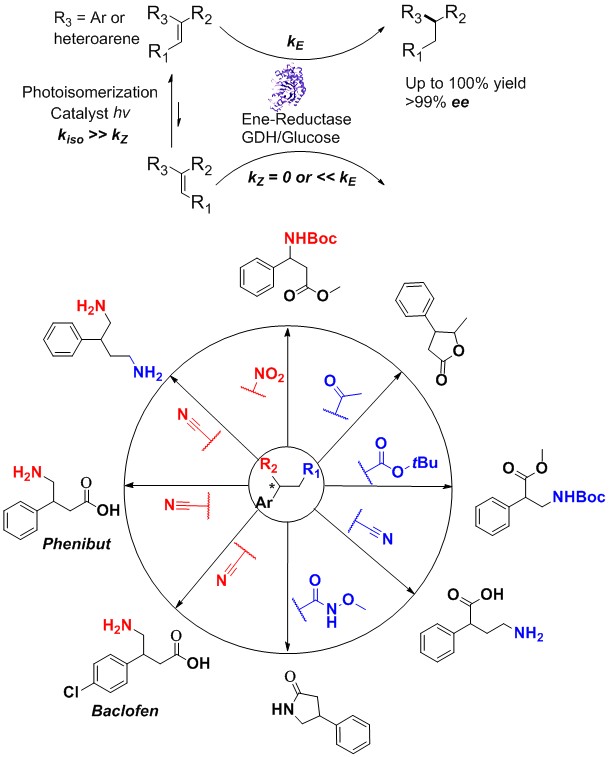
The increasing demand for chiral building blocks, especially those used for the preparation of biologically active compounds, has motivated the development of novel strategies for enantioselective synthesis. Particularly, there is a growing interest in the development of one-pot tandem catalytic systems combining the reactivity of a chemical catalyst with the selectivity engendered by an enzyme. Such tandem systems can achieve levels of chemo-, regio- and stereo-selectivity that are unattainable with a small molecule catalyst. Here, we report the development of a conceptually distinct cooperative chemoenzymatic system by coupling a photosensitizer-catalyzed alkene isomerization in tandem with an enantioselective ene-reductase that selectively reduces one of the isomers for the synthesis of various chiral building blocks of drugs and biologically active compounds. With this system, we can stereoconvergently reduce the isomer mixtures of 2-substitued 1,4-dicarbonyl alkenes, cyano-substituted acrylate esters or ketones, cyano- or ester-substituted acrylamides to corresponding enantiopure reduced products at high yield (>80%) and excellent enantiomeric excess (>95%). These products can be used to easily synthesize ɣ-butyrolactones, ɣ-lactams, β-amino acids, ɣ-amino acids, amines and diamines, a structural motif found in many bioactive compounds, such as Phenibut and Baclofen. Importantly, this is the first example of combining photoisomerization with enzymes for enantiopure product synthesis rather than photocatalyst-directed co-factor regeneration in an oxidoreduction reaction. In addition, we show for the first time, that flavin mononucleotide (FMN) can catalyzes two different reactions, alkene isomerization and hydride transfer, in a single system, making our tandem reaction potentially metal-free. We anticipate our system to be a starting point for more synthetic applications when coupled with different enzymes.
See more of this Group/Topical: Catalysis and Reaction Engineering Division