
Liquid film, as a basic contact way between gas and liquid, is commonly encountered in chemical engineering process. Based on the features of film formation, it can typically be divided into two types: wall-bounded film1, which is supported by a solid wall, and free film, which flows without contact with any solid frame and has two apparent free interfaces. Different from traditional liquid film investigation, coexistence and interaction of wall-bounded film and confined free film2 were found on some chemical engineering equipment, such as falling-film heat exchangers with bundles of horizontal tubes, rotating disc reactors with large windows on the wall and random or structured packings with holes.
VOF method was used to simulate flow behaviour of such a novel film (twin-liquid film) over a vertical plate with an open window. According to its development of flow structure in stream wise, three regions are divided: Region 1, at inlet of window, velocity profile rearrangement within falling liquid film in its transition from wall-bounded film to free film flow are shown; Region 2, at middle of window, liquid film falls freely under gravity and stationary varicose waves occur; Region 3, at outlet of window, liquid film impinges on the lower wall and flows back on the plate. The existence of confined free film apparently changes film thickness and velocity distribution of wall-bounded film around while the latter increases stability and waviness of confined free film in the window. Compared with traditional wall-bounded film, twin-liquid film owns a larger mean velocity, thinner film thickness, stronger fluctuations and vorticity on the free surfaces, which are all considered to improve mass transfer efficiency. Considering geometry effects of window: with increasing window depth, amplitude of waves in the window increases first and then fluctuation of free surface becomes dynamic and irregular; with increasing window height, typical flow characteristics of wall-bounded film, wavy twin-liquid film and smooth free film are seen one after the other; with increasing window width, waves on confined free film become three dimensional and wave intensity decreases. Considering effects of operation condition: for varicose waves in the window, the wave length decreases with increasing Re and Ca, while the wave amplitude increases with increasing Re and decreasing We. Complement of experimental observations show a good agreement with corresponding three-dimensional simulations and offer more three-dimensional flow characteristics of twin-liquid film. The conception of twin-liquid film will expand traditional liquid film investigation field and offers an effective way to improve heat and mass transfer in chemical engineering process.
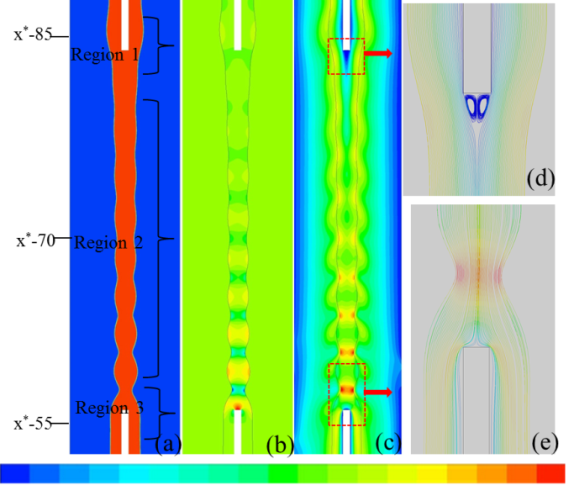
Figure 1 Re=150, Ca=0.0175, D=0.28 H, Case A: (a) Liquid fraction (0-1);
(b) Pressure (-300-200 Pa); (c) X-velocity (0-0.9 m/s); (d) and (e) streamline (0-0.9 m/s)
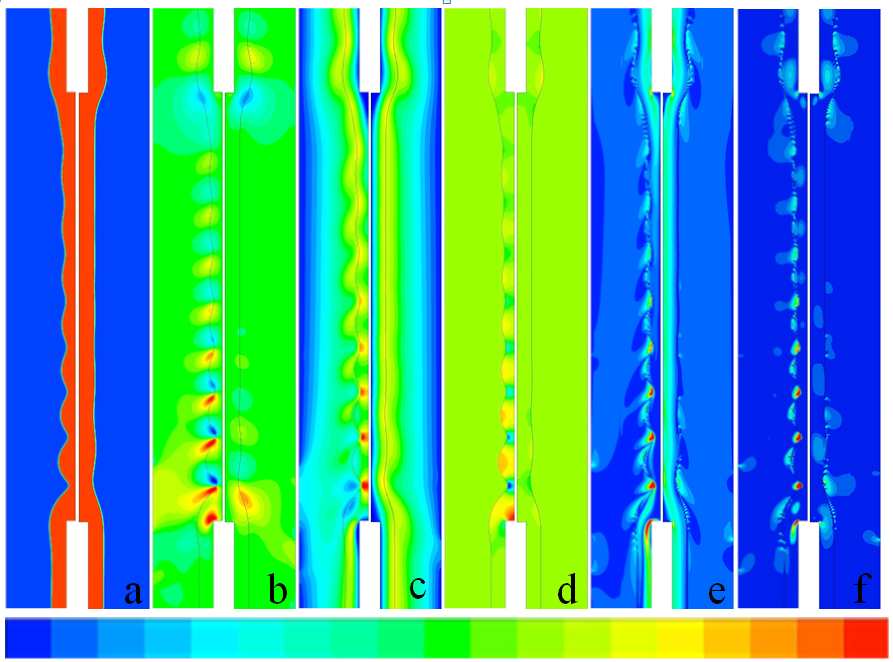
Figure 2 Comparison of twin-liquid film (left) and wall-bounded film (right ) at Re=150 and Ca=0.0175. (a) Liquid fraction (0-1); (b) Y-velocity (-0.3-0.3 m/s); (c) X-velocity (0-0.9 m/s) (d) Pressure (-300-200 Pa); (e) Vorticity (0-7000/s); (f) Swirling strength (0-3000/s)
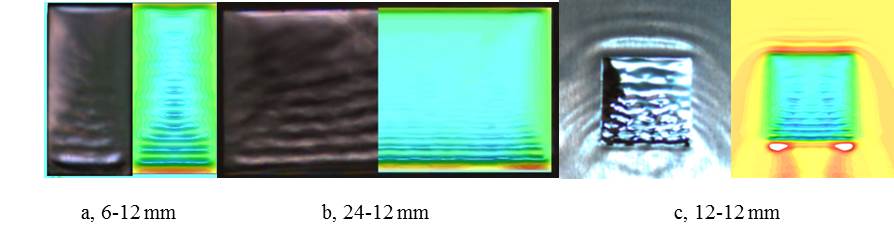
Figure 3 Comparison between 3D simulations and experimental results (water, Re=150)
References
1. Batchelor GK, Moffatt HK, Worster M. Perspectives in fluid dynamics: a collective introduction to current research: Cambridge University Press; 2002.
2. Hu J, Yang X, Dai G. Numerical investigation on hydrodynamics of vertically confined free film. The Canadian Journal of Chemical Engineering. 2016;94(2):340-348.
See more of this Group/Topical: Engineering Sciences and Fundamentals