
Structure Sensitive Phenol Hydrogenation on Pd Nanostructures
Shelaka Guptaa, Sreedhala.Sb, Tuhin Suvra Khana, C.P.Vinodb and M. Ali Haidera
bCatalysis Division, CSIR-National Chemical Laboratory, Dr. Homi Bhabha Road, Pune - 411 008
aRenewable Energy and Chemicals Laboratory, Department of Chemical Engineering,
Indian Institute of Technology Delhi, Hauz Khas, New Delhi-110016
Tel: +91-11-26591016, Fax:
+91-11-2658-2037
haider@iitd.ac.in
Phenol hydrogenation on unsupported Pd nanostructures showed structure sensitivity with respect to particle shape and insensitivity with respect to particle size. The hydrogenation reaction was performed over Pd octadehra (~27 nm, Figure 1(a)), cubes (~25 nm, Figure 1(b)), and spheres (~6nm). While Pd cubes (exposing only the (100) facets) were observed to selectively (100%) produce cyclohexanone, octahedra (exposing only the (111) facets) were 100% selective towards cyclohexanol. Interestingly, Pd spheres of varying size (<5 nm tp 6 nm) and exposing both (111) and (100) facets were observed to produce cyclohexanone only. Density functional theory (DFT) calculations showed that the difference in the binding modes of phenol on Pd(111) (Eb = -102 kJ/mol) and Pd(100) (Eb = -135 kJ/mol), primarily lead to the difference in the selectivity (Figure 1(a) and 1(b)). On Pd(111), cyclohexanol was produced by phenol dissociation to phenoxy and subsequent hydrogenation (Figure 1(a)), whereas on Pd(100) cyclohexanone was produced by direct phenol hydrogenation (Figure 1(b)). Further hydrogenation of cyclohexanone to produce cyclohexanol on Pd(100) was observed to be prohibitive (E a = 125 kJ/mol) at reaction conditions. Interestingly, a mixture of cube and octahedra with 40:60 ratio, resembling a spherical supported Pd nanoparticle was observed to yield cyclohexanone with 100% selectivity even on increasing the phenol weight in the reaction from 50 mg to 450 mg. However, a small fraction (8% selectivity) of cyclohexanol was detected when phenol concentration was raised to 600 mg. The shift in selectivity was attributed to the reduction in the adsorption energy of phenol on the (100) facets (Eb = -97 kJ/mol at 0.6 ML coverage) which became comparable to the (111) facet due to increased lateral interactions at high phenol coverage (Figure 1(c)). The reaction however remained structural insensitivity on varying the size of the Pd sphere
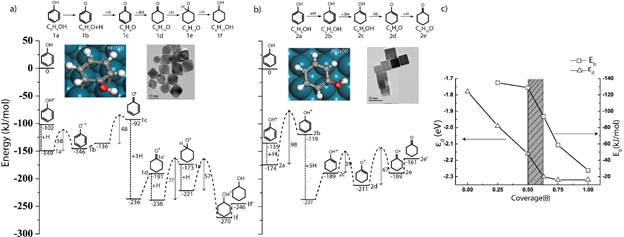
Figure 1: Reaction energy diagram for phenol hydrogenation on a) Pd (111) and b) Pd (100) surface. c) Trend in calculated binding energy (Eb) of phenol and d-band centre (ɛd) of Pd (100) versus phenol coverage (shaded area shows the region where selectivity is likely to shift towards cyclohexanol).
See more of this Group/Topical: Catalysis and Reaction Engineering Division