
Gas-liquid multiphase flow is commonly encountered in bubble columns, stirred tanks and other reactors. The complexity of multiphase turbulent flow increases the difficulty of design and scale-up of the reactors. CFD simulation is an effective tool to analyze and predict multiphase flow in reactors, which is widely used for aided design of industrial reactors. The development of suitable models and numerical methods is hence a significant task.
Gas-liquid flow can be numerically investigated by various methods. For small-scale simulation of detailed turbulence and bubbles, direct numerical simulation (DNS) can be employed. For reactor scale simulation, the Euler-Euler two-fluid model is commonly used, coupled with the Reynolds-averaged Navier-Stokes (RANS) method. The two-fluid model is preferable for industrial multiphase flow simulation due to its simplicity. For gas-liquid flow, the presence of bubbles will affect the structure and intensity of local turbulence. In turn, the turbulence also affects the bubble behavior. Therefore, suitable models should be developed taking the bubble induced turbulence into account, based on the two-fluid model.
There are two ways to introduce the effect of bubbles into liquid turbulence. One way is additional viscosity method, in which an additional viscosity due to bubble motion is added to calculate the effect viscosity [1]. The other way is an additional source term method, in which additional source terms are added to the turbulence kinetic and energy dissipation equations [2]. Both methods are widely used for gas-liquid simulations in stirred tanks and other reactors [3,4]. However, these models include empirical parameters, which are taken on various values in the literature.
In this work, bubble induced turbulence models are investigated by direct numerical simulations. First, gas-liquid flow in a periodic vertical channel is predicted by direct numerical simulation using a front tracking method (Fig.1) [5]. The flow field and other quantities of interest, at every temporal and spatial location, are given by the DNS results. The results are then used to find the various averages and statistical quantities in the model equations. Based on the DNS results and statistical analysis, a bubble induced turbulence model is developed and validated. The model will be used to simulate practice gas-liquid flow in industrial reactors in future works.
Acknowledgements: Financial support from the Li Foundation, the National Natural Science Foundation of China (21427814, 91434126) and National Key Research and Development Program (2016YFB0301701) are gratefully acknowledged.
*Corresponding author. Tel: +86-10-62554558; E-mail: chaoyang@ipe.ac.cn (C. Yang)
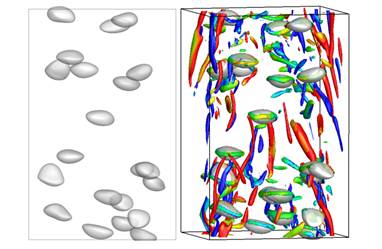
Fig.1 Deformable bubbles and vorticity by DNS
Reference
1. Sato Y., Sadatomi M., Sekoguchi K., Momentum and Heat Transfer in Two-Phase Bubble Flow- = 1 \* ROMAN I Theory, Int. J. Multiphase Flow, 1981, 7: 167-177
2. Rzehak R., Krepper E., CFD modeling of bubble-induced turbulence, Int. J. Multiphase Flow, 2013, 55: 138-155
3. Islam A., Adoo N., Bergstrom D., Prediction of Momo-Disperse Gas-Liquid turbulent flow in a vertical pipe, Int. J. Multiphase Flow, 2016, 85: 236-244
4. Wang W., Mao Z.-S., Numerical Simulation of Gas-Liquid Flow in a Stirred Tank with a Rushton Impeller, Chinese J. Chem. Eng., 2002, 10(4): 385-395
5. Tryggvason G., Scardovelli R., Zaleski S., Direct Numerical Simulations of Gas-Liquid Multiphase Flow, Cambridge University Press, 2011
See more of this Group/Topical: North American Mixing Forum