
Super-dry reforming of CH4
L.C. Buelens1, V.V. Galvita1,*, H. Poelman1, G.B. Marin1
1Laboratory for Chemical Technology, Ghent University, Technologiepark 914, 9052 Ghent, Belgium
*Corresponding author: vladimir.galvita@UGent.be
1. Introduction
During the past decade, environmental research targeting the mitigation of CO2 emissions has been shifting from CO2 storage towards CO2 utilization. The conversion of CO2 to CO could provide a cheap C1 building block for the chemical industry. Development of processes for CO2 conversion are necessary to fully exploit these properties. In this respect, the conversion of diluted CO2 streams into CO by means of chemical looping is particularly interesting [1]. Among the chemical looping processes, super-dry reforming of CH4 takes up a prominent position as it allows for intensified CO2 utilization and can be driven by renewable energy sources such as biogas [2].
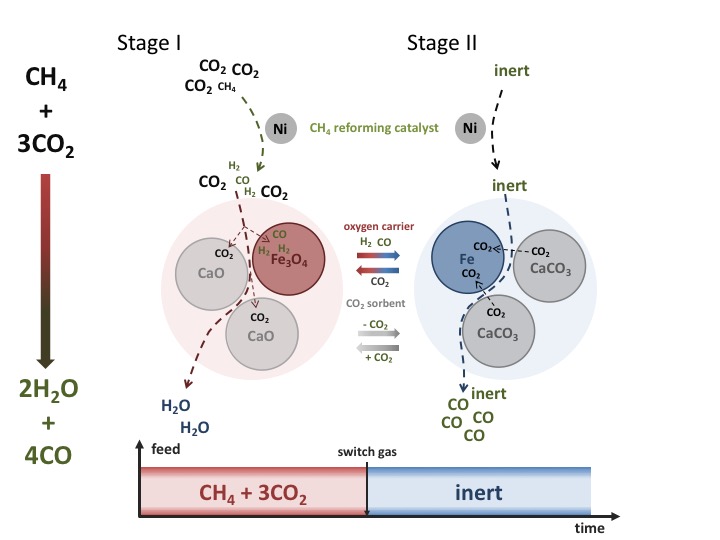
The super-dry reforming process (Figure 1) relies on the combination of a reforming catalyst, typically nickel based, with an oxygen carrier and CO2 sorbent material, which are typically iron oxide and calcium oxide based. In the CH4 oxidation step, a CO2 rich mixture of CH4 and CO2 is dry reformed into syngas over the reforming catalyst. This syngas is fed to a mixed bed of oxygen carrier and CO2 sorbent, where CO and H2 are converted into CO2 and H2O upon reduction of the oxygen carrier, while CO2 is fixated by the CO2 sorbent. In the CO2 reduction step, the oxygen carrier and CO2 sorbent materials are regenerated either by increasing temperature or isothermally by means of a sweep gas. A major advantage of this process is its potential to achieve a three times higher capacity for CO2 conversion than conventional dry reforming of CH4.
The oxygen carrier is the heart of the super-dry reforming process, periodically cycling between reduction by syngas and reoxidation by CO2, thus allowing the conversion of CO2 into CO. Indeed, the choice of oxygen carrier material is governed by the degree of reducibility of the oxygen carrier and its capacity to convert CO2 into CO. The reforming catalyst aids in achieving deepest possible reduction of the oxygen carrier by first converting the fuel to syngas. The role of the CO2 sorbent in super-dry reforming is threefold: (i) A tremendous decrease in coke formation on the nickel catalyst can be achieved because a higher CO2:CH4 feed ratio can be used without compromising the product purity. (ii) The CO2 sorbent also enhances the reducibility of the oxygen carrier by a continuous in situ removal of CO2. Hence, H2O is the main product during the first step of super-dry reforming, even though 4 different processes (dry reforming, WGS reaction, oxygen carrier reduction, CO2 removal) occur. (iii) In the CO2 reduction step of the super-dry reforming process, decomposition of the CO2 sorbent provides CO2 for the oxygen carrier reoxidation, hence producing CO.
The aim of this work is to study the stability and activity of functional materials applied in super_dry reforming.
2. Experimental
As dry reforming catalyst, a nickel based material was prepared [3]. As oxygen carrier and CO2 sorbent, an iron oxide based [4] and calcium oxide [2] or lithium orthosilicate based material were prepared. Nanomorphology and chemical information were obtained by materials characterization via STEM-EDX. For studying solid phase transitions, time-resolved in situ XRD experiments were performed in a Bruker-AXS D8 Discover apparatus with Cu Kƒ¿ radiation and a Vantec linear detector. For studying the gas phase product yields, a quartz tube microreactor (inner diameter of 10mm) was used. The reactor, equipped with K_type thermocouples contacting the reactor walls at the position of the catalyst bed, was heated by an electric furnace. EkviCalc [5], a software package containing an extensive database of chemical species, was used for performing thermodynamic calculations.
3. Results and discussion
By combining a Ni/MgAl2O4 dry-reforming catalyst, Fe2O3/MgAl2O4 oxygen carrier and CaO/Al2O3 CO2 sorbent in the isothermal super-dry reforming process, a higher CO production yield was obtained than through conventional dry reforming. The increased yield of CO can be explained through the inherent separation of H2O from CO, hence avoiding equilibrium limitations in CO yield caused by the water-gas shift reaction. In fact, this two-step process owes its success to the application of Le Chatelierfs principle in both steps. In the CH4 oxidation step, the reduction of iron oxide is improved by continuous removal of CO2 in the form of CaCO3. In the CO2 reduction step, the introduction of an inert sweep gas initiates the decomposition of CaCO3 upon which the oxygen carrier is reoxidized by CO2. Here, the formation of CO provides a driving force towards the complete decomposition of CaCO3. Overall, the theoretical yield of super-dry reforming goes up to four molecules of CO per CH4 with a space-time yield of 7.5 mmolCO s-1 kgFe-1 at 1023 K. [2]
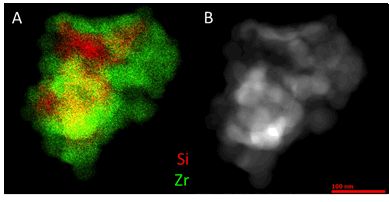
The effect of the choice of materials (reforming catalyst, oxygen carrier and CO2 sorbent) and their cyclic stability are investigated. A major challenge in the design of the reforming catalyst is the mitigation of catalyst deactivation through carbon deposits. One promising strategy is the addition of iron to obtain a Ni-Fe/MgAl2O4 catalyst, in which iron assists in the oxidation and removal of carbon deposits from the catalyst surface [3]. The long-term application of an oxygen carrier is mostly limited by sintering and the undesired formation of inactive solid phases. To this end, 50Fe2O3/MgAl2O4 seems to provide a good candidate in terms of material stability and activity based on cyclic redox experiments over 4 days time on stream. As for the CO2 sorbents, CaO based and Li4SiO4 based materials are compared. One possible strategy for increasing the cyclic stability of the CO2 sorbent is the application of a coating, such as ZrO2 (Figure 2). The aim of doing so is to reduce the effect of crystallite growth due to sintering by providing a physical barrier between the different CO2 sorbent particles. However, it needs to be addressed whether or not this coating has any adverse effect on the properties of the CO2 sorbent material, such as a reduced accessibility of the core material for CO2. Hereto, both experimental evidence and thermodynamic considerations are taken into account.
4. Summary
This work discusses the material properties, important for the real-life implementation of the super-dry reforming process. On the one hand, the properties of a structured CO2 sorbent material, based on Li4SiO4 and ZrO2, are investigated in view of its application. On the other hand, the effect of redox cycling on different Fe2O3/MgAl2O4 oxygen carrier materials is elaborated on.
Acknowledgment
This work was supported by the Long Term Structural Methusalem Funding of the Flemish Government, the Interuniversity Attraction Poles Programme, IAP7/5, Belgian State _ Belgian Science Policy and the Fund for Scientific Research Flanders (FWO; project G004613N). L.C. Buelens acknowledges financial support from the Institute for the Promotion of Innovation through Science and Technology in Flanders (IWT Vlaanderen). The authors also thank Prof. Christophe Detavernier (Department of Solid State Sciences, Ghent University) for access to in situ XRD equipment.
References
[1] V.V. Galvita, H. Poelman, C. Detavernier, G.B. Marin, Appl. Catal. B-Environ. 164 (2015) 184-191.
[2] L.C. Buelens, V.V. Galvita, H. Poelman, C. Detavernier, G.B. Marin, Science 354 (2016) 449-452.
[3] S.A. Theofanidis, V.V. Galvita, H. Poelman, G.B. Marin, ACS Catal. 5 (2015) 3028_3039.
[4] N.V.R.A. Dharanipragada, L.C. Buelens, H. Poelman, E. De Grave, V.V. Galvita, G.B. Marin, J. Mater. Chem. A. 3 (2015) 16251_16262.
[5] B. Nolang, EkviCalc and Ekvibase, version 4.30 (2013) Svensk Energi Data: Balinge, Sweden.
Figure SEQ Figure \* ARABIC 1 Schematics of the
super-dry reforming process
Figure SEQ Figure \* ARABIC 2 STEM-EDX characterization of Li4SiO4-ZrO2
CO2 sorbent material. (A) EDX elemental mapping of Zr and Si, clearly showing the presence of a silica based
particle, coated by zirconia. (B) Corresponding HAADF-STEM image. Scale bar
represents 100 nm.
See more of this Group/Topical: Topical Conference: Innovations of Green Process Engineering for Sustainable Energy and Environment