
A forward modeling approach for the inverse estimation of transient local heat fluxes
Jiu LUO1, Ya-Qiao WANG1, Jia-Li LUO1, Dong-Chuan MO1, Yuan-Xiang FU1,
Shu-Shen LYU1, Hiroyuki OZOE2, Yi HENG1*
1. School of Chemical Engineering and Technology, Sun Yat-sen University, Guangzhou, China
2. Kyushu University, Kasuga Koen 6-1, Kasuga, Fukuoka, 816-8580, Japan
* Corresponding author. E-mail address: hengyi@mail.sysu.edu.cn (Yi Heng)
The efficient and robust solution of inverse heat conduction problems (IHCP) has received enormous research interest due to its extensive applications in numerous branches in the last several decades. However, IHCP are often ill-posed in the sense of Hadamard[1]. Hence, it is hard to obtain physically stable solutions. Furthermore, the solution techniques for IHCP are mostly limited to the transient solution in one or two space dimensions[2-5] or the steady-state solution for regular computational domains in space of three dimensions (3D)[6] due to computational obstacles.
In this work, a benchmark 3D transient IHCP arising in Chemical Engineering is considered, namely the estimation of unmeasurable transient local boiling heat fluxes on micro/nano porous copper surfaces from available temperature readings. It is known that micro/nano surface modification can be used for the enhancement of boiling heat transfer[7,8]. An example of modified micro/nano porous copper surface prepared by us and the mechanism for the bubble departure in a real experiment are shown in Fig. 1 and Fig. 2, respectively. To the best of our knowledge, few studies addressed the estimation of unknown transient local boiling heat fluxes. Together with the optical probe information obtained in the liquid side, the heat-flux distribution and dynamics evaluated by solving large-scale IHCP is supposed to provide a data basis for the development of realistic mechanistic heat transfer models for boiling regimes beyond nucleate boiling. The IHCP solution approach also has a wide range of applications in other engineering disciplines such as the estimation of transient heat flux on slab for optimal control of temperatures in a reheating furnace[9,10], the reconstruction of time-and space-dependent boundary heat flux in alloy solidification problems[11] and the recovery of high intensity periodic laser heat flux on the front surface of a target object[12].
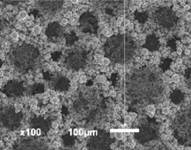
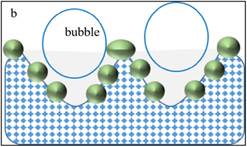
Figure 1 Modified micro/nano porous Figure 2 Mechanism for the bubble departure
copper surface (adopted from [8]) of modified one (adopted from [8])
A forward modeling approach is presented in this work for the efficient solution of the abovementioned benchmark IHCP. As a first step the temperature field is simulated on the surface boundary by using a first order approximation derived by a Taylor expansion. The original IHCP can be transformed into a well-posed forward heat conduction problem in the second step. The unknown heat flux is then estimated by the solution of the forward problem using the numerical finite-difference formulae. In contrast to the optimization-based solution method[13], the proposed forward modeling approach shows its high computational efficiency and its great superiority to resolve the heat-flux discontinuity. Besides, it is easy to implement and it is platform-independent. In this work, Comsol Mutiphysics is used to solve the arising forward heat conduction problems. Other commercial softwares such as CFX, Fluent, or open source codes DROPS, NGSolve are also applicable.
A
simulation case study is presented
to demonstrate the efficiency and accuracy of the proposed forward modeling approach. A
thin heater of  is considered. Micro/nano porous structure is modeled as
an inverted cone to reflect the sophisticated geometric structure in a real pool
boiling experiment (see Fig. 3).
Inspired by the
microlayer theory[14] that predicted that heat during boiling is mainly
transferred in the local area of the three-phase contact line by evaporation, a ring-shaped transient
heat flux is used for the simulation (see Fig. 4, bottom). By considering this heat flux as
the Neumann boundary condition of the forward heat
conduction problem, the temperature measurements are generated on a very fine mesh. This finite element space discretization results in
a total number of
54133 tetrahedra. 50 time steps of 0.001s are
considered for the time discretization to simulate a time
period of 0.05s.
Exact and estimated local
transient heat fluxes at a representative time
instant t=0.025s are compared. The
main temporal and spatial characteristics of the simulated heat flux can be
captured (see Fig. 4, top).
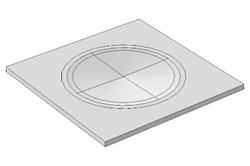
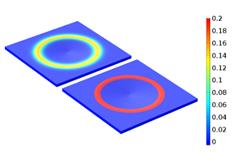
Figure 3 Geometrical model for the Figure 4 Exact and estimated surface heat
micro/nano structure fluxes at time instant t=0.025s
Further simulations to address the heat-flux discontinuity problems are also considered in this work. Huang et al.[15] estimated the heat flux with leaps by the Conjugate Gradient (CG) method. The simulated and estimated heat fluxes for noise-free temperature data by Huang et al.[15] are shown in Fig. 5. In another case study Cui et al.[4] tested a nondifferentiable heat-flux function in a 1D IHCP, namely the heat flux function in this case study is time dependent and space independent. For comparison, the results produced by our solution approach for the same problems are shown in Fig. 6 and Fig. 7, respectively. Together with the results of the abovementioned inverse boiling problem, these two case studies verified the validity of our approach in estimating time- and space-dependent heat flux functions that have leaps.
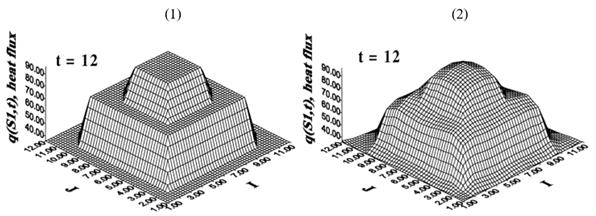
Figure 5 (1) Exact instantaneous heat flux by Huang et al. (adopted from [15])
(2) Estimated instantaneous heat flux by Huang et al. (adopted from [15])
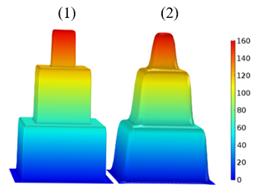
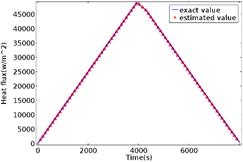
Figure 6 (1) Exact heat flux distribution (t = 12s) Figure 7 Exact and estimated heat
(2) Estimated heat flux in the present work (t = 12s) fluxes in the present work
In summary, the forward modeling approach proposed in this work can transform the IHCP into a simple-to-solve forward problem. In this way, it is inherently more efficient than the optimized-based inversion method, which often need to solve dozens or hundreds of forward problems. The proposed forward modeling approach also shows its great superiority in estimating the heat-flux functions with leaps. Moreover, due to its efficiency the proposed solution approach can also be used to yield initial estimates for the optimized-based inversion method. In this way, high solution accuracy and efficiency can be ensured simultaneously.
REFERENCES
[1] Hadamard, J.(1923): Lectures on Cauchy's Problem in Linear Partial Differential Equations, Yale University Press, New Haven.
[2] Chen, H., Frankel, J. I., Keyhani, M. (2016): Two-dimensional formulation for inverse heat conduction problems by the calibration integral equation method (CIEM). Applied Mathematical Modelling 40(13-14), 6588-6603.
[3] Ijaz, U. Z., Khambampati, A. K, Kim, M. C., et al. (2007): Estimation of time-dependent heat flux and measurement bias in two-dimensional inverse heat conduction problems. International Journal of Heat and Mass Transfer 50(21-22), 4117-4130.
[4] Cui, M., Yang, K., Xu, X. L., et al. (2016): A modified Levenberg-Marquardt algorithm for simultaneous estimation of multi-parameters of boundary heat flux by solving transient nonlinear inverse heat conduction problems. International Journal of Heat and Mass Transfer 97, 908-916.
[5] Yu, G. X., Sun, J., Wang, H. S., et al. (2014): Meshless inverse method to determine temperature and heat flux at boundaries for 2D steady-state heat conduction problems. Experimental Thermal & Fluid Science 52(1), 156-163.
[6] Faoite, D. D., Browne, D. J., Gamboa, V, et al. (2014): Inverse estimate of heat flux on a plasma discharge tube to steady-state conditions using thermocouple data and a radiation boundary condition. International Journal of Heat and Mass Transfer 77(77), 564-576.
[7] Wang, Y. Q., Mo, D. C., Lyu, S. S. (2016): Enhanced Pool Boiling Heat Transfer on Mono and Multi-Layer Micro-Nano Bi-Porous Copper Surfaces. ASME 2016 5th International Conference on Micro/Nanoscale Heat and Mass Transfer. American Society of Mechanical Engineers V001T04A005-V001T04A005.
[8] Wang, Y. Q., Luo, J. L., Mo, D. C., Lyu, S. S. (2017): A Way to Enhance Pool Boiling Performance of the Micro Nano Porous Copper Surface. ACTS Asian Conference on Thermal Sciences P00347.
[9] Cui, M., Yang, K., Liu, Y. F., Gao, X. W. (2012): Inverse Estimation of Transient Heat Flux to Slab Surface. Journal of Iron & Steel Research International 19(11),13-18.
[10] Li, Y., Wang, G., Chen H. (2015): Simultaneously estimation for surface heat fluxes of steel slab in a reheating furnace based on DMC predictive control. Applied Thermal Engineering 80, 396-403.
[11] Nejad, A. A., Maghrebi, M. J., Tabrizi, H. B., Heng, Y., Mhamdi, A. and Marquardt, W. (2010): Optimal operation of alloy material in solidication processes with inverse heat transfer, International Communications in Heat and Mass Transfer 37(6),711-716.
[12] Zhou, J. J., Zhang, Y. W., Chen, J. K. and Feng, Z. C. (2010): Inverse estimation of surface heating condition in a three-dimensional object using conjugate gradient method, International Journal of Heat and Mass Transfer 53(13-14), 2643-2654.
[13] Heng, Y., Karalashvili, W., Mhamdi, A. and Marquardt, W. (2011): A multi‐level adaptive solution strategy for 3D inverse problems in pool boiling. International Journal of Numerical Methods for Heat and Fluid Flow 21(5), 469-493.
[14] Stephan, P. and Hammer, J. (1994): A new model for nucleate boiling heat transfer, Heat and Mass Transfer 30(2), 119-125.
[15] Huang, C. H. and Wang, S. P. (1999): A three-dimensional inverse heat conduction problem in estimating surface heat flux by conjugate gradient method, International Journal of Heat and Mass Transfer 42 (18), 3387-3403.
See more of this Group/Topical: Engineering Sciences and Fundamentals