
Constructing Fenton-like Reaction over g-C3N4/NH2-MIL-88B(Fe) Photocatalyst to Degrade Organic Contamination in Aqueous solution
Xiyi Li, Yunhong Pi, Zhong Li, Jing Xiao*
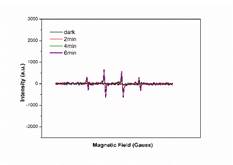
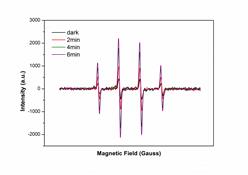
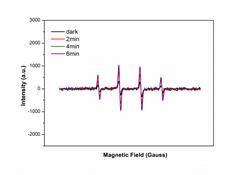
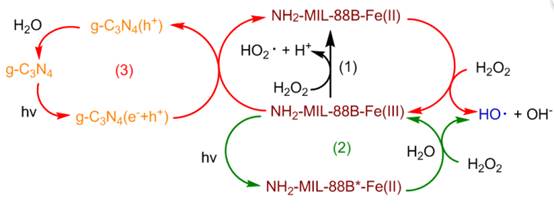
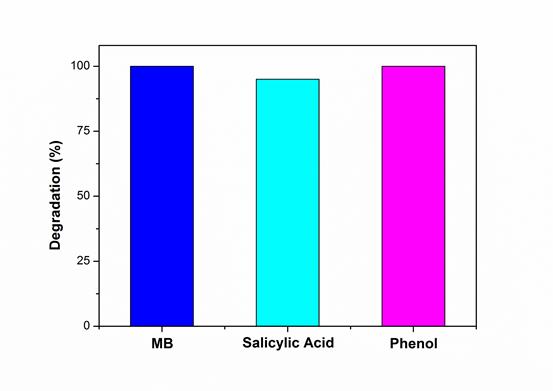
Efficient generation of active radicals plays a key role in advanced oxidation process (AOPs) for the degradation of organic contamination from aqueous solution. To facilitate the Fenton-like process, the NH2-Iron terephalate metal-organic framework is incorporated with carbon nitride in order to effectively covert H2O2 to highly reactive hydroxyl radical (•OH). The formation of •OH can be promoted via two paths, one is the Fe3+ in the framework acts as the trigger to convert H2O2 generated by the reaction between O2 and g-C3N4, the other one is the heterojunction leads to the efficient transfer of photo-induced electrons to participate in the Fenton-like reaction with the addition of H2O2. The synergistic index in the lp-2/visible-light/H2O2system reached as high as 305%. The mechanism was illustrated through Electron spin resonance (ESR) spectra, as shown in Figure 1 and 2. Moreover, under visible light irradiation, the Fenton-like photocatalyst exhibit excellent degradation efficiency of MB, salicylic acid and phenol, as shown in Figure 3. This strategy of coupling metal-organic framework with carbon nitrides for Fenton-like process provides a useful and promising solution for the remediation of aqueous organic pollution under visible light irradiation.
Keywords: Fenton-like Reaction; photocatalytic degradation; visible light
a.
| ||||
b.
| c.
| |||
Figure 1 ESR spectra of DMPO-•OH adducts formed with irradiation time of visible light in the suspension of (a) g-C3N4/NH2-MIL-88B(Fe), (b) g-C3N4/NH2-MIL-88B(Fe)+H2O2 and (c) NH2-MIL-88B(Fe)+H2O2 | ||||
|
Figure 2 The mechanism of photocatalytic Fenton-like reaction over g-C3N4/NH2-MIL-88B(Fe) |
|
Figure 3 Photocatalyic degradation efficiency of MB, Salicylic Acid and Phenol. (Reaction condition: 50 mg photocatalyst, 50 ml solution at 30 mg/L, 100 µL of H2O2, >420nm) |
See more of this Group/Topical: Materials Engineering and Sciences Division