
CFD Analysis for Boundary Effect of Particle Flow in Pipeline Manifold
Mohanrao Rampure
SABIC Technology & Innovation, SPADC Center, Riyadh (KSA) 11551
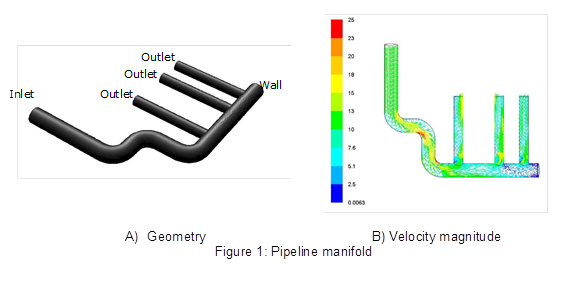
Gaseous feed stocks in Petrochemical plants has limits on impurities such as; undesired hydrocarbon gas/condensate components, and solid particles to ensure the performance and reliability of downstream unit operation. Pipelines contains iron oxides corrosion/erosion materials, and hydrocarbon condensate droplets carried by feedstock pipelines to plants systems that can be detrimental to the continued safe and reliable plant operation and business profitability. Solid particles and condensate droplets in gaseous feedstock streams tend to separates and re-distribute unevenly from main flows when feedstock is branched through distribution networks piping systems and headers. Design, sizing, and layout of feedstock receiving and filtration/cleaning systems becomes important to effectively capture these impurities and protect downstream plant operation. In this study, a multiphase solid/gas flow assessment in and industrial scale natural gas feedstock header is considered. This main header is branched into three smaller pipes of different sizes. Pipe branches travel in various size diameters based on the different plant capacity downstream. 3D CFD model is developed to determine the multiphase flow distribution between the branches along with a parametric study to assess the flow sensitivity to increased solid particles loading. Figure 1 below shows the geometry and velocity vector plot for the gas phase. The boundary conditions and CFD geometry to be considered plays an important role determining the particulate distribution at the outlet manifold. Particles such as iron oxides and oil droplets are studied to analyze the particles flow mal-distribution exiting the main header. The particles are solved in the Lagrangian frame of reference while the gas in Eulerian frame.
See more of this Group/Topical: Particle Technology Forum