
Phase Transformation Induced by Tertragnility Variation of Metal-redox Synthesised NiMn Nanoalloys
Jian Shen1,2*, Jin Xin2*
1 Water Environment Technology Research Institute, MCC, Nanjing 210019, China
2 State Key Laboratory for Heavy Oil Processing, China University of Petroleum, Qingdao 266580, China
Introduction
Advanced permanent magnets have emerged as a critical component for modern society from power electronics and data storage to green energy-related generators and electric motors. Manganese (Mn), as a rare-earth-free metal, attracts wide interest because of the largest magnetic moment among all transition metals.Such large unpaired electrons and high magnetic moment in Mn-based alloys are believed to be responsible for their complex structural and magnetic phases. One of the long range chemically ordered MnNi alloys is found in the antiferromagnetic equiatomic Mn50Ni50 (MnNi ¦È phase) compound, which adopts a face centered tetragonal (fct) L1 0 AuCu structure. Generally, the MnNi ordered structure tends to phase transform from a body centered cubic (bcc) structure after annealing at 973 K. At present, most studies in tetragonal MnNi growth are reliant on the energy-consuming processing (ball milling or arcmelting). The challenge of MnNi nanosynthesis arises from the simultaneous reducing and alloying between manganese and nickel due to their different reduction potentials and rates.
Iron cobalt (FeCo), as a ¡°soft¡± magnetic materials, has a body-centered cubic (bcc) nanostructure with small magnetocrystal-line anisotropy energy (MAE), limiting their application in energy-critical technologies requiring high energy product. Though computational efforts have predicted a giant uniaxial MAE in tetragonal FeCo nanostructures, it is still a challenging task to grow metastable tetragonal FeCo nanostructures. Here we adopt a unique synthesis utilizing the metal-red[1]ox method for MnNi synthesis[1]. Moreover, we report a facile epitaxial metal-redox growth method to deposit the FeCo shell onto NiMn core (Figure 1) to enable the core/shell nanostructures, where we select the lattice-matched NiMn and FeCo phases as a prototypical example to illustrate the effect of tetragonal-effects-induced phase transformation on the magnetic performance of FeCo shell.
Materials and Methods
Manganese carbonyl, nickel(II) acetylacetonate, iron pentacarbonyl, cobalt carbonyl, 1-octadecene, oleic acid, oleylamine, hexane, chloroform, all the chemicals and solvent were purchased from Sigma-Aldrich, and used without further purification. All synthesis procedures were operated in the Schlenk-line and the final samples were stored in the glove-box. TEM and VSM was adopted to characterize structural and magnetic properties, respectively.
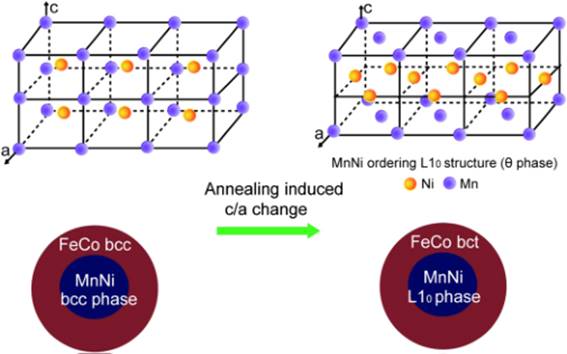
Figure 1. The schematic structural evolution of an FeCo shell induced by the tetragonality change of the MnNi phase under phase transformation.
Results and Discussion
To improve its MAE and utilize tetragonality change of MnNi phase, the FeCo shell is epitaxially grown on the MnNi nanocrystals. Figures 2(a)-(f) show the structural and elemental mapping images of MnNi-FeCo core-shell nanostructures. As shown in figure 2(g), the optimum coercivity of FeCo reaches 714Oe with an average shell thickness of 2.0 nm after thermal annealing at 673 K.
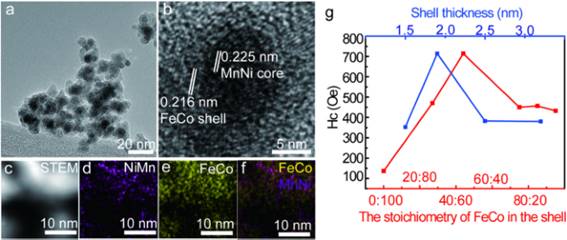
Figure 2. (a)–(f) TEM image, HRTEM image, STEM image and elemental mapping images of MnNi–FeCo nanoalloys. (g) The shell thickness (the stoichiometry of FeCo shell at 45:55, blue) and stoichiometry of FeCo (the average FeCo shell thickness of 2.0 nm, red) dependent coercivity of MnNi@FeCo core@shell nanoalloys.
The annealing temperature dictates the tetragonality of MnNi ¦È phase, which directly controls the tetragonal distortion in the FeCo shell. As shown in Figure 3(a)-(b), the results matches the concepts on temperature-dependent tetragonality of the MnNi ¦È phase. In order to verify phase transformation induced by tertragnility variation, we calculated the Bain strain mismatch of the (111)-(110) structure relationship between MnNi core and FeCo shell[2]. The calculated mismatches between L10-MnNi/bct-FeCo and L10-MnNi/bcc-FeCo were 3.7% and 6.9%, respectively, which confirms the stable interfacial structure in (111) L10-MnNi core and (110) bct-FeCo shell.. Therefore, the tetragonality change of the L10 MnNi phase triggers tetragonal distortion in the FeCo shell phase for the controlled magnetic coercivity. Ultimately, MnNi-FeCo nanocrystals with high coercivity and saturation magnetization were obtained (940 Oe and 154 emug-1).
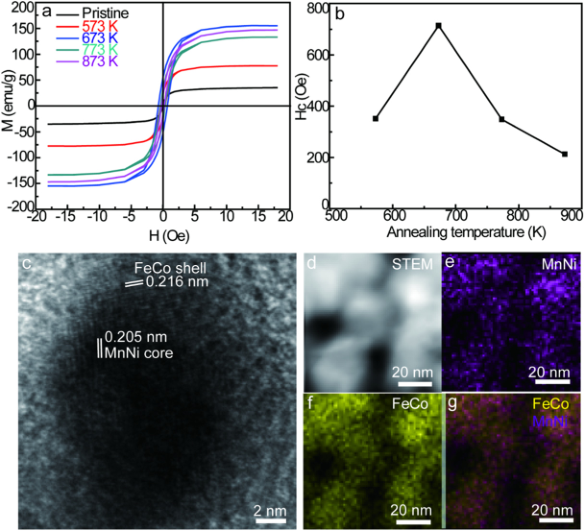
Figure 3. (a) The magnetic hysteresis (M–H) loops of MnNi-FeCo nanocrystals with an average shell thickness of 2.0 nm and thestoichiometry of FeCo 45:55, annealed at temperatures from 573 K to 873 K. (b) The annealing temperature-dependent coercivity of MnNi-FeCo nanocrystals with an average shell thickness of 2.0 nm and the stoichiometry of FeCo 45:55. (c)–(g) HRTEM image, STEM image and elemental mapping images of MnNi–FeCo nanoalloys with an average shell thickness of 2.0 nm and the stoichiometry of FeCo 45:55 after annealing at 673 K.
Significance
Phase transformation induced by tetragonality change for tunable MAE, which open up a new strategy to grow metastable tetragonal nanostructures with high MAE.
Reference
1£®Alec, K., Shen, J., Gong, M., Cui, J., Ren, S. Chemistry of Materials 27 (2015) 4677-4681.
2£®Shen, J., Dai, Q., Ren, S. Nanotechnology 27 (2016) 10LT01.
See more of this Group/Topical: Materials Engineering and Sciences Division