
Study on the adsorption behavior of activated red mud
for Cr(VI) ions from aqueous solution
Lei Wang, Pengjie Gao, Shuqin Liang, Dan Zhang, Suyu Jiang, Huiping Li*
School of Chemical Engineering and Energy, Zhengzhou University, Zhengzhou, Henan 450001, China
*Corresponding author phone: +86 0371 67781807; Fax: +86 0371 67781807;
E-mail: huipingli@zzu.edu.cn (H.Li.)
Abstract: The red mud (RM) was activated with different methods, followed by adsorption experiments for optimal conditions. The results revealed that the adsorption effect of modified RM by FeCl3 was most efficient. The removal efficiency of Cr(VI) was 99.6 % under the optimal conditions with initial Cr(VI) concentration 100 mg/L, adsorbent concentration 8.0 g/L, pH 5, 180 min and 25 ¡æ. The adsorption capacity decreased with the temperature increasing from 25 to 45 ¡æ. The thermodynamic parameters showed that the sorption of Cr(VI) onto Fe-RM was feasible, spontaneous and exothermic in nature. The Freundlich and pseudo-second-order model provided the best correlation with the experimental data compared to other models. It was concluded that the Fe-RM can be used as effective sorbent for treating the Cr(VI) ions from industrial wastewaters.
Keywords: Modified red mud; Chromium; Adsorption; Thermodynamic property; Kinetic
1. Introduction
Chromium compounds are present in the effluents from various industries that include metal plating, textile dyeing, leather tanning, pigments and mining industries and pose severe threat to eco-environment and human health because of its toxicity, high carcinogenicity and oxidation [1]. A number of treatment technologies such as adsorption [2], biosorption, ion exchange [3], membrane filtration, and reduction-precipitation etc, have been conducted for the removal of chromium ions from wastewaters.
Red mud (RM) is a fine-textured waste material generated during the combined process of alumina production from bauxite. Several studies have reported that activated red mud has also demonstrated strong adsorption capability to adsorb different pollutants from effluents [4].
In this study, the effect of different parameters containing adsorbent concentration, initial pH and contact time on the removal efficiency were investigated in a batch equilibrium experiments. Several models of isotherms and sorption kinetics were commissioned to fit these experimental equilibrium data.
2. Experimental sections
For the thermal treatment, the sample was calcined at various temperatures (200-1000 ¡æ). Batches of dry RM were suspended in 100ml of 0.5-5.0 mol/L HCl solutions. For the activation with ferric chloride, the aqueous solutions containing different concentrations of FeCl3 were prepared: 0.1, 0.3 and 0.5 mol/L.
The sorption tests took place at controlled adsorbent concentration (0-15 g/L), initial pH (1-9) and contact time (0-240 min). Batch sorption experiments were carried out to estimate the property of sorbent in the removal of Cr(VI) from solution.
The removal efficiency and uptake capacity of Cr(VI) were calculated as follows:
 (1)
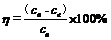 (2)
where co and ce (mg/L) are the initial and equilibrium concentrations of Cr(VI), respectively, m (g) is the mass of dry adsorbent used, and V (L) is the volume of solution, qe (mg/g) is the equilibrium Cr(VI) uptake capacity£¬h is the Cr(VI)removal efficiency.
3. Results and discussion
As the temperature increases, there was gradual increase in Cr(VI) removal and it was maximum at T = 600 ¡æ when the T exceeded in 600 ¡æ, a sharp decrease in the chromate removal efficiency being observed (Fig. 1(a)). A faster increase in the acid concentration up to 3.0 mol/L caused an increase in the efficiency of Cr(VI) removal, thereafter a gradual decrease in the efficiency was observed (Fig. 1(b)). It can be observed that the removal efficiency decreases with increasing initial Cr(VI) concentration. The adsorption capacity of Cr(VI) increased with increase in initial Cr(VI) concentration from 20 to 120 mg/L (Fig. 1(c)).
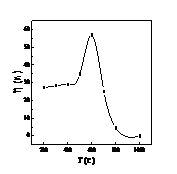
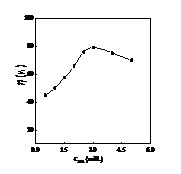
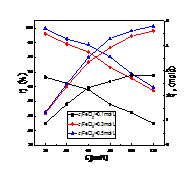
Fig. 1 Effect of different calcination temperature (a)¡¢HCl concentration (b) and FeCl3 concentration (c)
The results showed that the sorptive properties of Fe-RM were the best. The subsequent experiments were carried out with red mud activated with a 0.3 mol/L FeCl3 solution.
When the concentration of Fe-RM was increased from 1 to 8 g/L, the removal efficiency of Cr(VI) increased from 23.4 to 69.5 %. At higher concentrations of Fe-RM, the removal efficiency did not increase significantly (Fig. 2(a)). As the pH increases, there was little increase in the efficiency and it was maximum at pH = 5 when the pH exceeded in 5, a sharp decrease in the efficiency being observed (Fig. 2 (b)).The efficiency of Cr(VI) removal increased from 24.6 % in the 5 min to 68.7 % as the contact time was increased to 180 min, then little change of removal efficiency was observed that the indicated equilibrium condition was achieved (Fig. 2 (c)).
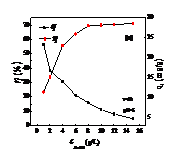
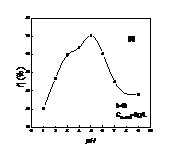
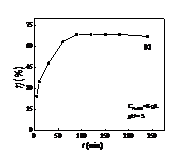
Fig. 2 Effect of sorbent concentration (a)¡¢pH (b) and contact time (c) on the removal efficiency
To study the effect of temperature on the sorption capacity, the temperature ranging from 25 to 45 ¡æ were carried out at the optimum conditions in 100 mL of Cr(VI) solutions with the initial Cr(VI) concentration 100 mg/L¡¢contact time 4 h¡¢sorbent concentration 8 g/L¡¢pH 5.
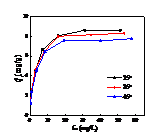
Fig . 3 Effect of temperature on the sorption capacity.
It was found that the temperature had a negative effect on the uptake capacity (Fig .2). The optimum temperature was selected as 25 ¡æ for further sorption experiments.
Thermodynamic behavior of Cr(VI) sorption onto Fe-RM was investigated using the thermodynamic parameter [5].
Table 1 Thermodynamic parameters | ||||
T (K) | KD (L/g) | DG (kJ/mol) | DH (kJ/mol) | DS (J/(mol¡¤K)) |
298 | 3.177 | -2.867 | -7.182 | -14.473 |
308 | 2.897 | -2.722 | ||
318 | 2.648 | -2.577 | ||
The thermodynamic parameters (DG¡¢DH¡¢DS) showed that the sorption of Cr(VI) onto Fe-RM was feasible, spontaneous and exothermic in nature.
There were several expressions for analyzing the experimental data, being that the most frequently used models were the Langmuir, Freundlich [5], and Tempkin isotherm models.
Table 2 Isothermal adsorption parameters | ||
Model | Equation parameters | R2 |
Langmuir | KL=5.311 L/mg£» qm=5.81 mg/g | 0.8738 |
Freundlich | KF=14.319mg0.701¡¤L0.299¡¤g-1£»1/n= 0.299 | 0.9720 |
Tempkin | KT=2.76103 L/mg£» B=1.197 | 0.9453 |
Several well-known kinetic models, Lagergren [6], Morris-Weber , Elovich and pseudo -second-order models have been applied to fit these experimental data, obtained for sorption of Cr(VI) onto Fe-RM.
Table 3 Kinetic models parameters | |||
Model | Equations | Parameter | R2 |
pseudo-second order | y = 0.1093x +1.2286 | k2=0.0097 (g/(©J min)) | 0.9983 |
Elovich | y = 1.5820x + 0.7608 | ¦Á=2.5590; ¦Â=0.6321 | 0.9486 |
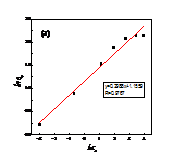
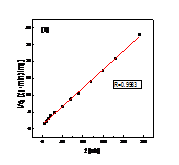
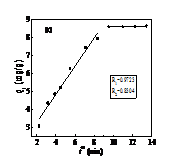
Fig. 4 Frendlich isotherm (a)¡¢pseudo-second order (b) and intra-particle diffusion kinetic plot (c)
The sorption behavior of Fe-RM-Cr(VI) system was consistent with the Freundlich model (Fig. 4 (a)), which indicated that adsorption process existed in multi-molecular physical adsorption. The correlation coefficient for the pseudo-second-order model was 0.9983 (Fig. 4 (b)), which led to believe that the kinetic model provided a best correlation factor for sorption of Cr(VI) onto Fe-RM in contrast to other models. The Figure indicated that the sorption process happened through surface sorption and intra-particle diffusion (Fig. 4 (c)). As seen from Table 2 and 3, there is chemical sorption from Tempkin and Elovich model. Thus, the sorption process was completed through physisorption and chemisorption.
4. Conclusions
In the present study, the red mud was activated via calcination, HCl soaking and FeCl3 modification, respectively. The red mud treated by FeCl3 had the higher sorption performance of Cr(VI) than that of other methods. The maximum Cr(VI) removal efficiency was 99.6% at the optimal condition of pH 5, contact time 180 min, sorbent concentration 8 g/L, and initial Cr(VI) concentration 100 mg/L. The calculated thermodynamic parameters (¦¤H£¬¦¤G£¬¦¤S) showed the sorption to be feasibility, exothermic and spontaneous with decreased randomness at the solid-liquid interface. The Langmuir, Freundlich and Tempkin isotherm models were employed for Cr(VI) sorption onto Fe-RM, and it was proved that the Freundlich isotherm model offered higher correlation factor than other models. The kinetic process was found to fit very well to pseudo-second-order model. The sorption process was completed through physisorption and chemisorption. Based on all results, Fe-RM can be used as an efficient and alternative sorbent for the treatment of wastewaters containing Cr(VI) ions because of the advantages of being natural, low-cost adsorbent and having high sorption capacity.
5. References
See more of this Group/Topical: Separations Division