
The focus of the present work lies on screening formulations for amorphous solid dispersions (ASDs) with a computational tool which allows a comprehensive set of virtual experiments to be performed without API expenditure and with a fast turnover and consequently to explore the design space in full prior to manufacturing prototypes in the laboratory.
ASDs of poorly water soluble active pharmaceutical ingredients (APIs) in hydrophilic polymeric matrices are a commonly used strategy to increase the solubility and dissolution rate of oral-dosage forms [1]. However, successful development of amorphous solid dispersions for optimal performance and stability depends on both the formulation (e.g. drug load, polymer system and surfactants) and on the manufacturing technology/process conditions. For example, adequate solvent mixtures used in the process offer the possibility of influencing particle morphology and drying rate [2] and have been reported to offer advantages in the solid state drug-polymer miscibility and on the stability of the ASDs [3,4]. On the other hand, excessively complex formulations can lead to undesirable phase separation which can compromise physical stability [5]. However, optimizing the formulation (e.g. drug load, polymer system and solubilizers) and the process (e.g. drying kinetics and droplet/particle size) requires extensive laboratory work, which is often compromised by time and cost constraints. Therefore the ability to perform virtual experiments is highly advantageous and cost-effective.
In this presentation we cover the mathematical modeling of the various concurrent physical phenomena that a solution of API and polymer (and sometimes other excipients) undergo prior to forming an amorphous solid dispersion, such as atomization, co-solvent evaporative dynamics, propensity for phase separation and shell formation [6,7]. We show a set of case studies of in silico screening benchmarked against data from solvent casting and spray drying experiments and also show a case-study where an excessively complex ASD formulation led to phase separation and compromised the stability of the amorphous intermediate.
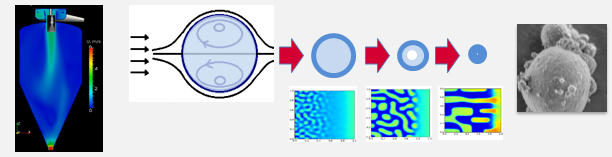
Figure 1: Sketch of various stages throughout the droplet drying history and the concomitant propensity for phase separation and crystalization if the formulation and/or process are not adequately designed.
References
[1] Perrie Y., Rades T. “Pharmaceutics - Drug Delivery and Targeting”, Pharmaceutical Press, 2010.
[2] Wulsten, E., Kiekens, F, van Dycke, F., Voorspoels, J. & Lee, G., “Levitated single-droplet drying: Case study with itraconazole dried in binary organic solvent mixtures”, Int. J. Pharmaceutics, 2009, 378(1-2) pp. 116-121
[3] Janssens, S, Anné, M., Rombaut, P. & Van den Mooter, G., “Spray drying from complex solvent systems broadens the applicability of Kollicoat IR as a carrier in the formulation of solid dispersions”, Eur. J. Pharm. Sci. 2009, 237, pp. 241-248.
[4] Paudel, A. & Van den Mooter, G., “Influence of Solvent Composition on the Miscibility and Physical
Stability of Naproxen/PVP K 25 Solid Dispersions Prepared by Cosolvent Spray-Drying”, Pharm. Res. 2012, 29, pp. 251-270.
[5] Janssens, S., Nagels, S., de Armas, H.N., D’Autry, W., Van Schepdael, A. & Van den Mooter, G., “Formulation and characterization of ternary solid dispersions made up of Itraconazole and two excipients, TPGS 1000 and PVPVA 64, that were selected based on a supersaturation screening study”, Eur. J. Pharm. Biopharm, 69:1, 2008
[6] Duarte, Í., Santos, J. L, Pinto, J. G & Temtem, M., “Screening methodologies for the development of spray-dried amorphous solid dispersions”, Pharm. Res., 2015, 32 pp. 222 – 237, 2015.
[7] Prudic, A., Ji, Y. & Sadowski, G., “Thermodynamic Phase Behavior of API/Polymer Solid Dispersions”, Mol. Pharmaceutics, 2014, 11(7), pp. 2294-2304
See more of this Group/Topical: Pharmaceutical Discovery, Development and Manufacturing Forum