
The development of novel catalysts for low-temperature CO elimination attracts a lot of attention not only in academic research but also in practical application, such as purifying automobile emission and preferential oxidation (PROX) in the proton exchange membrane fuel cell. Supported noble metal catalysts (Au, Pt, Rh, Pd), which show an excellent catalytic performance, have been widely investigated for CO oxidation. However, due to the high cost of the noble metals and remarkable progresses in oxide syntheses, catalytic oxidation of carbon monoxide over base metal oxide catalysts such as Mn2O3, Co3O4 and CuO has becoming a promising alternative for noble metals.
Among the metal oxide catalysts, CuO-CeO2 catalyst has been paid much more attention due to their low cost and comparable catalytic activity to the noble metal catalysts in low temperature CO oxidation. It is generally accepted that the high performance for CuO-CeO2 catalysts is dependent on the synergetic redox property between copper and ceria at the interfacial sites, which is considered as the active sites in CO oxidation reaction.
Up to now, based on the understanding of structure of the active component, two strategies should be employed for the improvement of the catalytic performance of copper-ceria catalysts for CO oxidation. Firstly, the facility for achieving the entities of the Cu+ species at the Cu-Ce interface, which is favored by an increase in the dispersion and decrease in the particle size. Secondly, the redox properties of the interface sites between partially reduced copper species and the support, this may be the most important factor in determining the catalytic activities when the nature of the ceria-based support is varied.
Therefore, in the present study, the geometry and electronic structure at the interfacial sites were tuned by adding In into the catalyst to enhance the catalytic performance. The structure-performance relationship was thoroughly studied to support fundamental understanding on CO oxidation over CuO-CeO2 catalyst.
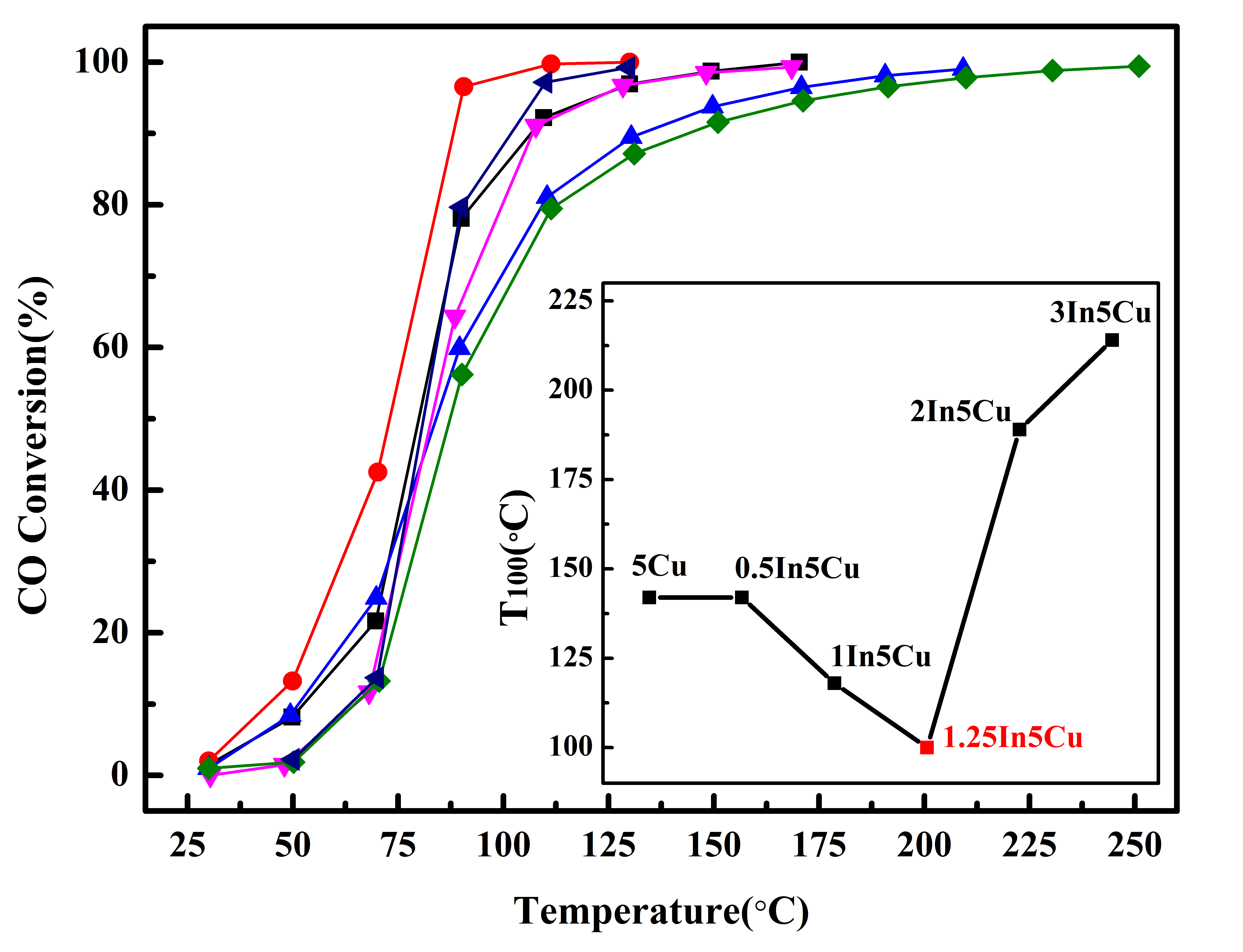
Fig. 1. Temperature-dependent CO oxidation over (¨‹) 5Cu/CeO2, (¡ö) 0.5In5Cu/CeO2, (◄) 1In5Cu/CeO2, (¡ñ) 1.25In5Cu/CeO2, (¡ø) 2In5Cu/CeO2, (♦) 3In5Cu/CeO2 and (insert) T100 of various In-Cu/CeO2 catalysts.
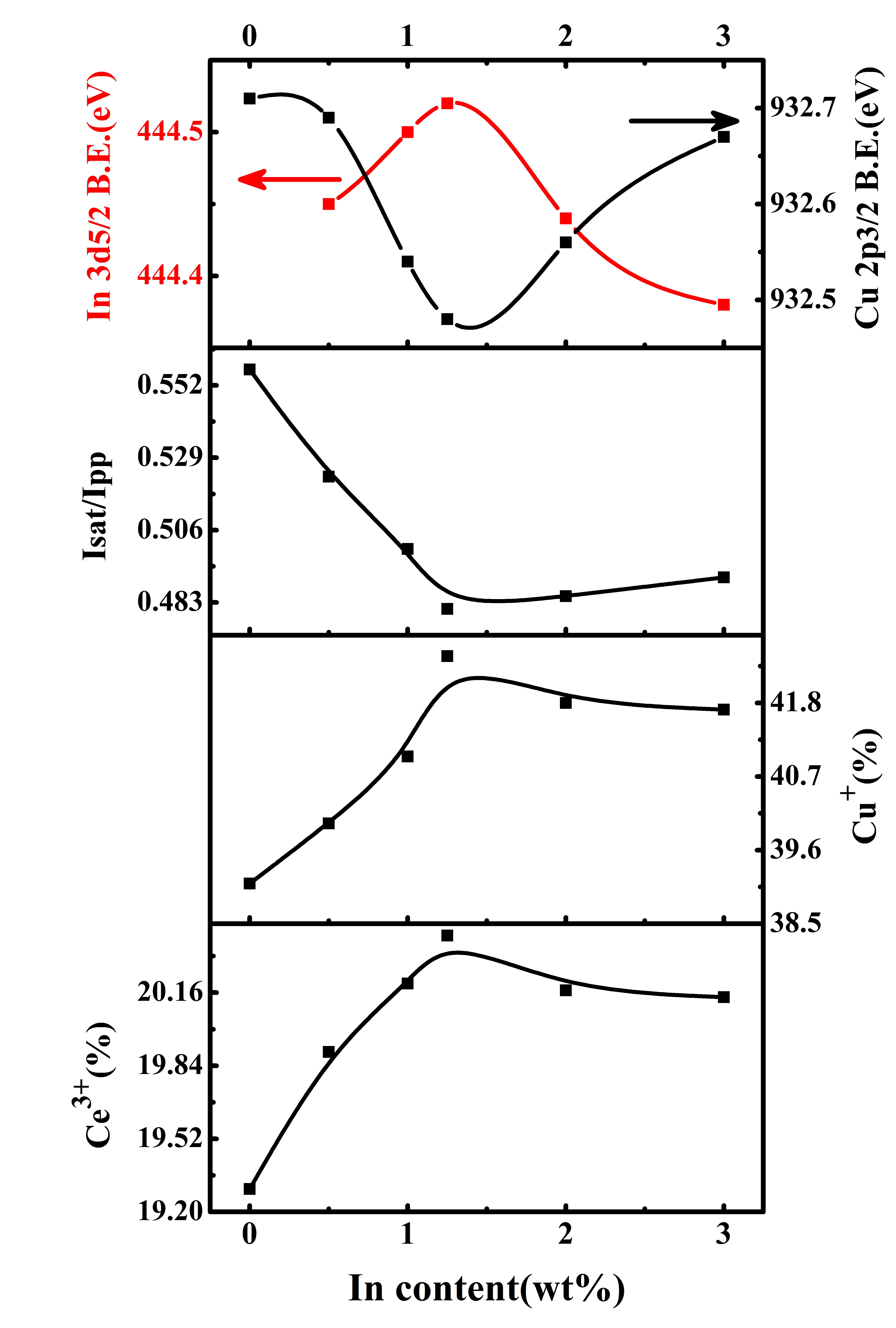
Fig. 2. Binding energy of In 3d5/2 and Cu 2p3/2, Isat/Ipp, Cu+(%) and Ce3+(%) as a function of In content in the Cu-In/CeO2 catalysts.
In this work, In-promoted Cu/CeO2 catalyst exhibits remarkable catalytic performance for low temperature CO oxidation. A volcano-shape curve is observed for reaction rate vs. In content, in which the 1.25In5Cu/CeO2 catalyst possesses the lowest temperature of complete conversion (T100 = 100 oC). The highest reaction rate (5.93¡Á10-6 mol gcat-1s-1) over 1.25In5Cu/CeO2 at 80 oC is obtained. HAADF-STEM images and in situ DRIFTS have proved that an addition of In into the catalysts leads to a decrease in particle size of copper. Copper atoms are diluted by indium atoms indicating that more low-coordination copper sites are exposed and more metal-support interfaces are created, which are considered to be the active sites for this reaction. The adsorption strength of CO on copper is weakened after doping indium, which is assumed to be more favorable for reacting with the adjacent lattice oxygen, preventing the accumulation of surface carbonate-containing products and enhancing the stability and the resistance for CO2. The electronic structure of the surface copper atoms is changed by accepting electron through the redox equilibrium between copper and indium, which could facilitate the stabilization of Cu+ sites at the interface. Tuning the interfacial property of Cu/CeO2 catalyst by indium sheds deep insight for the rational design and controllable synthesis of copper-ceria based catalysts with high catalytic performance.
See more of this Group/Topical: Catalysis and Reaction Engineering Division