
Catalytic membrane reactor for CO2 hydrogenation using H2-containing renewable streams: Model-based feasibility analysis
Robert Currie and David Simakov
Department of Chemical Engineering, University of Waterloo, Waterloo, ON N2L 3G1, Canada
Converting CO2 into synthetic fuels and platform chemicals is an attractive pathway to decrease CO2 emissions and to reduce our dependence on fossil fuels. Thermocatalytic hydrogenation provides advantages of fast reaction rates and high conversion efficiencies (as compared to electro-catalytic and photo-catalytic routes), thus allowing for compact, high-throughput operation. The most fundamental disadvantage is the requirement to supply a pure H2 stream (water is a source of H2 in the electro- and photochemical CO2 reduction). Natural gas reforming is obviously not an option, as this approach will result in the overall positive carbon footprint. Water electrolysis using renewable or surplus electricity is a possibility, but this technology requires high capital investments and operation costs. This study assesses the feasibility of using H2-containing renewable streams, such as biomass gasification product gases, as a source of H2 for the thermocatalytic CO2 conversion to renewable natural gas (Sabatier reaction, CO2 + 4H2 = CH4 + 2H2O).
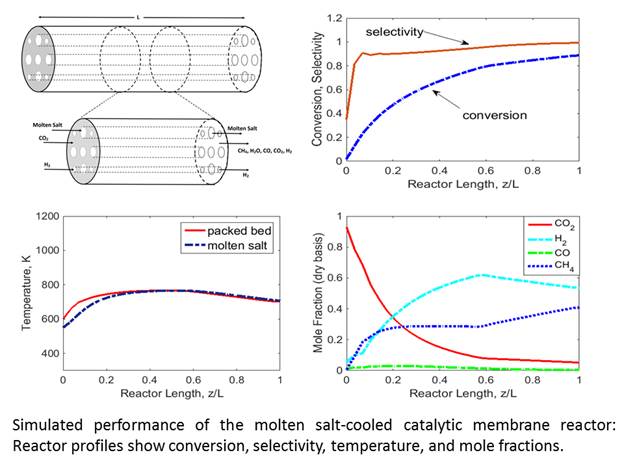
It is suggested to use a H2-selective membrane to extract H2 from a H2-containing stream in situ. The suggested Catalytic Membrane Reactor configuration is based on the distributed H2 supply via a H2-selecive membrane along the axial reactor dimension. The heat generated in the highly exothermic Sabatier reaction is simultaneously removed using molten salt as a heat transfer fluid. A dynamic mathematical model was formulated and analyzed by numerical simulations. The model accounts for the heat exchange between the reaction compartment and the cooling tube, for the mass exchange through the H2-selective membrane, as well as for catalyst deactivation. The reactor fed with a CO2-rich waste stream (biogas or landfill gas) without upstream CO2 separation was analyzed. Effects of feed temperature, pressure, and space velocity on the reactor spatiotemporal behaviour were investigated. Catalyst deactivation was found to be significant but not severe, owing to the distributed H2 supply that leads to more uniform temperature distribution and reduced rate of coking. The simulation results show that, with a proper selection of operating parameters, it is possible to achieve CO2 conversions over 80% after 1,000 h on stream, producing renewable natural gas from a waste CO2-rich stream and a H2-containing biomass gasification product gas.
See more of this Group/Topical: Catalysis and Reaction Engineering Division