
Von Willebrand disease (VWD) is one of the most common bleeding disorders in humans, caused by qualitative or quantitative deficiencies of von Willebrand factor (VWF), a multimeric glycoprotein composed by a variable number of identical subunits, consisting of 2050 amino acid residues and up to 22 carbohydrate side chains [1]. VWF mediates platelet adhesion, platelet aggregation, thrombus growth and binds, transports and protects coagulation factor VIII. VWD occurs in a large variety of forms and its symptoms range from sporadic nosebleeds and mild bleeding from small lesions in skin, to acute thrombocytopenia or prolonged bleeding episodes [2]. Diagnosis of VWD may be a complicated task, due to the various number of VWD types (1, 2A, 2B, Vicenza etc.), therefore pharmacokinetic models [3] have been recently proposed for the classification of the disease type, elucidating the critical pathways involved in the disease characterization. However, the complexity of the models requires long (at least 24 h) and invasive non-routine tests like DDAVP to be carried out on the subjects to achieve a statistically satisfactory estimation of the individual haemostatic parameters. Therefore, the scientific community is pushing researchers to study a way to identify the mechanistic model of VWD without the need of DDAVP test, exploiting only basal clinical trials. The alternative basal tests which are considered in this study are: (a) VWF propeptide (VWFpp) test [4] to quantify VWF elimination from the blood stream; (b) VWF antigen (VWF:Ag) test to quantify VWF molecule in the bloodstream; (c) VWF collagen binding (VWF:CB) test to assess the ability of VWF to bind collagen and the presence of large VWF multimers. From these clinical tests two other important physiological parameters are derived for diagnostic purposes: i) VWFpp ratio expressed as the ratio between VWFpp and VWF:Ag; ii) VWF:CB ratio defined as the ratio between VWF:CB and VWF:Ag.
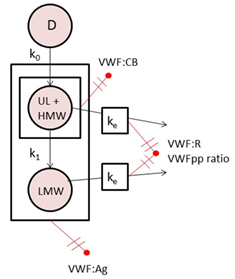
The overall objective of this project is to design a minimal set of basal clinical assays for the identification of the PK model of VWD in order to decrease the time and effort required for the diagnosis and characterization of the disorder. For this purpose, a simplified version of the mechanistic model of VWD by Galvanin et al. [3] is used. The model, illustrated in Figure1a, assumes that high (HMW) and ultra-large (ULMW) molecular weight multimers are released in the bloodstream from the endothelial cells. Then, HMW and ULMW multimers are cleaved by the metalloproteinase ADAMTS13 into low molecular weight multimers (LMW) and eliminated from the bloodstream. A modified model is proposed in this work by including in the formulation a set of explicit correlations linking the PK parameters (k0, k1, ke) to basal VWF:Ag, VWF:CB and VWFpp clinical tests and readings. The new equations are obtained using response surface methodology (RSM). RSM [6] is a design of experiment technique, used to develop “black-box” regression models to establish a correlation between inputs and outputs in a system. The approach is used to approximate the information coming from experimental data with the aim of defining the profile of responses in the experimental design space.
|
|
(a) | (b)
|
| |
(c) | |
Figure 1. (a) Simplified pharmacokinetic model of VWF proteolysis; (b) Fitting with linear model response surface with interactions in type H0 category; (c) Simulated profile of VWF:Ag in H0 category with parameter ke obtained from basal clinical trials.
| |
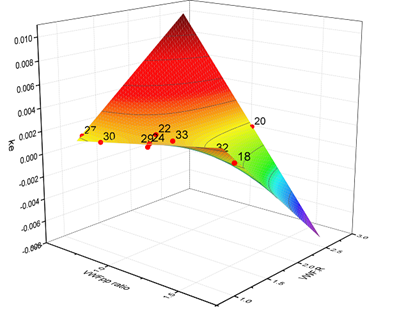
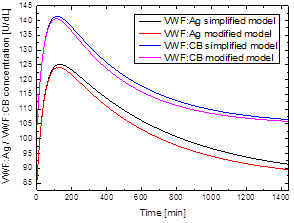
A two-stage model identification procedure is applied based on RSM. In the first step, a model discrimination based on Akaike index [7] is used to determine the best structure of the response surface (linear, quadratic, with interactions, etc.). In the second step a data mining procedure is carried out to estimate RSM parameters in the most precise way. Following the procedure suggested in [8], identifiability tests (sensitivity analysis and information content analysis) are conducted to evaluate if PK model parameters can be uniquely estimated from the experimental data. A linear response surface with interactions has been successfully applied for each type of VWD and it represents the first step for finding an explicit correlations between ke and the two basal quantities VWFpp ratio and VWF:CB. As an example, Figure 1b, which considers healthy subjects with O blood group (HO), shows how the surface can be used to represent the ke data obtained from the simplified model. Figure 1c illustrates the prediction of VWF:Ag and VWF:CB profile following DDAVP for a subject in HO category, once the new explicit relation for ke is added to the simplified model. Results show a good agreement between the simplified model and the modified model including RSM correlations. This work represents a first step towards reaching model identification starting only from basal clinical tests. This will allow an accurate diagnosis of the disease without the invasive DDAVP test, resulting therefore into a better quality of life for the patients.
References
[1] Zaverio M. Ruggeri (2007). The role of von Willebrand factor in thrombus formation. Thrombosis Research, 120, S5-S9.
[2] D. Lillicrap (2007). Von Willebrand disease-Phenotype versus genotype: Deficiency versus disease. Thrombosis Research, 120, S9-S16.
[3] Galvanin, F., M. Barolo, R. Padrini, S. Casonato, F. Bezzo (2014). A model-based approach to the automatic diagnosis of Von Willebrand disease. AIChE J., 60, 1718-1727.
[4] Casonato, A., Daidone, V., Padrini, R. (2011). Assessment of von Willebrand Factor Propeptide Improves the Diagnosis of von Willebrand Disease. Semin Thromb Hemost, 37, 456-463.
[5] Sweeney, J.D., Hoerning, L.A. (1992). Intraplatelet von Willebrand factor and ABO blood group.Thromb Res., 68(4-5), 393-398.
[6] Box G., Benhken D., (1960). Some new 3 level designs for the study of quantitative variables. Technometrics, 2, 455-475.
[7] Akaike, H., (1974). A new look at the statistical model identification. IEEE transactions on automatic control, 19, 716-723.
[8] Asprey S.P, Macchietto S. (2000). Statistical tools for optimal dynamic model building. Computers and Chemical Engineering, 24, 1261-1267.
See more of this Group/Topical: Food, Pharmaceutical & Bioengineering Division