
The use of nanoparticles in complex biological environments has motivated study of their dynamics in concentrated mixtures of macromolecules. Synovial fluid, a lubricant found in joints, is one such complex fluid, with macromolecules like hyaluronic acid and lubricin as major constituents that define its structure and function. Fundamental knowledge of how nanoparticles diffuse in synovial fluid would help engineer better drug delivery agents and also improve basic understanding of the structure of synovial fluid. Here, we study the translation and rotation of magnetic nanoparticles in synovial fluid analogues – concentrated suspensions of hyaluronic acid.
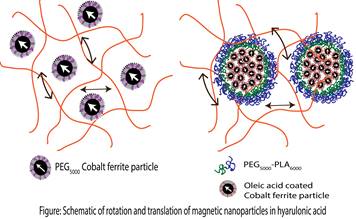
Hyarulonic acid (HA) solutions at concentrations where the HA molecules are well separated (i.e., the dilute regime) and where they overlap (i.e., the semi-dilute regime) were prepared as a first approach to mimic the composition of synovial fluid. Cobalt ferrite particles of two hydrodynamic sizes (40 nm and 240 nm) with an outer coating of polyethylene glycol were suspended in these HA solutions to study the effect of particle size on hydrodynamic drag exerted by the complex fluid matrix. The dynamic response of the particles to an applied alternating magnetic field was analyzed to obtain their rotational diffusion coefficients and, through the Stokes-Einstein relation, the apparent viscosity of the fluid. We found that the average viscosities obtained from nanoscale measurements were similar to that of water and did not correspond to the viscosity of the bulk fluid as measured using a rheometer, for HA solutions in both the dilute and semi-dilute regimes. Control measurements of rotation of the particles in glycerol solutions indicated that the viscosity determined by rotation of the particles in simple fluids was similar to the bulk viscosity.
To complement these measurements, semi-quantitative estimates of the relative translational hydrodynamic drag on the nanoparticles was obtained through measurements of the rate of magnetic capture. Magnetic nanoparticles were subjected to an external magnetic field gradient and their translation was monitored by the amount of particles recovered as a function of time. The rate of translation of particles in solutions in the semi-dilute regime was found to be slower than for particles in solutions in the dilute regime, indicating greater viscous drag experienced by the particles in the more concentrated HA solutions. However, comparison to rates of capture in control glycerol solutions with similar viscosity suggests that the translational hydrodynamic drag experienced by the nanoparticles in the HA solutions is lower than expected based on their macroscopic viscosity.
These studies suggest that rotational motion of nanoparticles below 240 nm in diameter is unimpeded by the HA network in these synovial fluid analogues, whereas translation of the particles does appear to be impeded by the HA network, albeit the effect is much less pronounced than expected based on macroscopic rheological measurements. These observations provide insight into the dynamics of nanoparticles in complex biological fluids and can serve to develop novel nanoparticle-based drug delivery and diagnostic technologies applicable in joint diseases.
See more of this Group/Topical: Engineering Sciences and Fundamentals