
Supported transition metal carbides as catalysts for CO2 conversion to syngas via Reverse Water Gas Shift reaction
Yichen Zhuang, Faisal Mohamed Khan and David Simakov
Department of Chemical Engineering, University of Waterloo, Waterloo, ON N2L 3G1, Canada
Converting CO2 into synthetic platform chemicals is an attractive approach to decrease CO2 emissions and to reduce our dependence on fossil fuels. Thermocatalytic hydrogenation provides advantages of fast reaction rates and high conversion efficiencies (as compared to electro-catalytic and photo-catalytic routes), thus allowing for compact, high-throughput operation. Among possible reaction pathways is the Reverse Water Gas Shift reaction (CO2 + H2 = CO + H2O) that has the advantage of low H2 consumption. The generated CO can be mixed with H2 to produce syngas, which is a valuable feedstock for chemical industry, i.e., methanol synthesis. Challenges include insufficient activity, incomplete selectivity to CO production, and low stability against coking and sintering.
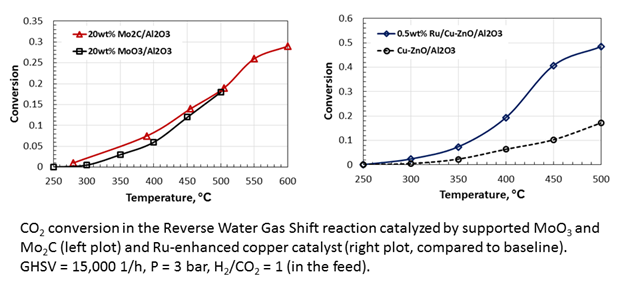
Copper-based catalysts are highly selective, but their activity is relatively low. Addition of small amounts of noble metals (e.g., Ru) with proper nanostructuring can improve the catalytic activity by as high as 250% (right panel in the figure below). However, it is highly desirable to avoid the use of platinum group metals. Among emerging low-cost catalytic materials, transition metal carbides were recently identified as promising candidates for a number of heterogeneous reactions. In this study, a series of supported transition metal carbides are investigated for their catalytic performance in the Reverse Water Gas Shift reaction. Some catalytic formulations, such as Mo2C/Al2O3, show reasonably high conversions with complete selectivity to CO formation. Molybdenum oxide initially shows similar conversion (left plot in the figure below), but deactivates rapidly by coking. On the contrary, the Mo2C/Al2O3 catalyst exhibits excellent stability maintaining high CO2 conversions over 100 h of operation at elevated space velocity (GHSV = 15,000 1/h). Results presented include catalytic performance evaluation for several formulations of transition metal carbides, including mixed carbides, as well as characterization of fresh and spent catalytic materials by means of electron microscopy, infrared spectroscopy, thermal gravimetric analysis, physical adsorption, and chemisorption.
See more of this Group/Topical: Catalysis and Reaction Engineering Division