
Direct, single-pass thermocatalytic upgrading of biogas and landfill gas into renewable natural gas over the ultra-low loading Ru/g-Al2O3 catalyst
Yichen Zhuang and David Simakov
Department of Chemical Engineering, University of Waterloo, Waterloo, ON N2L 3G1, Canada
Converting CO2 into synthetic renewable fuels is an attractive pathway to decrease CO2 emissions and to reduce our dependence on fossil fuels. Thermocatalytic hydrogenation provides advantages of fast reaction rates and high conversion efficiencies (as compared to electro-catalytic and photo-catalytic routes), thus allowing for compact, high-throughput operation. One option is to convert CO2 into synthetic methane, so-called renewable natural gas (RNG) via the Sabatier reaction (CO2 + 4H2 = CH4 + 2H2O). Water electrolysis using renewable or surplus electricity can be used to provide a non-fossil source of H2 required for the reaction. There are multiple sources of concentrated CO2-containing streams including biogas and landfill gas (up to 50 mol% CO2). It is highly desirable to develop a technology that can convert such CO2-rich streams directly, without costly upstream CO2 separation.
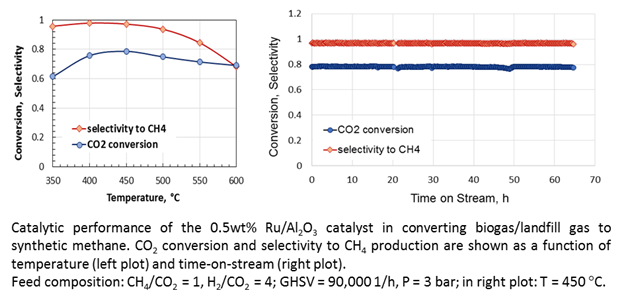
One of the most fundamental challenges is the development of a catalyst, which is highly active, selective to CH4 formation, stable against coking, and low-cost at the same time. The selectivity becomes a major challenge when a mixed feed (biogas or landfill gas contain up to 50 mol% CH4 in addition to CO2) is used instead of purified CO2 feed. In this study, a highly selective Ru-based catalyst with ultra-low Ru loadings (less than 0.5 wt%) is reported. A series of catalysts with Ru loadings ranging from 0.05-0.5 wt% were synthesized and evaluated for their catalytic activity in selective conversion of CO2 in the mixed CH4/CO2 feed. CO2 conversions up to 80% were achieved with nearly complete selectivity to CH4 generation (left plot in the figure below). Importantly, the catalysts showed good stability, without any notable decline in performance over 60 hours on stream at very high space velocity of GHSV = 90,000 1/h (right plot in the figure below). A variety of analytical techniques were employed in order to investigate the mechanism of the superior selectivity and activity, including electron microscopy, thermal gravimetric analysis, temperature programmed reaction, chemisorption, and X-ray photon spectroscopy. Our results point out at the strong structure-activity relationship and the importance of the active phase interaction with the support.
See more of this Group/Topical: Topical Conference: Innovations of Green Process Engineering for Sustainable Energy and Environment