
Artificial water channels¨Dbioinspired and energy-efficient filtration materials
Yue-xiao Shen and Manish Kumar*
Department of Chemical Engineering, The Pennsylvania State University, University Park, PA 16802
Water purification is emerging as an important challenge in the 21st century,1 globally, and even in our own backyard with accidents of unsafe and scarce drinking water in Milwaukee, Flint and California in recent years. Membrane-based technologies that have been extensively used to produce fresh water from seawater and to purify microbiologically and chemically contaminated water are energy intensive. Nature provides excellent examples for energy-efficient desalination and water filtration. Mangrove trees purify saline water through its root systems with minimal energy input (Fig. A). In cell membranes, including those in the mangrove roots (Fig. B), biological water channel proteins aquaporins (AQPs) (Fig. C) conduct single channel water transport while excluding all other molecules. This mechanism has inspired us to study on the design of artificial structures that mimic AQPs and led to the exciting development of biomimetic membranes for energy-efficient desalination using these structures.2
Here we report that peptide-appended pillar[5]arene (PAP) artificial water channels (Fig. D) combine the advantages of biological water channels Aquaporins (AQPs) and carbon nanotubes (CNTs).3 These channels were functionally inserted into stable poly(butadiene)-b-poly(ethylene oxide) (PB-PEO) amphiphilic block copolymers.4 We showed that the water conductance of PAP channels in BCPs was in the range of AQPs¡¯ (~108-109 water molecules/s) (Fig. E). They could also be vertically aligned in 2 dimensional block copolymers membranes (Fig. F), with much higher packing density (~2´105/¦Ìm2) than current synthetic CNTs-based membranes (0.1~2.5´103/¦Ìm2). The channel based 2D materials were then assembled into a dense active layer on track-etched polycarbonate membranes via layer-by-layer deposition. This separating layer was further infiltrated with crosslinking reagents to enhance its integrity (Fig. G). The resulting highly packed artificial channel based composite membranes could be promising energy-efficient separation materials for the future, and showed high water permeability while maintaining selectivity.
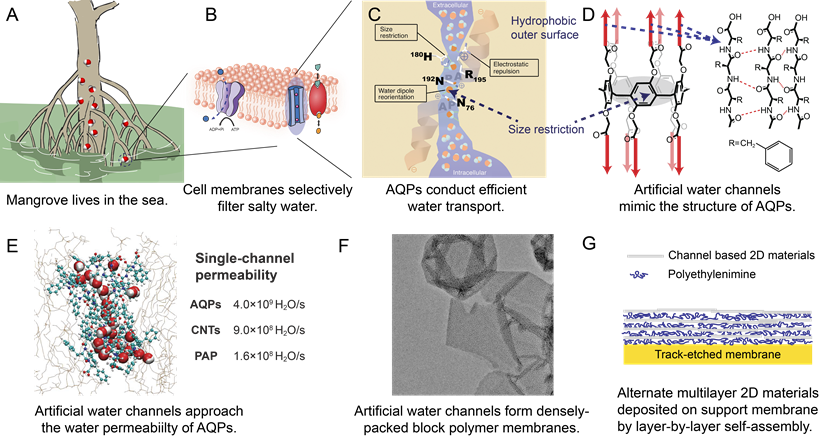
Figure. Bioinspired artificial water channels-based membranes are designed for energy-efficient desalination. (A-B) Mangrove lives in the sea and rely on its root system to purify sea water. (C) Biological water channel proteins aquaporins (AQPs) in the cell membranes of the mangrove root system have high water transport rate while rejecting any other solutes and ions. (D) Peptide-appended pillar[5]arene (PAP) artificial water channels mimic the structure of AQPs. (E) The water conductance of PAP channels are close to that of AQPs and carbon nanotubes (CNTs). (F) PAP channels can form densely packed polymer membranes. (G) Schematic representation of the alternate multilayers artificial channel based 2D materials and polyethylenimine deposited on track-etched membranes by layer-by-layer self-assembly.
References
2 Shen, Y.-x. et al. Biomimetic membranes: A review. J. Membr. Sci. 454, 359-381, (2014).
See more of this Group/Topical: Separations Division