
Hydrocracking and hydroisomerization reactions convert large-molecular-weight alkane feedstocks to more valuable smaller and more highly branched molecules, respectively, through cascade reactions mediated by alkene intermediates [1]. Such reactions require presence of metal function—sufficient to establish alkane-alkene equilibrium for reactants and to scavenge intermediates and alkene products—that resides within diffusion distances from kinetically relevant acid function. These distances are seldom well-defined and are sensitive to synthetic and formulation protocols but, in part, define concentration gradients of reactant and product alkenes with significant consequences for rates and product selectivities, respectively, especially when acid sites reside within channels and voids of zeolite or zeotype materials (with characteristic sizes ~0.4-1.1 nm [2]). These apertures and voids restrict diffusion of reactants and products—and do so sensitively based on molecule size and shape—and also confer higher reactivity through stabilizing van der Waals and electrostatic interactions with carbocation moieties at ion-pair transition states. Resultant concentration gradients of product alkenes depend on the size of the acid domain and on the density of protons and lead to product selectivities reflecting multiple secondary interconversion events occurring before product alkenes exit acid domains and become hydrogenated at extracrystalline metal functions. Such diffusion-enhanced secondary reactions are rarely treated using rigorous kinetic-transport formalisms, and their effects on measured isomerization and β-scission rates and selectivities are typically attributed, unconvincingly and often inaccurately, to transition state selectivity or to effects of framework structure on acid strength.
Here, we dissect the effects of diffusion, acid strength, and transition state confinement to assess their respective catalytic consequences. Kinetic data, benchmarked against density functional theory, are reported for n-heptane (nH) and 2,4-dimethylpentane (24DMP) isomerization and β-scission on physical mixtures of Pt/SiO2 and zeolites with diverse confining environments (MFI, MTW, BEA, SFH, FAU) but similar acid strengths and MFI zeotypes with different framework heteroatoms (Al, Fe, Ga, B) which contain H+ of different acid strength within the same confining environment. To attain intrinsic product formation rates, we assess the effects of product-alkene concentration gradients within acid domains using rigorous reaction-transport formalisms that account for diffusion timescales independently measured from isochoric, isothermal transient uptake of 2,2-dimethylbutane. We additionally develop and report descriptors of confinement as van der Waals interaction energies, Evdw, for transition states based on Lennard-Jones potential force fields [3] and of acid strength as deprotonation energy (DPE), defined as that required to heterolytically cleave the Brønsted O-H bond; these descriptors, together with thermochemical cycles providing the conceptual framework for interpreting activation barriers in terms of separable properties of the acid (Evdw and DPE), the reactant (proton affinity), and the interacting moieties at the confined ion-pair transition state, permit systematic interpretation of the independent effects of acid strength and confinement on intrinsic isomerization and β-scission rates and selectivities.
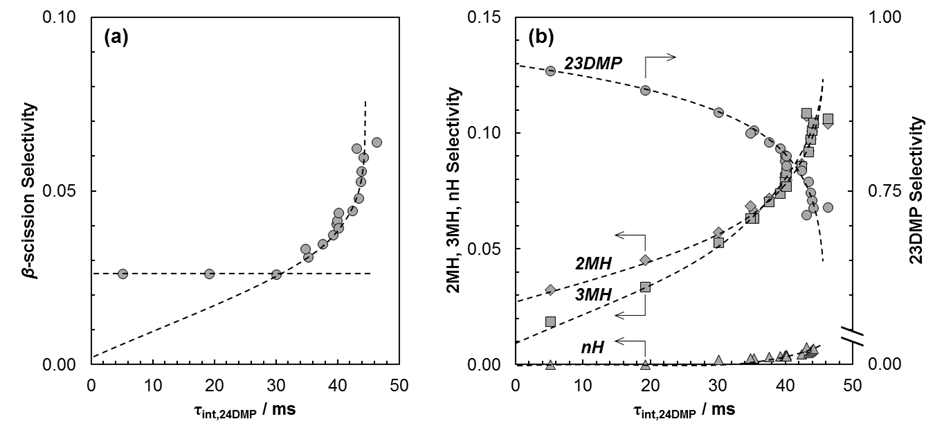
n-Heptane and 2,4-dimethylpentane isomerization and β-scission turnover rates (per H+; 548 K; 0.5-25 kPa alkane; 60-101 kPa H2) on all physical mixtures are proportional to alkane/H2 molar ratio (a surrogate for the prevalent pressure of heptenes) at low values of this ratio and approach constant values as molar ratio increases. First-order rate constants (kisom,nHKprot,nH for n-heptane isomerization and (kisom,24+kβ,24)Kprot,24 for combined 2,4-dimethylpentane isomerization and β-scission) reflect the free-energy differences between their respective confined, ion-pair transition states and unconfined, neutral precursors (gas phase alkene & acid sites). Measured ratios of kβ,24/kisom,24 reflect ubiquitous secondary reactions that occur within the acid domain before alkene products leave an acid domain and become alkanes. Similarly, on all acids and for both reactants, measured product selectivities (the ratio of the measured formation rate for a given product to the consumption rate of the reactant) were invariant with reactor residence time or alkene reactant pressure; these selectivities do not reflect the intrinsic values of primary formation events because primary alkene products undergo multiple secondary interconversions before they form their respective less-reactive alkane analogs. The extent of these diffusion-enhanced secondary reactions was assessed for each aluminosilicate by varying the intracrystalline residence time (τint) through monotonic changes in the proton density ([H+]) during desorption of weakly bound NH3 titrants from the active protons. Figure 1 shows selectivities measured during NH3 desorption as a function of τint for (a) β-scission products and (b) isomer products during 2,4-dimethylpentane conversion on FAU-Pt/SiO2 catalyst mixtures. Product selectivities at low values of τint are invariant with τint, indicating that such β-scission selectivities reflect primary chemical events. As τint increased, β-scission, n-heptane, 2-methylhexane, and 3-methylhexane selectivities increased, while that for to 2,3-dimethylpentane decreases, indicating the prevalence of secondary alkene interconversions of primary 2,4-dimethylpentane products as [H+] increases.
|
Figure 1. Measured (a) β-scission and (b) 2-methylhexane (◆; left), 3-methylhexane (▲; left), n-heptane (■; left), and 2,3-dimethylpentane (●; right) selectivities for reactant 24DMP as a function of the intracrystalline residence time (varied by desorption of NH3) on physical mixtures of Pt/SiO2 with FAU (548 K). Dashed lines are guides for the eye.
|
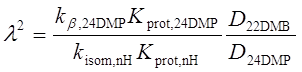
Rigorous
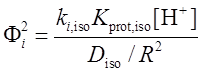
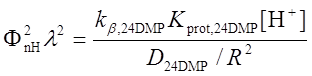
reaction-transport treatments reveal that a Thiele parameter for the primary isoalkene products determines the extent of such
diffusion-enhanced secondary reactions (


|
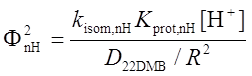
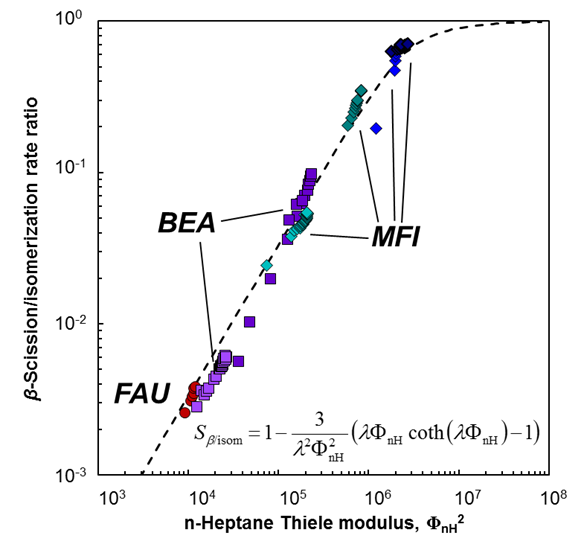
Figure 2. Measured β-scission selectivity for reactant nH as a function of the n-heptane Thiele modulus (ΦnH2; varied by desorption of NH3) on physical mixtures of Pt/SiO2 with FAU, BEA, and MFI (548 K; 100 kPa H2, 0.5 kPa nH). MFI and BEA of different [H+] are indicated. Dashed line represents the regressed fit to the inset equation.
|
These confinement effects, however, lead to preferential stabilization of both β-scission and isomerization transition states with respect to their gas phase precursors; the stabilization of transition states by van der Waals interactions with the framework is reflected in Evdw, where a better match between void size/shape and organic carbocation size/shape results in more negative values. First-order nH isomerization rate constants decrease exponentially with increasing Evdw. The effects of Evdw on activation barriers are attenuated by energy penalties brought forth by distortions of the framework (Estr) and the carbocation at the transition state in order to establish more effective van der Waals contacts, especially as the organic moiety approaches the size of the confining voids.
Such organic carbocations, together with the conjugate anion of the zeolite or zeotype, constitute ion pair transition states mediating isomerization and β-scission reactions. First-order isomerization and β-scission rate constants for 2,4-dimethylpentane, measured on MFI zeotypes with H+ of different acid strength (by varying framework heteroatom, in order of decreasing acid strength: Al, Ga, Fe, B; DPE = 1226-1292 kJ mol-1; in physical mixture with Pt/SiO2), were corrected for diffusion-enhanced secondary reactions to obtain intrinsic values. These first-order rate constants decrease exponentially with increasing DPE, predominantly a reflection of the less stable conjugate anion at ion-pairs of weaker acids. The ratio of rate constants kβ,24/kisom,24, however, increases with increasing DPE, indicating that β-scission occurs preferentially on weaker acids. Cations at transition states mediating β-scission resemble “harder” carbenium ions (according to classical acid-base formalisms [4]) compared to those for isomerization. These “harder” carbocations interact more effectively with the conjugate anion, recovering more of the energy required to deprotonate a weaker acid, and consequently are less sensitive to DPE. Thus, for transition state structures differing in their tendency to delocalize charge, acid strength can influence product selectivity through stronger effects of DPE for the “softer” transition state.
This work mechanistically assesses the effects of both confinement and acid strength on intrinsic isomerization and β-scission turnover rates and selectivities. Methods of untangling the dramatic and ubiquitous effects of diffusion-enhanced secondary reactions on measured product selectivities are also demonstrated. The insights gained from this work can be applied to design catalytic architectures to obtain desired selectivities and reaction rates.
References
[1] H.L. Coonradt, W.E. Garwood, Ind. Eng. Chem. Process Des. Dev. 3 (1964) 38–45.
[2] C. Baerlocher, L. McCusker, Database of Zeolite Structures, http://www.iza-structure.org/databases/.
[3] S. Herrmann, E. Iglesia, J. Catal. 346 (2017) 134–153.
[4] G. Pearson, J. Am. Chem. Soc. 85 (1963) 3533–3539.
The authors acknowledge technical discussions with Drs. Stacey I. Zones (Chevron) and William Knaeble (UC Berkeley), diffusion timescale measurements by Zhichen (Jane) Shi (UC Berkeley), financial support from Chevron Energy Technology Company, and computational resources from the National Science Foundation’s Extreme Science and Engineering Discovery Environment (ACI-1053575).
See more of this Group/Topical: Catalysis and Reaction Engineering Division