
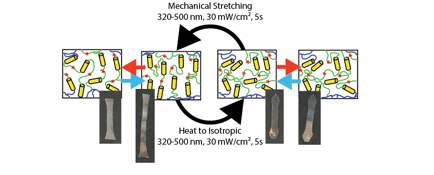
Reversible addition fragmentation chain transfer (RAFT) presents a powerful approach to control the bond connectivity, molecular orientation, and three-dimensional shape of crosslinked networks postpolymerization with spatial and temporal control. Here, we demonstrated its implementation in crosslinked liquid crystalline networks (LCNs) and used RAFTÕs light responsive bond exchange process coupled with a mechanical or thermal bias to permanently alter the alignment of the LCN. The radical mediated mechanism of RAFT bond exchange was initiated through photo-driven cleavage of radical photoinitiators, molecules that fragment into radical species upon excitation with the appropriate wavelength. Because of this light initiated process, the bond exchange process was decoupled from the thermotropic phase behavior of the LCN, unlike other covalent adaptable LCNÕs, allowing unprecedented control over the alignment and stress relaxation. The RAFT bond exchange process and thermoresponsive LCN behavior gives rise to a multitude of controllable variables that were tuned to alter birefringence, develop surface topographies, and program thermoreversible shape changes. We programmed thermoreversible optical images, which are written in the birefringence, by using temperature to drive disruption of pre-aligned LCNs coupled with varying light intensity and exposure time. The programmed LCN disruption occurred in a continuous manner allowing more complex grayscale images to stored in the birefringence. Extending this approach to surface coating, we found that mismatches in alignment, programmed with RAFT bond exchange, lead to protrusions and wrinkling that was used to develop ordered surface topography on an other flat surface. In freestanding RAFT-LCNs, complex and hierarchical shape change was programmed and erased repeatable demonstrating the power of light responsive processes to program shapes independent of the bias being applied to the LCN. By decoupling the thermal behavior and the bond exchange process in RAFT-LCNs, we have demonstrated broad applications and powerful control over thermoreversible shape changes in elastomeric LCNs.
See more of this Group/Topical: Materials Engineering and Sciences Division