
Enhanced Activity for Oxygen Reduction Reaction by Gold at Step/Edge Sites of Ni@AuPt Core-Shell Nanoparticles: A DFT Investigation
Wei An*, Hao Wang
College of Chemistry and Chemical Engineering, Shanghai University of Engineering Science, Songjiang District, Shanghai 201620, China.
*E-mail: weian@sues.edu.cn
ABSTRACT
Modifying Ni@Pt nanoparticle (NP) with Au has been proved to be an efficient strategy to enhance not only the activity of Ni@Pt nanoparticles for oxygen reduction reaction (ORR) demonstrated by previous theoretical study,1 but also the stability of cathode from experimental observations.2-3 Still, there is an urgent need for understanding the ORR behaviors at step/edge sites of a NP considering the large portion of surface Pt atoms consumed by step/edge sites for the closure of a NP buildup besides the key roles of step/edge ¡®defect¡¯ sites that play in promoting a catalytic reaction.
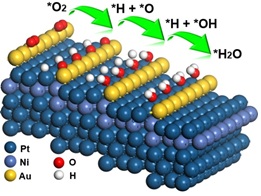
In view of the remarkable effect of Au, we investigate ORR at step/edge sites of Ni@AuPt NPs employing periodic spin-polarized density functional theory (DFT) method. We built high-index (221) facets as model catalysts and found that the ORR activity can be greatly enhanced by replacing the surface Pt atoms at edge site with Au atoms. Our results show that ORR activity at edge site is much higher than that at step site. Inert Au atoms localized at the surface edge sites of Pt-based NPs can effectively promote the elementary steps of ORR. At working potential (U=0.8V), the rate-determining step of ORR at step/edges sites of Ni@AuPt core-shell NPs is likely to be O2 protonation to *OOH, compared with *O protonation to *OH on Pt NPs. Furthermore, the BEP relations are held for O2 dissociation in the form of the linear correlation between the transition-state and final-state energies on potential energy surface, and are held for *O protonation in the form of the linear correlation between the activation barrier and reaction energy in which the rate of *O protonation is increased as the reaction becomes more exothermic. We identified that the surface activity of Pt atoms of core−shell NPs can be well explained by either d-band model or coordination-number model, which have the same origin of chemical nature. Our study provides fundamental understanding of functionality of step/edge sites of Pt-based core−shell NPs for ORR that can be used for engineering of practical cathode catalyst with atomic efficiency and precision by maximizing occupancy of gold atoms at edge sites.
REFERENCES
See more of this Group/Topical: Catalysis and Reaction Engineering Division