
Abstract:
Since global warming is getting worse, the United Nations signed the Paris Agreement in April 2016 to control the rate of temperature rise. The agreement including restricting the increase of temperature within 1.5~2 C, setting a fund for climate change and balancing CO2 emission/nature consumption before 2050. Due to the legal validity of this agreement, countries show their determination to solve global warming.
There are four major technologies to capture carbon dioxide: chemical absorption, cryogenic separation, membrane separation and adsorption. Among these technologies, PSA has advantages of low cost and easy to operate. PSA can separate different gas mixture by various adsorbents, which makes it very competitive.
This simulation research studies the separation and concentration of carbon dioxide from syngas after water gas shift reaction (41.4% carbon dioxide, 1.3% carbon monoxide and 57.3% hydrogen after water removal) by pressure swing adsorption (PSA) process. The UOP 13X zeolite is used as adsorbent. Langmuir-Freundlich isotherm equation is used to regress the isotherm data to obtain the parameters of CO2, N2, CO and H2. The mass transfer coefficient of linear driving force (LDF) model was calculated by theory. In order to test the reliability of the simulation program, we compare the results of simulation program with breakthrough curve experimental data (Figure 1), desorption curve experimental data (Figure 2) and the results of single-bed four-step PSA process experiments. The verification shows that the simulation program can be trusted.
Finally, a dual-bed six-step PSA process (Figure 3) with beds of inside diameter 2.32 cm is employed for syngas feed to find the optimal operating conditions and for temperature from 373 K to 413 K because syngas is usually at high temperature. The operating variables such as feed pressure, adsorption time/vacuum time, adsorption time/cocurrent depressurization time, pressure equalization time, bed length, vacuum pressure and feed/surrounding temperature are discussed.
The results show that when feed pressure increases, total amount of feed gas increases and so does the amount of gas adsorbed, which makes CO2 purity increase, but makes recovery decrease because of more gas exhaust from top stream. As adsorption time/vacuum time increase, adsorber adsorbs more CO2 and is regenerated better which make CO2 purity increase and slight influence on CO2 recovery. While adsorption time/cocurrent depressurization time increase, more weak adsorptive gas exits from top stream, which makes CO2 purity increase but recovery decrease. There is only slight influence on CO2 purity and recovery while pressure equalization time increases. As bed length increases, more gas is adsorbed and less gas exits at cocurrent depressurization step, which makes CO2 purity decrease but recovery increase. When vacuum pressure increases, CO2 purity increases because more CO exits at cocurrent depressurization step, but recovery decreases because CO2 also exits at cocurrent depressurization step. The last variable is feed and surrounding temperature. While temperature increases, less CO2 adsorb, which makes CO2 purity decrease but CO2 recovery increase slightly.
After discussing the operation variables, the optimal operating conditions are feed pressure 3.95 atm, bed length 110 cm, vacuum pressure 0.05 atm, adsorption time 160 s, cocurrent depressurization time 10 s, vacuum time 130 s, pressure equalization time 5 s and feed temperature 393 K. The results of final conditions are 95.3% purity and 97.6% recovery of CO2 in bottom product (Figure 4) and, at the same time, hydrogen with 97.6% purity and 98.3% recovery is obtained.
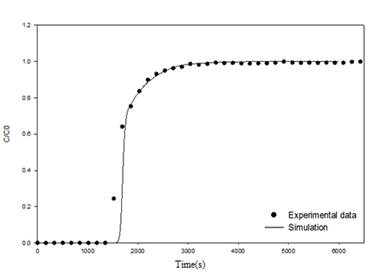
Figure 1. Breakthrough curve of CO2 of gas mixture.
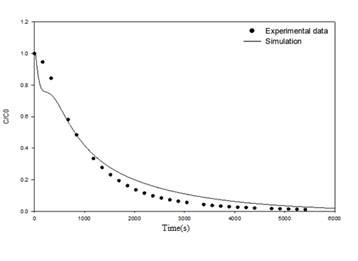
Figure 2. Desorption curve of CO2.
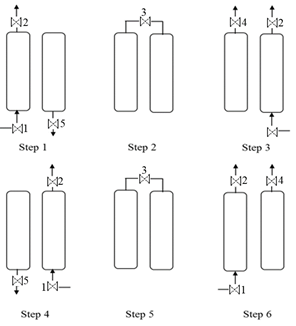

Figure 3. Schematic diagram of dual-bed six-step PSA process.
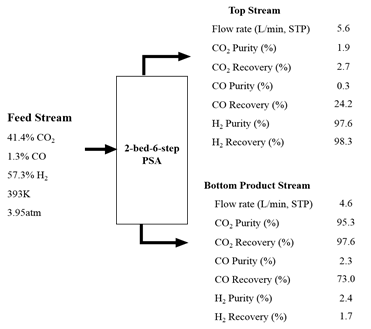
Figure 4. Schematic diagram of optimal results for CO2 capture from syngas feed.
See more of this Group/Topical: Separations Division