
A Zeolitic Imidazolate Framework-8 (ZIF-8) Film for H2/CO2 separation
Eunhee Jang1, Jungkyu Choi1*
1 Department of Chemical & Biological Engineering, Korea University, Seoul 02841, Republic of Korea
ehphoenix@korea.ac.kr, jungkyu_choi@korea.ac.kr
Zeolitic imidazolate framework-8 (ZIF-8) membranes are highly suitable as H2 selective walls in membranes reactors used for water gas shift reactions because of their efficient molecular sieving properties that favor H2 transport, coupled with their high thermal stability and processability. In this study, we adopted an in-situ counter diffusion method (CD method) to fabricate a ZIF-8 membrane; Zn sources, already placed inside a porous support, were allowed to diffuse out and react with the 2-methylimidazole (mim) ligands in the bulk phase. Because the reaction rates between the Zn source and the mim ligand were very high, their diffusion rates played a key role in determining the final properties of the membranes. To exploit the effect of diffusion rate on preparation of ZIF-8 membrane via the CD method, a hierarchically structured support, i.e., a gamma alumina layer-coated alpha alumina disc (gamma/alpha alumina disc), was used in addition to an intact alpha alumina disc. Existence of ZIF-8 membrane was demonstrated with SEM, EDX of Zn atom, XRD, and contact angle. The position of ZIF-8 grains in the supports was estimated based on the direct measurement of N2 physisorption. ZIF-8 membranes in the alpha alumina disc (membrane ZIF-8_A) were primarily formed on top similar to a conventional supported-membrane, whereas those in the gamma/alpha alumina disc (membrane ZIF-8_GA) were embedded inside the modified support. From the N2 physisorption analysis, it was found that the ZIF-8 grains in membrane ZIF-8_GA was pre-dominantly formed inside the alpha alumina disc, while filling ~70% of the mesopores in the gamma alumina layer. As desired, the embedded membrane ZIF-8_GA showed marked H2 separation performance with a maximum H2/CO2 separation factor (SF) of ~9.9 plus-minus 1.2 at 250 deg C (vs. a maximum H2/CO2 SF of ~7.5 plus-minus 0.2 for membrane ZIF-8_A). Although both type membranes persisted at 200 and 250 deg C for up to 72 h, at a higher temperature of 300 deg C, the membrane performance started deteriorating after ~2 h and ~10 h for membranes ZIF-8_A and ZIF-8_GA, respectively. This indicates that the gamma alumina layer served as a protective layer for preserving the performance of the embedded ZIF-8 membrane. Their performance was completely degraded due to the eventual conversion of ZIF-8 into ZnO phases.
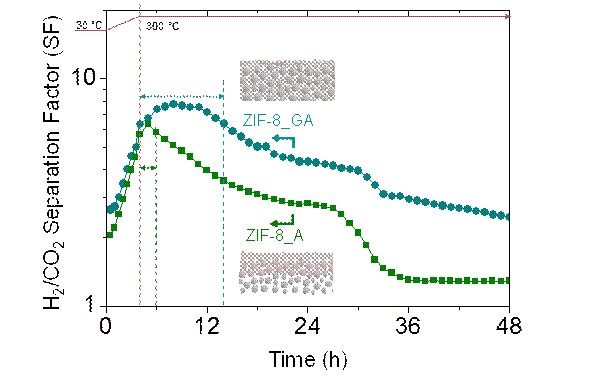
Figure. 1. H2/CO2 separation performance test of ZIF-8-A and ZIF-8-GA at 300 ¡ÆC for 72 h. Here, performance test result obtained for 48 h was expressed. Schematic images for ZIF-8-A and ZIF-8-GA was depicted at the bottom of the performance test.
See more of this Group/Topical: Separations Division