
Chemical Vapor Deposition on Chabazite (CHA) Zeolite Membranes for Improving CO2/N2 Separation Performance
Yanghwan Jeong1, Jungkyu Choi1*
1Department of Chemical & Biological Engineering, College of Engineering, Korea University, Anam-dong, Seongbuk-gu, Seoul, 02841, Republic of Korea
*E-mail: jungkyu_choi@korea.ac.kr
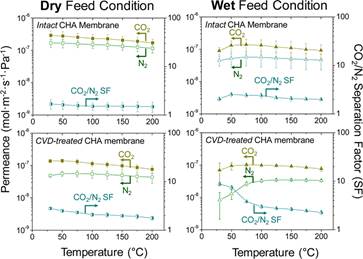
Chabazite (CHA) zeolites with a pore size of 0.37 * 0.42 nm2 are expected to separate CO2 (0.33 nm) from larger N2 (0.364 nm) in post-combustion flue gases by recognizing their minute size differences. Furthermore, the hydrophobic siliceous constituent in CHA membranes can allow for maintaining the CO2/N2 separation performance in the presence of H2O in contrast with the CO2 affinity-based membranes. In an attempt to increase the molecular sieving ability, the pore mouth size of all silica CHA (Si-CHA) particles was reduced via the chemical vapor deposition (CVD) of a silica precursor (tetraethyl orthosilicate). Accordingly, an increase of the CVD treatment duration decreased the penetration rate of CO2 into the CVD-treated Si-CHA particles. Furthermore, the CVD process was applied to siliceous CHA membranes in order to improve their CO2/N2 separation performance. Compared to the intact CHA membranes, the CO2/N2 maximum separation factor (max SF) for CVD-treated CHA membranes was increased by 2 fold under dry conditions. More desirably, the CO2/N2 max SF was increased by 3 fold under wet conditions at 50 ¡ÆC, a representative temperature of the flue gas stream. In fact, the presence of H2O in the feed disfavored the permeation of N2 more than that of CO2 through CVD-modified CHA membranes and thus, contributed to the increased CO2/N2 separation factor.
See more of this Group/Topical: Separations Division