
Controlled drug release systems have gained a lot of attention in pharmaceutical industry, due to its improved therapeutic efficacy by delivering drug molecules in a predetermined rate at the targeted site for a prolong time. Designing polymer based drug delivery system involves in-depth understanding of drug-device interactions and good control over the parameters which can modulate transportation of drug molecules as per the treatment. Recently, electrospun nanofibers have attracted interest as a controlled drug delivery device due to their unique structural features. Electrospinning has become the most common nanofiber production method in the past decade due to its capability of fabricating ultrafine fibers (nano to micron level) from a variety of materials like synthetic and natural polymers, polymer blends. This is the most cost-effective way to produce continuous fibers with very high surface-to-volume ratio, interconnected porosity with tuneable pore dimensions. The versatility in morphology in nanometer level accuracy of fibers can be achieved by optimizing electrospinning process parameters, the polymer solution properties. This kind of nanofibrous structure has tremendous applications in different biomedical fields.
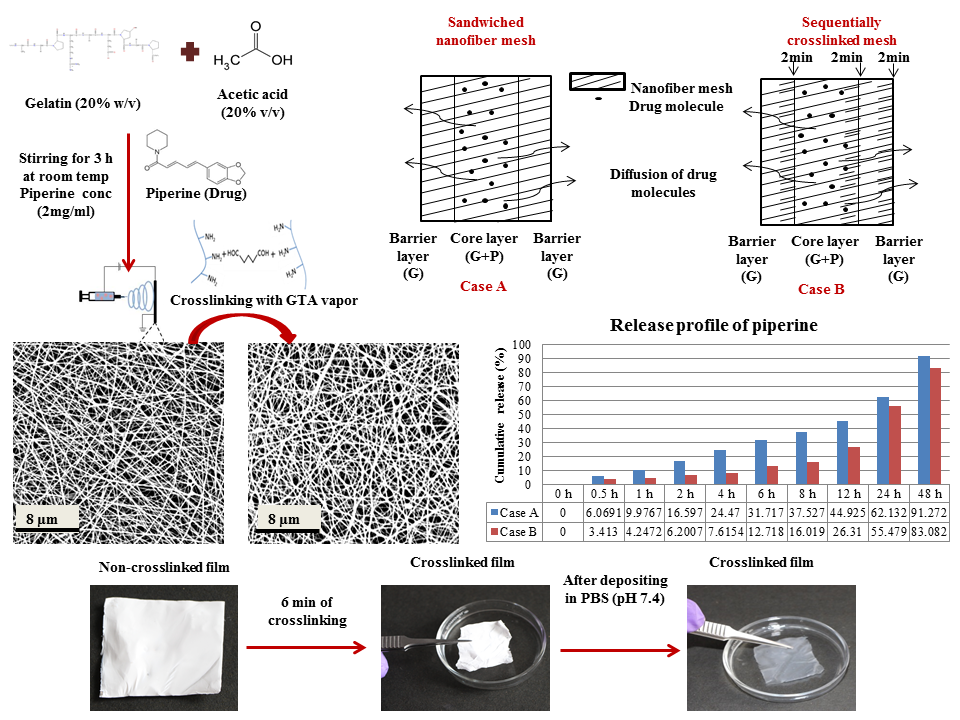
The purpose of the present study is to fabricate large surface area to volume polymeric electrospun nanofibric device for drug delivery application. The work includes main three steps i.e. (a) fabrication of hydrophobic drug (piperine) encapsulated hydrophilic natural polymer (gelatin) based nanofiber film, (b) modulating the stability of hydrophilic film by crosslinking with saturated vapor of glutaraldehyde (GTA) with minimal exposer time and (c) finally modifying the vehicles with different crosslinking strategy and different layer by layer deposition of polymer to achieve sustained and prolonged release of hydrophobic drug piperine.
In this work, first biodegradable polymer gelatin is electrospun to produce continuous long nanofibers and then the possibility of using them as a suitable carrier of hydrophobic drug (piperine) is explored. Releasing hydrophobic drug is a challenge which significantly depends upon the nature of drug and polymer and their interactions. Thus, drug-polymer interactions are checked using Fourier Transform Infrared spectroscopy (FTIR) and it is found that piperine is intact in gelatin nanofiber mesh without reacting with polymer matrix. There is no interference of polymer matrix is found from FTIR and the characteristic peaks of piperine are present clearly. The morphology of the fibers is also examined using Scanning Electron Microscopy (SEM) imaging instrument after gold coating fibers for 10 sec. Long and continuous fibers with average diameter of 150 nm and characteristic peaks of piperine in gelatin nanofiber film are evidence which confirm the encapsulation of drug in polymer matrix.
As a next step, drug loaded gelatin nanofiber film is crosslinked using saturated vapor of GTA only few minutes. In-vitro degradation study of crosslinked samples (6 and 8 min) is performed to check the stability of the vehicle in different physiological pHs for more than 24 h. The fusion of nanofibers at the crossing points of fiber network is due to the water vapor in GTA solution which is evident from SEM images. Interestingly, it is found that the presence of hydrophobic drug can significantly reduce the fusion of gelatin fibers while crosslinking with GTA vapor. Crosslinked samples shows significant amount of improvement in terms of thermal stability after performing Thermogravimetric analysis. Thus we have successfully fabricated piperine encapsulated gelatin nanofiber based device which is chemically, thermally and mechanically stable.
After the fabrication of the device, in-vitro release study is done to analyze the effect of release medium and degree of crosslinking on the drug release from the nanofiber mat. While the amount of drug release decreases with increase in crosslinking time, the same increases with higher pHs. Release profile shows bi-layered curves i.e. sudden release of drug followed by sustained release which is far from zero-order kinetics. One very quick fit is to increase the crosslinking timing which is not desirable because of the toxicity of GTA and also it will reduce the overall total release. Thus new strategies are incorporated to control the rapid release of drug during the initial hours. Sandwiched structured nanofiber mesh with 6 min and 8 min crosslinking with GTA is the next attempt in order to increase the diffusional barrier between the drug molecules and release medium to tone down the initial rapid release. Piperine loaded gelatin nanofiber layer is basically put in-between two layers of only gelatin nanofiber layers. It is evident that, increase in barrier layer decreases the initial release and also decreases the drug loading. As a consequence different variation of barrier and core layer has been tried and this greatly improves the release profile. In the present vehicle, with higher drug loading the barrier is not able to release molecule in zero order manner. Thus, the concept of sequential crosslinking comes into the scenario to give a near zero order release profile. There is a hierarchy of crosslinking degree within the layers in case of single time crosslinking for 6 min. To increase the compactness of the fiber mesh uniformly within the layers, fiber mesh is crosslinking each time for 2 min after depositing barrier layer, core layer and finally at the end of opposite side barrier layer. This drastically improves the release kinetics of higher drug encapsulated device. These results suggest potential use of biodegradable electrospun nanofibers as an oral drug delivery system with promising controlled release features.
See more of this Group/Topical: Materials Engineering and Sciences Division