
With the ever-increasing need to find a sustainable source of renewable energy, bio-oil produced via the fast pyrolysis of biomass is a promising source of liquid fuel; however, the resulting bio-oil contains oxygenated products that contribute to poor fuel quality [1]. Hydrodeoxygenation (HDO) is used to refine the bio-oil by reducing the oxygen content, ideally using a minimal amount of H2 in order to form H2O. Bimetallic catalysts such as Pd on Fe have demonstrated synergistic behavior that contributes to a more cost-effective and longer-lasting catalyst [2-4]. Similarly, Pt/Sn catalysts have also exhibited traits favorable for the HDO of phenolic compounds [5], namely a propensity to promote lower temperature desorption of aromatic compounds like benzene [6]. Identifying the cause of the different synergetic effects of these systems can provide insight into the synthesis of a superior HDO bimetallic catalyst. However, the behavior of bimetallic catalysts is complex and necessitates a thorough understanding of the nanoscale behavior of these systems in order to develop a truly predictive model on relevant time scales. In particular, we present a DFT study that examines the importance of including coverage effects into theoretical models in order to accurately predict experimental behavior.
Quantifying the lateral interactions between adspecies is necessary in the development of truly predictive, theoretical models for bimetallic catalysts, as they will significantly affect the coverage and diffusion of adspecies and therefore the heterogeneous catalytic environment. However, such a characterization of the lateral interactions between adspecies for the highly complex HDO reaction has not yet been attempted. To that end, we have characterized the benzene-benzene lateral interactions on a Pt (111) surface and a Pt3Sn (111) surface alloy. This coverage-dependent adsorption behavior was incorporated into a kinetic model for each surface and used to simulate the temperature-programmed desorption (TPD) spectra. We benchmarked our simulated spectra by comparing it to experimental TPD [6]. We found that it is imperative to incorporate the effect of surface coverage in these theoretical models if the desorption behavior is to be accurately predicted (see Figure 1). Furthermore, we found that a mean-field model is sufficient in describing the benzene-benzene lateral interactions. Using our models, we were able to interpret the desorption behavior at an atomistic level and provide a deeper level of insight into these systems. While it was previously speculated that the broad desorption peak for benzene on Pt (111) was the result of desorption from two adsorption sites of different binding strengths [6], our results indicate that the behavior is due to benzene desorbing from a single site but experiencing strong lateral interactions on the surface. We also found that the adsorption of benzene was significantly weaker on the Pt3Sn (111) than on Pt (111), and as such, we were able to assign the monolayer desorption of benzene to a TPD peak previously attributed entirely to multilayer benzene desorption [6]. In this regard, we were also able to attribute the higher temperature desorption peaks observed on Pt3Sn (111) to benzene desorbing from defects in the alloy surface, where Pt atoms were not substituted for Sn atoms in the alloying process.
Our investigation into modeling the lateral interactions of an aromatic molecule on both the Pt (111) and the Pt3Sn (111) surfaces warrants the application of our approach onto systems less experimentally characterized, such as Fe surfaces doped with different noble metals.
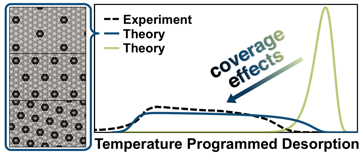
Figure 1. TPD spectra for benzene on Pt (111) simulated with coverage effects (blue) and without coverage effects (light green) compared to experiment (black) [6].
References
[1] H. Wang, J. Male, Y. Wang, ACS Catal. 3 (2013) 1047-1070.
[2] Y. Hong, H. Zhang, J. Sun, K.M. Ayman, A.J.R. Hensley, M. Gu, M.H. Engelhard, J.-S. McEwen, Y. Wang, ACS Catal. 4 (2014) 3335-3345.
[3] J. Sun, A.M. Karim, H. Zhang, L. Kovarik, X.S. Li, A.J. Hensley, J.-S. McEwen, Y. Wang, J. Catal. 306 (2013) 47-57.
[4] A.J.R. Hensley, Y. Hong, R. Zhang, H. Zhang, J. Sun, Y. Wang, J.-S. McEwen, ACS Catal. 4 (2014) 3381-3392.
[5] M.A.n. González-Borja, D.E. Resasco, Energy Fuels 25 (2011) 4155-4162.
[6] C. Xu, Y.L. Tsai, B.E. Koel, J. Phys. Chem. 98 (1994) 585-593.
See more of this Group/Topical: Catalysis and Reaction Engineering Division