
Fast Pyrolysis of Four Different Microalgae: Apparent Kinetic Parameters Evaluation and Product Analysis
Ribhu Gautam*, R. Vinu
Department of Chemical Engineering and National Center for Combustion Research and Development, Indian Institute of Technology Madras, Chennai, Tamil Nadu, India
Economic growth and development is resulting in fast depletion of fossil fuel reserves. Presently, the mitigation of environmental impacts caused due to the excessive use of fossil fuels has gained importance. Over the past few years, research for replacement of conventional fossil fuels is gaining importance with focus on biomass as it has got high potential and is an abundant energy source. Compared to terrestrial biomass, marine biomass has advantages such as high growth rate, high per hectare yield and high photosynthetic efficiency. Marine biomasses have flexibility to grow in sea water, fresh water ponds, industrial effluents and waste water. Microalgae, one of the most prominent marine biomass, are abundantly distributed water plants. They consist of lipids, proteins and carbohydrates and these lipids are converted into biodiesel. Some microalgae have lipid content as high as 80 wt.%, and are hence considered as potential feedstocks for biodiesel and biofuel production.
Fast pyrolysis is a promising thermochemical processing technique to convert microalgae into liquid, gas and solid products in the absence of oxygen at moderate temperatures. High heating rates (>1000°C s-1) involved in fast pyrolysis leads to faster completion of reactions within seconds. This results in high yields of liquid bio-oil as compared to slow pyrolysis. The existing kinetic models of algae pyrolysis are all based on thermogravimetric mass loss data obtained at slow heating conditions. The use of these data limits the application of these models for fast pyrolysis. Therefore there is an immense need to obtain kinetic parameters under fast pyrolysis conditions and validate them with the existing rate parameters.
This study reports a new experimental technique to evaluate the mass loss profiles of microalgae under fast pyrolysis conditions using an analytical pyrolyzer. Fast pyrolysis of four different microalgae (Chlorella vulgaris (C. vulgaris), Nannochlorpsis oculata (N. oculata), Schizochytrium limacinum (S. limacinum) and Arthrospira platensis (A. platensis)) was studied in the temperature range of 400-700°C and sample residence times in the range of 2-60 s. The apparent kinetic parameters of fast pyrolysis of the algae were evaluated using first order, one dimensional (1D), 2D and 3D diffusion models. Prior to the fast pyrolysis experiments the dried microalgae samples were characterized by TGA, proximate analyser, CHNS analyser, bomb calorimeter for thermal stability, proximate analysis, ultimate analysis and heating value respectively. Fast pyrolysis experiments were carried out in an analytical pyrolyzer with 4.5±0.2 mg of sample in a quartz tube. The mass loss data of the microalgae samples was generated in isothermal conditions via gravimetry. The most conventional rate loss equation was considered for the estimation of rate constants.
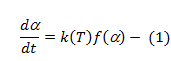
Where f(a) is the dependence of conversion on the reaction model, k(T) is dependence of rate on temperature. ‘a’ termed as normalized conversion can be calculated with the formula a = (m0-mt)/(m0-m∞), where m0, mt and m∞ are initial sample mass, sample mass at time t and final mass obtained respectively. As the reaction proceeds from initial to completion, a increases from 0 to 1. This cannot be linked to specific reactions during the process, so a is the degree of overall completion of reaction. Now,
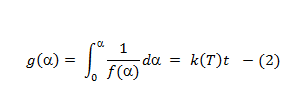
The function of g(a) has been approximated as –ln(1-a), a2, [(1-a)ln(1-a)+a] and [1-(1-a)1/3]2 for first order, 1D, 2D and 3D diffusion respectively for solid state reactions. The rate constants for each reaction temperature was obtained from the slope of the g(a) v/s t graph. The estimation of apparent activation energy was done by fitting temperature and rate constant data in Arrhenius Equation represented below
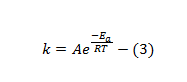
First order kinetic model fitted the experimental data well with very high R2 for all the four microalgae samples. The apparent activation energies (Ea) and pre-exponential factors (A) for fast pyrolysis of the algae varied in the range of 4-24 kJmol-1 and 0.03–1.7 s-1 respectively. The obtained rate parameters were validated by constructing a kinetic compensation plot, which showed that Ln(A)=0.19Ea–0.43 (R2=0.97) justifying the kinetic compensation effect. The pyrolysates obtained from fast pyrolysis in an analytical pyrolyzer at 500°C were characterized using gas chromatograph/mass spectrometry for all the four microalgae samples. The pyrolysates were characterized in a GC/MS coupled with pyrolyzer. Fast pyrolysis S. limacinum yielded highest aliphatic and aromatic hydrocarbons owing to its high lipid content. A detailed kinetic analysis comprising all the kinetic models and the presence of various compounds observed in the pyrolysates will be discussed during the presentation.
See more of this Group/Topical: Sustainable Engineering Forum