
Fluoride removal from Antarctic Krill (Euphausia superba) by Donnan Dialysis
Guojia Yan1,2, Yan Bao1, Xiaolan Lu2, Ming Tan1*, Yang Zhang1*
1Qingdao Institute of Bioenergy and Bioprocess Technology, Chinese Academy of Sciences, 189 Songling Road, Laoshan District, Qingdao 266101, PR China
2Key Laboratory of Marine Chemistry Theory and Technology, Ministry of Education, College of Chemistry and Chemical Engineering, Ocean University of China, Qingdao 266100, PR China
*Corresponding author: tanming@qibebt.ac.cn (Ming Tan); zhangyang@qibebt.ac.cn (Yang Zhang)
Abstract:
Antarctic krill (Euphausia superba) has abundant species in the Southern Ocean which makes krill an alternative protein source for humans as well as rich fishery resource [1]. However, a high fluorine levels in Antarctic krill have attracted attention which is the reason why krill has not been widely used commercially. The total fluoride concentration in the exoskeleton of krill is 3828-4278 mg kg−1 dry weight (DW), 178-285 mg kg−1DW in muscle, and 1102-1432 mg kg−1DW in whole krill [2]. Thus, fluoride should be removed and those expenses adversely affected the economics of krill exploitation. [3]
Donnan dialysis (DD) is a potentially attractive membrane-based equilibrium process for removing undesirable ions from solution [4]. Compared to other popular methods, a low purity of treated water is a serious problem by absorption [5]. Electrodialysis [6] may have high kinetics compared to DD, it has some disadvantages which is great strength of DD, i.e. economical, energy saving and need simple technology, etc. [4]
The effect of NaCl concentration (0.1, 0.5,1 and 2mol/L) on receiver cell, experiment stage (1st, 2nd and 3rd) and flow velocity (0.01 and 0.03cm/s) were investigated by synthetic solution (43mg/L NaF and 4.15g/L NaCl) firstly. The results show that fluoride was removed 65% at first stage which is the most removal rate when receiver concentration was 1 mol/L. Higher receiver concentration provided higher driven force for chloride to pass through anion exchange membrane which is good for defluorine. However, higher receiver concentration also increased the percentage of other ion, such as sodium which may explain 1mol/L result is better than 2mol/L. Furthermore, flow velocity 0.01 cm/s offered high removal efficiency than 0.03cm/s at 65% and 62% respectively. More time for fluoride to be exchanged into receiver chamber at 0.01cm/s. When concentration and flow velocity were both optimized, three stages were investigated at 1 mol/L. The results were 65%, 85% and 93.6% at 1st , 2nd and 3rd stage separately as displayed by Fig. 1.
After that, krill solution was operated by optimum parameters, leakage of protein and amino acids were investigated at the same time. Due to complex impurity characteristic of krill solution, the absence of other ion leakage cut down the removal rate. Nevertheless, fluoride removal by DD maintained more protein than absorption as well as higher purity of treated water.
Figure:
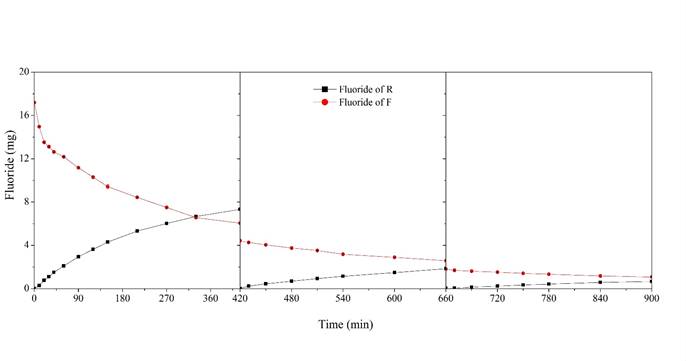 |
Fig.1 The effect of experimental stage at 1 mol/L receiver concentration.
References:
[6]. Arahman, N., et al., The removal of fluoride from water based on applied current and membrane types in electrodialyis. Journal of Fluorine Chemistry, 2016. 191: p. 97-102.
See more of this Group/Topical: Separations Division