
Robust dynamic optimization/adaptive control has been proposed to overcome a significant drawback of conventional dynamic optimization (DRTO) and optimal control (NMPC), namely, the requirement for accurate process models. One of the existing types of robust NMPC/DRTO is stochastic NMPC/DRTO (Rossi et al., 2016). This approach relies on stochastic optimization techniques and approximates the uncertainty in the process model using an appropriate set of uncertain parameters (SUP) and their joint probability distribution function (PDFUP). Although this type of strategy is applicable to a large variety of systems, we will consider the case of batch processes.
It is well-known that the performance of stochastic NMPC/DRTO primarily depends on the selection of the SUP and on the estimate of the PDFUP. The latter can be updated periodically based on the measurements acquired in successful batch cycles, using, for instance, Monte-Carlo approaches or Bayesian frameworks (Mockus et al., 2015). However, the PDFUP mainly affects the performance of the stochastic NMPC/DRTO algorithm and not its robustness. The selection of the SUP is the more crucial and challenging aspect because it may strongly affect both the robustness and the performance of the stochastic NMPC/DRTO method. Moreover, in order to meet real time computational constraints, the SUP can only include a limited number Np (Np ≤ 4, 5) of uncertain parameters.
Typically, the SUP is identified statically using sensitivity analysis (Saltelli et al., 2005) or based on empirical knowledge of the batch process. However, the use of a fixed SUP is often sub-optimal because the importance of any given uncertain parameter can be expected to vary over time, even over a single batch cycle. This is because the relevance of the uncertain parameters may depend on both their stochastic properties (PDFUP) and the operating conditions of the batch process. While the PDFUP does not significantly change over time in a single batch cycle, the same does not apply to the operating conditions of the process, which are continuously modified to compensate for process disturbances and to improve process performance.
Therefore, we identify the SUP in real-time, using a three-stage, hierarchical procedure (Figure 1). First, we employ conventional methods based on sensitivity analysis and/or empirical knowledge of the batch process to construct a set of Nptot parameters called SUPtot (Nptot ≤ 10, 15) (Phase I). This set includes those parameters, which have the most impact on the model predictions over a wide range of operating conditions. Secondly, after every batch cycle, we employ the algorithm called PDFE&U (Probability Distribution Function Estimation & Update), presented at the 2016 AIChE Annual Meeting, to re-estimate in parallel the joint probability distributions of all the subsets of Np uncertain parameters (SUPs) included in SUPtot (Phase II). In this phase, we also define proper indicators of both the statistical dispersion of all the uncertain parameters and their correlation. Note that the application of parallel computing allows us to carry out this phase in the idle time between two consecutive batch cycles. Finally, after every control action (specifically, in the idle time between two consecutive actions), we apply the novel algorithm called RTSASUP (Real-Time Selection of the Active Set of Uncertain Parameters) to select the optimal SUP (SUPopt) (Phase III). This newly estimated set of uncertain parameters is used, in the stochastic NMPC/DRTO engine, to compute the control action after the next one (in other words, the SUPopt identified at the end of control action n is used to compute control action n+2).
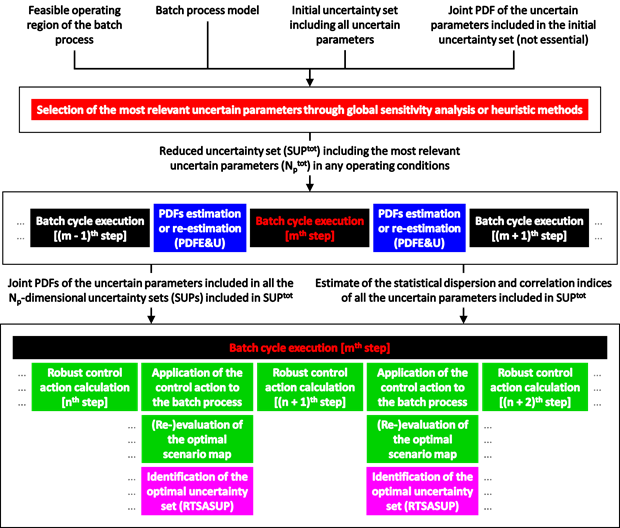
Figure SEQ Figure \* ARABIC 1: Architecture of the proposed strategy for the online identification of the optimal uncertainty set.
Note that RTSASUP chooses SUPopt as the set of Np uncertain parameters that have the most influence on the predictions of the process model, show the largest statistical dispersion and exhibit the smallest correlation among them. In order to do this, the algorithm measures the sensitivity of the process model to the uncertain parameters by solving a series of decoupled small-scale dynamic optimization problems in parallel, and then combines this latter information with the indicators of the statistical dispersion and the correlation of the uncertain parameters, estimated in Phase II. The use of parallel computing allows RTSASUP to be efficient enough to run in the idle time between two consecutive control actions (approximately a minute or two of clock time).
We demonstrate the proposed approach to the online identification of the optimal SUP (SUPopt) using a batch version of the Tennessee Eastman challenge. The case study confirms that the online re-estimation of the SUP carried out via RTSASUP benefits both the performance and the robustness insured by stochastic NMPC/DRTO frameworks. Such efficiency improvements appear to be more pronounced in the presence of process perturbations, i.e. when the operating conditions of the process experience larger variations in single batch cycles.
References:
L. Mockus, J.J. Peterson, J.M. Lainez, G.V. Reklaitis, 2015, Batch-to-batch variation: a key component for modeling chemical manufacturing processes, Organic Process Research & Development, 19, 908-914.
F. Rossi, G. Reklaitis, F. Manenti, G. Buzzi-Ferraris, 2016, Multi-scenario robust online optimization and control of fed-batch systems via dynamic model-based scenario selection, AIChE Journal, 62, 3264-3284.
A. Saltelli, M. Ratto, S. Tarantola, F. Campolongo, 2005, Sensitivity analysis for chemical models, Chemical Reviews, 105, 2811-2828.
See more of this Group/Topical: Computing and Systems Technology Division