
Study of kinetics, solubility, heat of absorption and formation of bicarbonate and carbamate of linear and ring diamines in CO2 absorption process
Rui Zhanga, Zhiwu Lianga*, Qi Yangb*, Xiao Luoa
aJoint International Center for CO2 Capture and Storage (iCCS), Provincial Key Laboratory for Cost-effective Utilization of Fossil Fuel Aimed at Reducing Carbon-dioxide Emissions, College of Chemistry and Chemical Engineering, Hunan University, Changsha, Hunan, 410082, P.R. China
bCSIRO Manufacturing, Clayton Victoria 3168, Australia
Keywords: amines; CO2 capture; ring amines
* Author for correspondence: Dr. Zhiwu Liang Email: zwliang@hnu.edu.cn
Tel: +86-13618481627 and +86-73188573033
Climate change has caused strong concern worldwide and excessive CO2 emission is considered to be the main contributor to global warming, therefore CO2 capture and storage has become an important research subject. Among different CO2 capture methods, post-combustion capture using chemical absorbents, especially amine absorbents, is regarded as a feasible method for mitigating the CO2 emissions from many industrial sources. The most commonly studied amine absorbent is monoethanolamine (MEA). Aqueous solutions of other primary, secondary and tertiary amines and amino acid salts have also been studied to investigate their mass transfer performance, reaction kinetics and energy consumption in absorption-desorption processes. All of these absorbents, however, demonstrated some challenges for use in CO2 capture processes. For example, primary amines such as MEA have a fast reaction rate with CO2 during absorption but require large energy consumption during CO2 desorption; a tertiary amine such as N-methyldiethanolamine (MDEA) requires less energy for CO2 desorption but has a slow reaction rate with CO2 during absorption. Other challenges for CO2 capture processes include amine degradation, facility corrosion, and the escape of amine or other substances to the environment. These challenges, in particular high energy consumption, result in high CO2 capture costs. To address these challenges, it is important to develop better solvents and better processes.
An ideal amine absorbent for CO2 capture should have fast reaction kinetics during CO2 absorption, large CO2 cyclic capacity (the difference between rich amine CO2 loading and lean amine CO2 loading), and low energy consumption during desorption. The performance of amines during CO2 absorption and stripping is strongly related to amine molecular structure. To design and develop better amine absorbents for CO2 capture, it is necessary to understand the effect of amine molecular structure on amine performance in CO2 capture. Yang et al. and Conway et al., have studied a number of specifically designed amine absorbents for CO2 capture1, 2. These designer amines contained two or three amino groups of different types which were spaced by two or three carbons in the same molecules. Their results showed that the designer amines demonstrated a significant improvement in CO2 cyclic capacity. Especiallly the designer amines contain a ring structure in its molecular structure, so in this work, there are 5 damines (Table 1) were selected to investigated their CO2 capture performance. The CO2 equilibrium solubility, the formation of carbamate/bicarbonate, the reaction kinetics and the heat of absorption also was investigated at the corresponding experimental condition. The current results we obtained now shows that the ring amine could produced more bicarbonate and less carbamate than the linear diamines as shown in Figure 1. More bicarbonate vs. less carbamate is benefits to the CO2 desorption performance.
The other experiments about the CO2 absorption-desorption performance will be performed in future. Through comparing the solubility, the heat of absorption and the reaction kinetics to get a good understanding on the effect of the molecular structure (ring) on the amine performance for CO2 capture.
Table 1. The details of each amine used in this work.
Amine | Abbreviation | Mol Wt | Purity (%) | Molecular structure |
Monoethanolamine | MEA | 61.08 | 99.0 |
|
Ethylenediamine | EDA | 60.10 | 99.5 |
|
N1,N2-Dimethylethane-1,2-diamine | DMEDA | 88.15 | 98.0 |
|
Piperazine | PZ | 86.14 | 99.0 |
|
2-Methylpiperazine | 2-MPZ | 100.16 | 95.0 |
|
2,6-Dimethylpiperazine | 2,6-DMPZ | 114.19 | 97.0 |
|


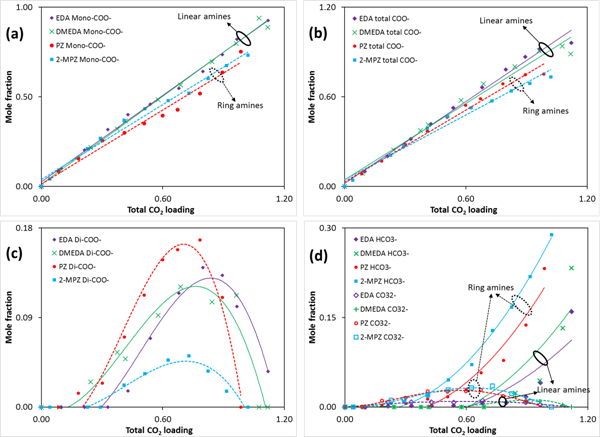
Figure 1. The profile of each species with the CO2 loading changes of each amine. Solid and dash line are the fitted line for different species of each amine.
ACKNOWLEDGEMENTS
The authors are very grateful for the
CSIRO PhD student scholarship to support this research and would like to
acknowledge the research contribution to the CO2 loaded amines test
by the CSIRO PCC team in Australia. The authors also would like to express
thanks for the financial support from the National Natural Science Foundation
of China (NSFC-Nos.21536003, U1362112 and 51521006), National Key Technology
R&D Program (MOST-No. 2014BAC18B04), Graduate Student Innovation Project of
Hunan Province (CX2016B121). China Scholarship Council and China Outstanding
Engineer Training Plan for Students of Chemical Engineering & Technology in
Hunan University (MOE-No.2011-40) are also greatly appreciated.
Reference
1. Yang, Q.; Puxty, G.; James, S.; Bown, M.; Feron, P.; Conway, W., Toward Intelligent CO2 Capture Solvent Design through Experimental Solvent Development and Amine Synthesis. Energy & Fuels 2016, 30, (9), 7503-7510.
2. Conway, W.; Yang, Q.; James, S.; Wei, C.-C.; Bown, M.; Feron, P.; Puxty, G., Designer Amines for Post Combustion CO2 Capture Processes. Energy Procedia 2014, 63, 1827-1834.
See more of this Group/Topical: Liaison Functions