
Ensuring a uniform concentration of API in the feed suspension/slurry of a spray drying process is a crucial step towards achieving a uniform dosage of the drug product intermediate. To accomplish this, an adequate feed tank design and process conditions are required to avoid heterogeneity of the suspension driven by, e.g., density differences between the solid and fluid phases. However, this heterogeneity can only be assessed a posteriori and the process optimization can only be achieved by trial and error. Here we present an alternative to this iterative and cost-ineffective development strategy by employing computational tools such as computational fluid dynamics coupled to discrete element methods (CFD-DEM) that allow offline experiments to be performed for various process conditions. These tools can also enable optimization of the agitation elements, such as number of impellers and distance to the bottom.
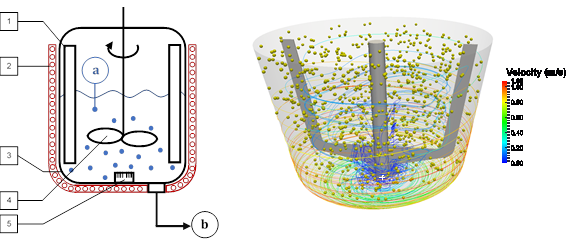
Here we focus on a spray drying case study where the feed suspension consists on a solid phase (the active pharmaceutical ingredient, or API) and the fluid phase is a solvent with a dissolved binder and other excipients. The process is run in batch mode while controlling key operation parameters, such as reactor wall temperature and agitator rotating speed, to obtain a homogeneous distribution of particles in the volume of the tank. Mixing in stirred tank reactors is enabled by fluid convection (at a larger scale) and turbulent exchanges (at a smaller scale) [1,2]. Therefore detailed information on the vessel, baffles and impeller (see Figure 1a), which determined the flow patterns, is required [2], [3].
A computational fluid dynamics (CFD-DEM) methodology (see Figure 1b), based on the OpenFOAM® framework, is used to aid process development and foresee potential issues related to accumulation zones within the reactor.
Upon choosing the
reactor, its configuration and operating conditions, a steady-state simulation
of the turbulent fluid flow, modeled via the Reynolds averaged Navier-Stokes
(RANS) equations and  shear stress transport (SST) turbulence model is
conducted. The selected transient solver then uses this pre-calculated velocity
field to update particles velocities considering the effect the forces exerted
on them by fluid drag; gravity; and Coriolis acceleration. Furthermore, other
capabilities such as particle-wall and particle-particle collision are
available and may be incorporated into the solution (at the cost of extra
computational effort). This way, the present workflow offers insight on how the
interchangeable parts and operating conditions of the reactor might influence
the steady-state particle concentration distribution.

[1] A. Ochieng and M. S. Onyango, “CFD simulation of solids suspension in stirred tanks: Review,” Hem. Ind., vol. 64, no. 5, pp. 365–374, 2010.
[2] G. R. Kasat, A. R. Khopkar, V. V. Ranade, and A. B. Pandit, “CFD simulation of liquid-phase mixing in solid-liquid stirred reactor,” Chem. Eng. Sci., vol. 63, no. 15, pp. 3877–3885, 2008.
[3] P. K. Biswas, S. C. Dev, K. M. Godiwalla, and C. S. Sivaramakrishnan, “Effect of some design parameters on the suspension characteristics of a mechanically agitated sand–water slurry system,” Mater. Des., vol. 20, no. 5, pp. 253–265, 1999.
See more of this Group/Topical: Pharmaceutical Discovery, Development and Manufacturing Forum