
Crystal morphology modifid and solution recovery improved membrane crystallization
Xiaobin Jiang, Dapeng Lu, Guannan Li, Gaohong He*
State Key Laboratory of Fine Chemicals, School of Chemical Engineering, Petrochemical Energy-efficient Separation Technology Engineering Lab of Liaoning Province, Dalian University of Technology, Dalian, P. R. China
*Corresponding author: Email: hgaohong@dlut.edu.cn
Abstract
For the multiple requirements of environmental protection and biochemical resource reuse, the treatment of industrial wastewater and recovery of the high value-added products in the food and bioprocess with high efficiency is a pivotal topic.1,2 Traditional treatment approach of multi-component wastewater with high salinity and organic solvent (which is commonly found in petrochemical, biochemical, food and pharmaceutical engineering) include vacuum evaporation crystallization (VEC), membrane based-hybrid separation technology, etc.3-5 Among these approaches, membrane distillation crystallization (MDC) that combined membrane distrillation with traditional crystallization process was attractive and significant by simultaneously recycling valuable salt crystals with high purity and specified molecular structural properties, pure volatile solvents with with high recovery.6-8
In this work, the comprehensive investigation is focused on the crystal nucleation and growth kinetics by considering both the membrane property and operational conditions of MDC. One of typical multi-component high sality wastewater, ethylene glycol (EG)-NaCl aqueous solution system, is introduced for the evaluation. The nucleation barrier, diffusion controlled crystal grwoth and interface reaction processes present a significant difference under various feed conditions and operation temperatures, which have profound effect on the crystal morphology (Fig. 1) and size distribution (Fig. 2). As a consequence, the resulting crystal with specified morphology can furtherly improve the separation efficiency. The advantage operating range of MDC for crystal morphology modification and solution recovery improvement on the researched system can be then outlined and optimized.
Acknowledgment
We acknowledge fnancial contribution from from National Natural Science Foundation of China (Grant No. 21527812, 21676043, U1663223), Changjiang Scholars Program (T2012049), the Fundamental Research Funds for the Central Universities (DUT16TD19) and Education Department of the Liaoning Province of China (No. LT2015007).
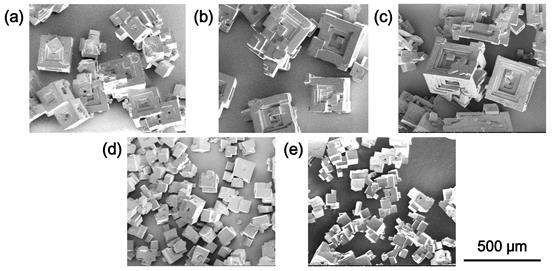
Fig. 1. NaCl crystal morphologies under different feed solution composition MEG/(MEG +MH2O): (a), 0 %; (b), 20 %; (c), 40 %; (d), 60%; (e), 80% (Pv=7 kPa£¬T=70 ¡æ).
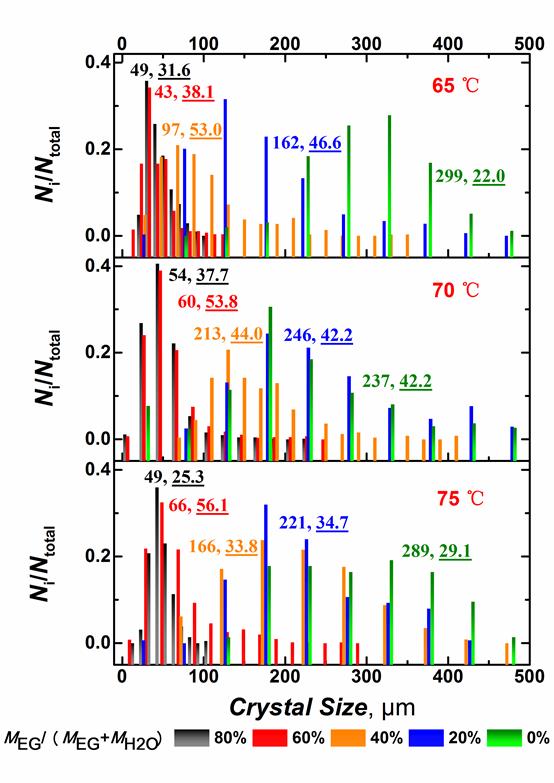
Fig. 2. Crystal particle properties comparison between with various feed composition and operation temperature. (Pv=7 kPa, MNaCl: MH2O=6.6: 40; Number in the figure: average crystal size and C.V. (underlined).
References
See more of this Group/Topical: Food, Pharmaceutical & Bioengineering Division