
Abstract:
The emission legislations are transmuting to be rigid in accordance to reduce the emissions from the IC engines. Research has been focused to ameliorate both Spark Ignition and Compression Ignition engine in order to make them more efficient. Over the previous decade, major research has been focused on Homogenous Charge Compression Ignition (HCCI) engines. This engine has the potential to consummate the eminent feature of Spark Ignition engine, with no emission of NOx and Soot leading to cleaner combustion, the best of CI engine with higher efficiency and low fuel combustion along with lower carbon dioxide emissions1.
The focus of this work is to map the stable regions of operation of HCCI engine using Methane and Dimethyl Furan blend as fuel. DMF is comparable to gasoline since it has an energy density of 40% higher than ethanol. Also, Burning DMF requires 33% less air compared to the same amount of gasoline since its stoichiometric air to fuel ratio is 10.72. The Simulations of HCCI engine were carried out in CHEMKIN, where the model used was a closed transient CSTR2. The main objective of the study was to depict the stable regions of operation of HCCI engine with and without Exhaust gas recirculation. EGR refers to a part of the exhaust stream recycled back to the engine inlet along with the fuel mixture3.
Parameters such as EGR Temperature, EGR percentage and equivalence ratio were varied to study the effect on the sustainable emissions at the exhaust for CO, CO2 and NOx. Detailed Kinetics of DMF obtained from NCBI was used. Initial understanding of the working of HCCI engine was done using Methane as source fuel, keeping EGR temperature and HCCI engine temperatures as a constant at 600K and 447K and the equivalence ratio were varied from 0.5 to 0.7 and the EGR percentage were varied from 0 to 30%. The in-cylinder temperature, pressure and species profile were obtained as a function of Crank Displacement angle (CAD).
The Figure (1) shows the effect of equivalence ratio on the in-cylinder temperature, pressure and species profile for a engine temperature of 447K and EGR temperature of 600K for 30% EGR. Increase in equivalence ratio states the presence of higher amount of fuel where as smaller ratios represent deficit of fuel in the mixture. It could be observed that Peak temperature and pressure increases with increase in equivalence ratio. The mole fraction of CO increase with increase in equivalence ratio, this is because of the lack of oxygen available for complete combustion. In case of Thermal NO production rate, it increases with increase in equivalence ratio due to increase in temperature which leads to increased production of NO at higher temperatures. It was observed from the initial study using Methane as a fuel that, for Lesser exhaust emissions, the fuel must be lean with a higher percentage of EGR.
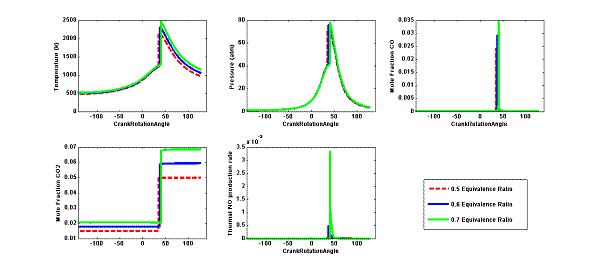
Fig 1: Variation of In-cylinder temperature, pressure, mole fraction of CO, CO2 and Thermal NO production rate with Equivalence ratio
The study was further extended to DMF as an additive to Methane and the parameters such as EGR percentage, Equivalence ratio and EGR temperature were varied to find the stable region of operation of HCCI engine for Methane and DMF blend. The effect of Equivalence ratio on the in-cylinder temperature, pressure and species properties for 0% EGR for an engine temperature of 447K and EGR temperature of 600K were studied initially. The figure (2) shows the effect of Equivalence ratio on Peak CO2 mole fraction in the cylinder for different percentage of Methane and DMF blend. It could be observed that the peak mole fraction of CO2 increases with increase in Equivalence ratio and also increases with increase in blend percentage. The latter is due to the increase in the carbon availability in the cylinder with increase in fuel.
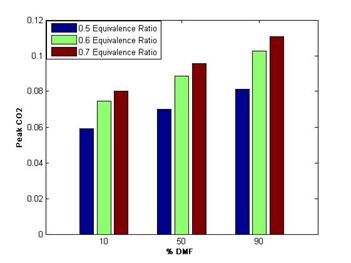
Fig 2: The Variation of Peak Mole Fraction of CO2 with percentage of the DMF blend for different Equivalence ratios
As a next step, it is intended to study the effect of EGR percentage and EGR mixing temperature on Methane and DMF blend as shown in the Table 1 and analyse the Peak in-cylinder temperature, pressure and species properties for the different parameters combinations and map the stable region of operation of HCCI engine for Methane and DMF fuel blend.
Table 1: Parameters to be estimated for the Blend
Blend
| Parameters
|
Methane & DMF blend
| EGR Percentage – 0%, 10%, 20% & 30% EGR temp – 400K, 500K & 600K Equivalence ratio – 0.5, 0.6 & 0.7 Blend Ratio – 0%, 50% & 90%
|
Keywords:
Exhaust Gas Recirculation, DMF, Crank Rotation angle.
References:
1. Harrison R. M. ed. (1996) Pollution, Causes, Effects and Control. 3rd Ed. Cambridge, The Royal Society of Chemistry.
2. Xu H., Liu, M., Gharahbaghi, S., Richardson, R., Wyszynski, M., Megaritis, T., “Modelling of HCCI Engines: Comparison of Single-zone, Multi-zone and Test Data”, SAE 2005-01-2123
3. Heywood JB, Internal Combustion Engine Fundamentals, Mc Graw Hill; 1988
See more of this Group/Topical: Catalysis and Reaction Engineering Division