
Performance of a submerged anaerobic membrane bioreactor (AnMBR) at long HRT and high solid concentration: focusing on membrane fouling and effluent quality
Yifru Waktole Berkessa1, 2, Binghua Yan1*, Ming Tan1, Yang Zhang1*
1 Lab of Waste Valorization and Water Reuse, Qingdao Institute of Bioenergy and Bioprocess Technology, Chinese Academy of Sciences, 189 Songling Road, Laoshan District, Qingdao 266101, PR China
2 University of Chinese Academy of Sciences, No.19A Yuquan Road, Beijing 100049, PR China
Corresponding author e-mail: zhangyang@qibebt.ac.cn, yanbh@qibebt.ac.cn
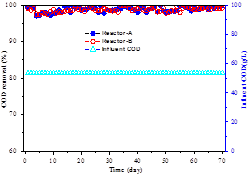
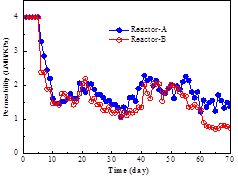
Aerobic membrane bioreactor is proved to be efficient for wastewater treatment and its application is widespread. However, it has drawbacks of high energy consumption and high solid yield. Interests in anaerobic membrane bioreactor (AnMBR) have increased in the last three decades due to its low energy consumption, low sludge production and biogas generation. Despite its merits membrane fouling is bottleneck to AnMBR technology and this study aimed at assessing treatment performance and mitigate membrane fouling by using newly designed submerged AnMBR under high MLSS concentration (22.30 g/l) and long HRT (47days). Submerged AnMBRs (two) ran in parallel with three phase separator placed between bulk sludge and membrane module. Microfiltration (0.40µm) membrane modules with effective total filtration area of 0.14m2 were installed. Results showed steady COD removal (average COD removal of >98%), high specific flux and mean biogas generation of 0.29 LCH4/g COD removed. The later could be due to active methanogens and syntrophic bacteria abundant in the sludge as confirmed from high-throughput sequencing of 16s rRNA targeting bacterial and archaeal community. Effluent quality analysis showed the effluent soluble microbial products were dominated by proteins compared to carbohydrates. Besides from specific ultraviolet absorbance (SUVA) analysis, effluent from both reactors had low aromaticity with SUVA <1 (L¡¤mg-1¡¤M-1) except for the first ten days. Furthermore, mean total resistance of both reactors (2.23E+09 m-1) and fouling rate (4.0E+08m-1¡¤day-1) values over course of operation time were low compared to literature values (usually >E+10 for both resistance and fouling rate) which could suggest the newly designed AnMBR mitigated fouling and produce effluent with better quality.
Key words: Anaerobic membrane bioreactor; mixed liquor suspended solid; membrane fouling; membrane flux
|
|
Fig. 1 Influent COD and COD removal over operation period | Fig. 2 Membrane permeability over operation period |
Acknowledgement: Financial support of the Shandong Provincial Natural Science Foundation (ZR2016bb06) and ¡°100 Talents Program¡± of Chinese Academy of Sciences (CAS).
See more of this Group/Topical: Food, Pharmaceutical & Bioengineering Division