
Direct non-oxidative methane conversion to higher hydrocarbons is a potential approach to convert natural gas into valuable hydrocarbons.1 Zeolite supported molybdenum (Mo) catalyst is the most effective catalyst reported for direct non-oxidative methane conversion into higher hydrocarbons in which HZSM-5 & HMCM-22 are the two well-known zeolites as support.2 Mo/HMCM-22 catalyst was reported for effective catalytic performance due to unique pore structure and framework of HMCM-22 zeolite support.3 Different factors such as reaction parameters (T, P and GHSV), catalyst formulation, such as Mo loading over HMCM-22 zeolite support, and SiO2/Al2O3 ratio (SAR) of HMCM-22 zeolite support significantly affects the reaction. In this regard we have studied here the effect of metal (Mo) loading over HMCM-22 (SAR-55) support and space velocity (GHSV) for non-oxidative methane conversion reaction. Firstly, effect of different Mo loading (2, 5 and 10 wt%) was analyzed and observed that 5 wt% Mo loading is suitable for benzene formation, major product of the reaction as shown in Figure 1(a). Effect of GHSV for the reaction has been shown in Figure 1 (b) for 5wt% Mo loaded HMCM-22 (SAR-55) catalyst, and it was observed that lower space velocity (720 ml/gm-hr) is effective for aromatics (benzene) formation compared to higher space velocity (1200 ml/gm-hr). Higher space velocity gives more ethylene compared to benzene due to lower residence time. Theoretical calculations were performed using density functional theory (DFT) for the Mo/Zeolite catalyst. Molybdenum carbide formed during the reaction has been proposed to be the active phase for C-H activation of methane, C2 coupling and aromatic formation reactions.4 MoxCy5 type nanocluster were supposed to be suitable form of molybdenum carbide species for methane activation and C2 coupling. In this reference, Mo4C2 nanocluster grafted over Al and Si site of zeolite channel was reported for C-H bond activation and a 112 kJ/mol energy barrier was observed when grafted over Al site.6 In the study we have investigated the C-H bond activation and ethylene (primary intermediate of benzene) formation via C2 coupling over Mo4C2 nanocluster. Schematic reaction paths for methane activation, ethane and ethylene formation over the Mo4C2 cluster and also the potential energy diagram for all these steps have been shown in Figure 2(a and b). Methane molecule gets activated over the Mo4C2 nanocluster with an activation barrier 112.8 kJ/mol to form CH3 and H adsorbed on the cluster. In the next step the second CH4 molecule dissociated over the same site with 115.5 kJ/mol activation barrier to form two CH3 groups attached to the same Mo atom, which then undergo C-C coupling reaction with an activation barrier of 150 kJ/mole which is comparatively high to form ethane. The energy barrier for C-H bond activation of ethane (89 and 94 kJ/mol) is relatively low and forms ethylene (C2H4), which is the major primary unit of benzene formation, over the catalyst as also observed experimentally, in Figure 1(a) and (b).
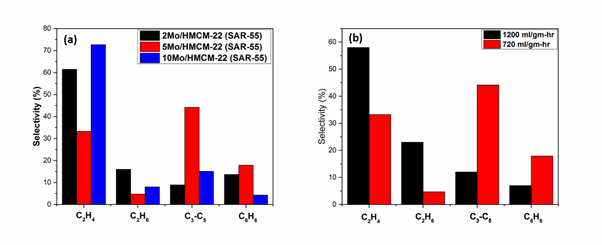
Figure 1. (a) Product distribution for different Mo loading over HMCM-22 (SAR-55) catalyst (b) Product distribution for 5wt%Mo/HMCM-22 (SAR-55) catalyst at two different GHSV (720 & 1200 ml/gm-hr)
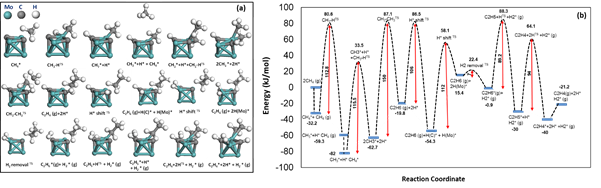
Figure 2. (a) Schematic paths for methane activation and C-C coupling over Mo4C2 nanocluster (b) Potential energy diagram for C-H activation and C2 coupling over Mo4C2 nanocluster
References
1. S. Majhi, P. Mohanty, H. Wang, K. K. Pant, Journal of Energy Chemistry, 2013, 22, 543-554.
2. S. Ma, X. Guo, L. Zhao, S. Scott, X. Bao, Journal of Energy Chemistry, 2013, 22, 1-20.
3. Y. Shu, D. Ma, L. Xu, Y. Xu, X. Bao, Catalysis Letters, 2000, 70, 67-73.
4. D. Zhou, S. Zuo, S. Xing, J. Phys. Chem. C 2012, 116, 4060-4070.
5. J. Gao, Y. Zheng, G. B. Fitzgerald, J. D. Joannis, Y. Tang, I. E. Wachs, S. G. Podkolzin, J. Phys. Chem. C 2014, 118, 4670-4679.
6. J. Gao, Y. Zheng, J. M. Jehng, Y. Tang, I. E. Wachs, S. G. Podkolzin, Science, 2015, 348, 62-35.
Acknowledgement
We would like to acknowledge Gas Authority of India Limited (GAIL) for financial support
See more of this Group/Topical: Topical Conference: Advances in Fossil Energy R&D