
Formulation strategies for solid dispersions containing tablets
S. Doktorovova, E. Voney, J. Henriques
R&D Drug Product Development, Hovione Farmaciência S.A, Sete Casas, 2674-506 Loures, Portugal
In this work we present the development of formulation strategies for amorphous solid dispersions containing hypromellose acetate-succinate (HPMC-AS-M). Solid dispersions, especially spray dried, frequently have poor tableting properties due to low bulk densities and small particle size [1]. Tablet formulation then relies on excipients with capacity to improve compactability and blend flow. Three strategies are outlined: i) using a plastic filler/binder that greatly improves blend compactability and assure good mechanical strength of the tablets, ii) using a free flowing filler to improve powder flow properties and guarantee low mass and content variation iii) use a combination of a plastic and brittle excipient. The later should assure a good balance between acceptable powder flow and compactability. For the purpose of this work, a simple formulation compromising the solid dispersion (here represented by sieved HPMC-AS-M), a diluent or combination of two diluents, a disintegrant and a lubricant was considered.
The strategy based on formulating HPMC-AS-M with free flowing diluent largely improved powder flow properties of the blend without compromising compactability, but the improvement of powder flow properties did not translate into good tableting properties. Formulation of HPMC-AS-M with plastic diluent/binder resulted in excellent mechanical strength of the produced tablets but increasing ratio of the diluent compromised mass uniformity. A combination of a plastic and a well flowing diluent was therefore required to achieve a compromise between mechanical strength and mass variability. Fine tuning of the required ratio of diluents depended on the percentage of polymer present in the blend, tablet tensile strength being impacted to greater extent by increased polymer fraction than mass variability.
A model using bulk properties of excipients and polymer was set up as a tool to optimize the formulation powder flow properties of blends and quality attributes of tablets. Various mixture models were used for each property, the one that showed the best correlation between predicted and observed values were selected for the model. Prediction of blend powder flow and tablet properties using the model will enable sparing material in solid dispersion tablet development.
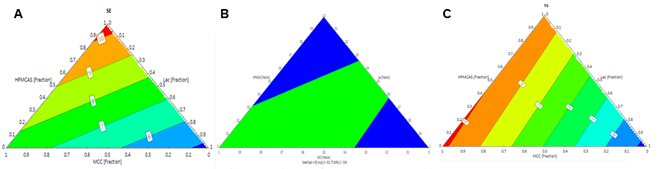
Figure 1: Modeling of a) powder flow properties using specific energy (SE, mJ/g) and c) tableting properties using tablet tensile strenght (TS, MPa) at 12 kN compression force and b) a sweet spot between acceptable powder flow and tableting properties.
References
[1] Henriques, J., Valente, P. & Winters, C. “Formulating Amorphous Solid Dispersions: Bridging Particle Engineering and Formulation”, American Pharmaceutical Review, Nov/Dec. 2016.
See more of this Group/Topical: Pharmaceutical Discovery, Development and Manufacturing Forum