
Microfluidization as an enabling technology for solubility enhancement
Iris Duarte, Clara Sa Couto, Tiago Porfirio, João Vicente and Marcio Temtem
R&D Drug Product Development, Hovione Farmaciência S.A, Sete Casas, 2674-506 Loures, Portugal
INTRODUCTION
Emerging drugs are essentially poorly water-soluble and such limited aqueous solubility has been one of the major hurdles in the development of oral-dosage forms, as poor solubility typically hinders oral bioavailability. This challenge has been addressed with different formulation strategies and enabling technologies, including: complexation with cyclodextrines (CD), production of amorphous solid dispersions (ASD) or particle-size reduction, such as the production of nanosuspensions and/or nanocrystals [1].
This work describes a technique which encompasses a microfluidization followed by a spray drying step, to produce nano- to microparticles of crystalline drug-alone, cyclodextrins complexes or amorphous solid dispersions. Three different case-studies will be detailed in this work. The manufacturing process is scalable to industrial scales and can operate either in batch or continuous manufacturing mode as benchmarked in the current work.
The microfluidization step is defined as a dynamic high-pressure process where two liquid streams, solution or suspension, pass through micro-channels toward an impingement area through which the fluids flow and interact [2]. The microfluidization step renders in either a liquid solution or liquid suspension that is typically followed by a spray drying step to remove the solvents and produce the dried particulate system. A schematic illustration of the process train is shown in Figure 1. This process was successfully demonstrated using fluticasone propionate as drug alone, itraconazole (ITZ) / Eudragit L-100 amorphous solid dispersions and ITZ / cyclodextrins inclusion complexes.
Case study I: production of micro / nanocrystals using microfluidization: Fluticasone propionate was dissolved in acetone. As anti-solvent, a mass of deionized water corresponding to 10 times that of the solvent was used. The two solutions were fed and mixed using PureNanoTM in a single passage. The particle size of the isolated product was characterized through scanning electron microscopy, SEM (Figure 2). Roughly, particles with nano-scale were obtained [3].
Case study II: complexation of a poorly water soluble API using cyclodextrines: ITZ was dissolved in DCM and SBE-β-CD dissolved in water. The two solutions were fed and mixed using PureNanoTM in a single passage. Two different trials at different temperatures were done, a filtration step was done prior to the spray dryer to remove the API not complexed. 3% was the maximum drug load obtained in the dried product [4].
Case study III: co-precipitation of nano-solid dispersions: ITZ and Eudragit L-100, in a mass proportion 1:9 and 40:60, were dissolved in a mixture of ethanol / acetone in a volume proportion of 1:1. Acidified cold water (pH=2) was used as anti-solvent with a ratio solvent:anti-solvent of 1:10 w/w. The results indicated that amorphization of ITZ was successful when using the present method (Figure 4) [5].
CONCLUSION
This work demonstrates that the technique herein described, consisting in a microfluidization step followed by an isolation step via spray drying is able to produce drug-alone nano-crystals, cyclodextrins complexes and amorphous solid dispersions. The process is scalable to industrial scales.
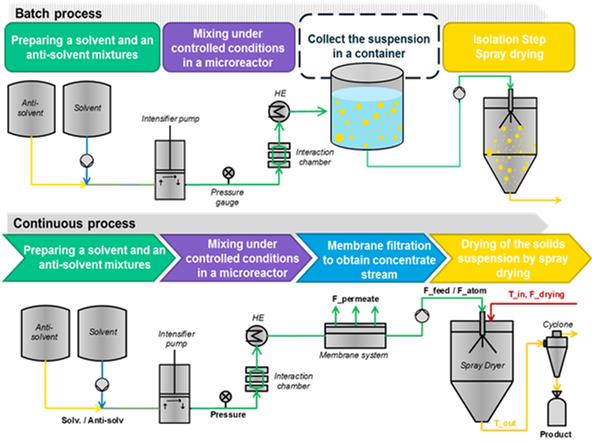
Figure 1 - Experimental set-up for the batch and continuous controlled precipitation process.
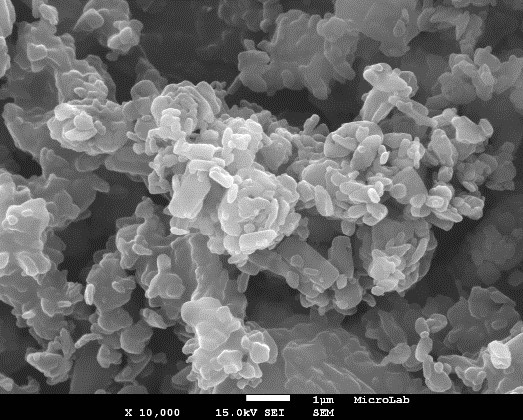
Figure 2 - SEM of spray dried particles of fluticasone propionate.
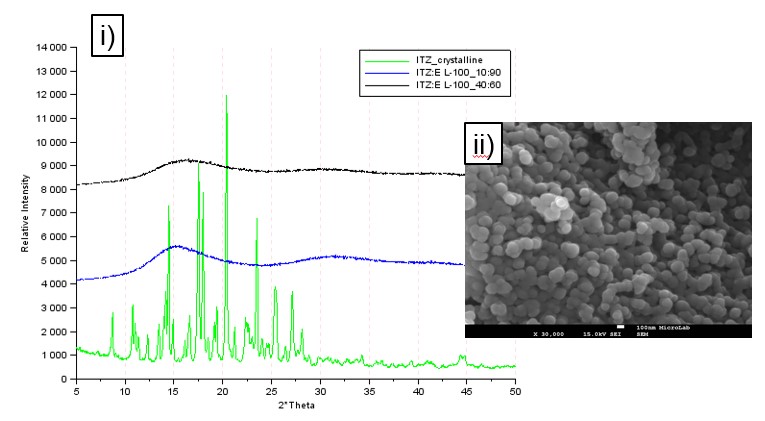
Figure 3 - i) X-ray diffractograms of ITZ solid dispersion at two different ratios and its crystalline form and ii) SEM of spray dried dispersion of ITZ.
[1] Perrie Y., Rades T. “Pharmaceutics - Drug Delivery and Targeting”, Pharmaceutical Press, 2010;
[2] Rakesh P. Patel, Ashok H Baria, Nikunjana A Patel, An overwiew of size reduction technologies in the field of pharmaceutical manufacturing, Asian Journal of Pharmaceutics October-December (2008) 216-220.
[3] Fonseca, T., Duarte, I., Vicente, J., Temtem, M. “Continuous production of particles”, Patent No. WO2016156841 A1, 2016.
[4] Lisboa, H., Santos, F., Vicente, J., Temtem, M. “Continuous complexation of active pharmaceutical ingredients”, Portuguese Patent No. 109117, 2016.
[5] Temtem, M., Pereira, R., Vicente, J., Duarte, I., Gaspar, F., Duarte, I. “A method of preparing amorphous solids dispersions in submicron range by co-precipitation”, Patent No. WO2016016665 A1, 2016.
See more of this Group/Topical: Pharmaceutical Discovery, Development and Manufacturing Forum