
2017 AIChE Annual Meeting
Topic/Group: Fluidization and Fluid-Particle Systems
Tentative Session: Fundamentals of Fluidization I
Title: Evaluation of Spouted Bed Flow Instabilities via High Speed Video and Pressure Fluctuations.
Authors:
Steven L. Rowan: Steven.Rowan@netl.doe.gov
Jingsi J. Yang: Jingsi.Yang@netl.doe.gov
Ronald W. Breault: Ronald.Breault@netl.doe.gov
Justin M. Weber: Justin.Weber@netl.doe.gov
Key Words: Fluidization, Spouted bed, Instability, Cold Flow, Energy
Abstract:
Spouted beds are a type of gas-solid contacting process first introduced by Mathur and Gishler [1] in 1955. The process, which is similar to fluidization, involves introducing gas into the bottom of a dense packed bed of solid materials through a small orifice. The gas jet pushes up through the densely-packed particles, forming an upwards moving core of entrained particles. These entrained particles are eventually ejected out of the top of the dense bed and fall into an annular region outside of the central core area, forming a fountain-like structure above the bed. The particles located within the annular region recirculate downwards towards the bottom of the bed, where they are eventually re-entrained into the upwards moving gas core. This process is particularly well-suited to processing of larger Geldart D particles that do not fluidize well using traditional fluidized bed systems [2].
Under stable operating conditions, the gas jet that forms the core of a spouted bed system will rise vertically through the densely-packed bed of solids, however, under certain flow conditions, the core will become unstable and take on more of a wavy, serpentine path through the bed of solids. Under even more extreme conditions, the gas core can be seen to migrate from the center of the bed towards the outer wall, bypassing the solids altogether. Examples of these can be seen in Figure 1.
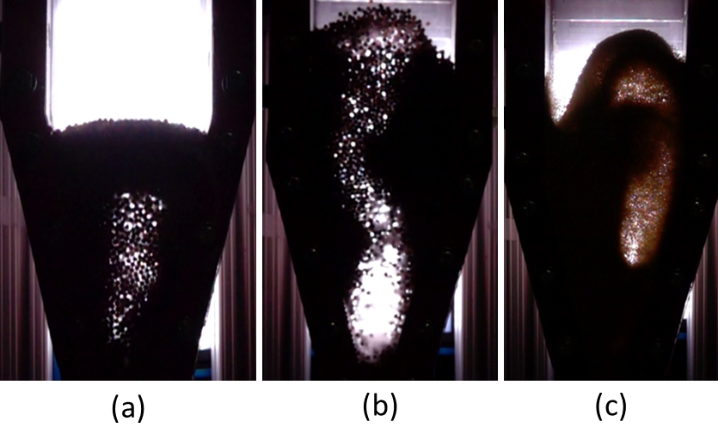
Figure 1: Examples of gas behavior in a spouted bed (a) stable, (b) snake-like instability, (c) gas bypassing.
References
[1] Mathur, K. B., Gishler, P. E. 1955. A Technique for Contacting Gases With Coarse Solid Particles, A.I.C.H.E. Journal, Vol.1, No. 2: 157-163.
[2] Geldart, d., Harnby, N., Wong, A.C. 1984. Fluidization of Cohesive Particles, Powder Technology 37, 25-37.
See more of this Group/Topical: Particle Technology Forum