
Novel Applications of Light Scattering Techniques for On-Line Characterization of Nano-Particles
Abstract.
As the nature of active pharmaceutical ingredients changes and more and more biologics are present in the drug development pipelines, nanoparticles like liposomes and nanoemulsions are emerging as useful vehicles for drug delivery. Nanoemulsions, consisting of dispersed colloidal droplets, typically around 50- 600 nm in size, within an immiscible continuous phase, are used routinely to encapsulate drugs that are poorly soluble or susceptible to hydrolysis and/or enzymatic breakdown. For these drugs nanosized micelles act as protective delivery vesicles in vivo, ensuring successful drug delivery to the target site.
The use of active ingredients that are only sparingly soluble in solid dosage forms also creates a need to disperse particles to a very fine size. Increasingly the optimal particle size for an active ingredient is in the nanometer, rather than the micrometer range. Nanomilling or micronization processes are applied to grind the particles, in suspension, and achieve the necessary comminution. Controlling particle size during the milling process is essential to ensure a safe and efficacious drug.
DLS is a technique used routinely to measure all types of nanoparticles across the size range 0.3 nm to 10 µm. The principle that underpins it is a relatively simple one, indeed simplicity is a key attraction. Small particles in a dispersion or solution are subject to Brownian motion which is driven by collisions with the solvent molecules. A DLS instrument determines the rate of diffusion of particles moving under Brownian motion, from measurements of fluctuations in scattered light intensity. The resulting diffusion coefficient is used to calculate particle size through application of the Stokes-Einstein equation:
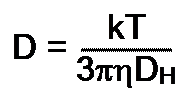
Where D = Diffusion coefficient, k = Boltzmann’s constant, T = absolute temperature, h = viscosity, and DH = hydrodynamic radius.
This relationship shows clearly how size can be determined from diffusion speed, provided that the temperature and continuous phase viscosity of the sample are known however, there are additional features of modern instrumentation that further enhance the industrial usefulness of the technique. For example, Non-Invasive Back Scattering technology (NIBS) makes it possible to achieve high sensitivity across a broad size range and at high measurement concentrations. It is also possible to apply DLS to measure a sample in flow, providing that the flow is laminar and of a limited rate.
The conventional way to use DLS in process development or monitoring is to manually extract a sample and carry out a measurement in the laboratory to determine particle size. The endpoint of the process is marked by particle size reaching a target value and this can be confirmed by offline sampling and analysis. However this approach introduces a significant lag between an action and any assessment of the impact with the results often obtained only once the batch is complete. This does not allow for an assessment of the trajectory of the process, as it progresses, or provide an opportunity to tune processing parameters to achieve a better result.
For example, in the production of a pharmaceutical nanoemulsion the endpoint of processing is marked by particle size reaching a stable value and the top end of the droplet population dropping below an upper limit. This limit is often guided by the need to achieve certain performance characteristics in subsequent processing steps, such as sterile filtration using a 0.2 µm filter, for example. Ensuring that the droplet size has been sufficiently reduced while minimizing over-processing requires multiple manual analyses over the course of a batch or during continuous production. This is a time and labor intensive approach, both at the pilot scale, when the focus is to scope and optimize processing conditions, and during commercial production, where precise monitoring is linked directly with confidence in quality and variable cost management. The need to submit in-process samples to an analytical lab for analysis results in the loss of valuable time and inhibits the ability to respond to process deviations.
The use of on-line particle characterization tools, in contrast, enables rapid, time relevant process monitoring. Real-time data make it possible to quickly see the impact of changing a process parameter and efficiently establish conditions that will deliver a successful outcome. Online measurement therefore brings clarity and reduces development efforts during the scoping and scale-up studies associated with QbD, as well as enabling efficient process monitoring and control at the commercial scale.
The case studies described in this presentation will discuss the comparability of manual and automatic analysis and results achieved from evaluating various formulations with emphasis on practical value of utilizing Process Analytical Technologies.
See more of this Group/Topical: Particle Technology Forum