
Dry reforming of methane over Zr,Y-modified Ni/Mg/Al hydrotalcite catalysts for hydrogen and carbon monoxide production
Katarzyna Świrka,b, Maria Elena Gálvezb, Monika Motaka, Teresa Grzybeka, Patrick Da Costab
a AGH University of Science and Technology, Faculty of Energy and Fuels, Al. A. Mickiewicza 30, 30-059, Krakow, Poland
b Sorbonne Universités, UPMC Paris 6, CNRS, UMR 7190, Institut Jean Le Rond d'Alembert, 2 Place de la Gare de Ceinture, 78210, Saint-Cyr-L'Ecole, France
1. Introduction
Dry reforming of methane (DRM) is a method of producing hydrogen and carbon monoxide while utilizing CO2. The process has not been launched yet on an industrial scale due to lack of stable, active and selective catalyst [1]. Ni-based catalysts, used e.g. in steam reforming, seem to be a great alternative for expensive noble metal materials. However, the main drawbacks of nickel catalysts is their fast deactivation caused by carbon deposition and/or sintering [2].
The hydrotalcites (HTs, or layered double hydrotalcites LDHs, which exhibit brucite-like structure) appear to be promising support for catalysts due to their strong interrelated nanostructure which hinders Ni from sintering at high temperatures needed for DRM [3]. On the other hand, an addition of metallic promoters may positively influence catalytic activity and stability in DRM process [4].
Zr and Y species seems to be good components for the DRM catalyst, because only a slight addition of yttrium may stabilize the zirconia phase resulting in high thermal stability of catalysts [5]. Moreover, the yttrium as a promoter, enhances activity and stability of the used catalyst in DRM process, due to ability of oxygen vacancies creation [6].
Thus, the goal of this work was to examine the effect of the promotion of Ni/Mg/Al hydrotalcites with Zr and Y on their structure and performance in dry methane reforming.
2. Experimental
The HT sample was prepared by the co-precipitation method at pH of 10 ± 2, from the aqueous solution of nickel, magnesium and aluminum nitrates (Ni/Mg=0.33, M2+/M3+=3.0). Subsequently, the fresh HT material was modified with zirconium (5 wt.%) and yttrium (0.2 wt.%, 0.4 wt.%, or 0.6 wt.%), resulting in HT/Zr5 Y0.2, HT/Zr5 Y0.4, HT/Zr5 Y0.6 catalysts. The introduction of these two metals occurred through wetness impregnation method (co-impregnation). So synthesized materials were dried at 80oC overnight, and calcined in air at 550oC for 6 hours. The obtained catalysts were characterized by XRD, TPR-H2, TPD-CO2, and FTIR.
The dry reforming tests were carried out in a fixed-bed quartz reactor at temperature range of 850-600°C. Before each catalytic test, the samples were reduced in situ at 900oC for 1 hour with hydrogen (5% H2 in Ar, flow 10oC/min). The gas composition was adjusted to 1/1/8=CH4/CO2/Ar, with total flow of feed gases of 100 cm3/min (GHSV=20,000h-1). The final products were analyzed by Varian GC-490 micro-GC.
3. Results and discussion
The X-ray analysis for the fresh samples confirmed successful synthesis of hydrotalcite-like materials (reflections at 2θ equal to ca. 11, 22 and 35o). Also, the periclase-like structure was registered after thermal treatment in air. On top of this, separate phase of Zr compound (ca. 31o and 51o) was observed. However, no separate phase was registered for yttrium in the XRD patterns of calcined and reduced samples.
The TPR-H2 profiles show wide peaks with maximum value at ca. 830-860oC, which arise from reduction of Ni particles derived from mixed oxides in hydrotalcite structure. The reduction temperature is dependent on the presence of promoters. There was observed a shift of the wide peak towards higher temperatures in Zr, and Zr,Y-modified samples (847oC), with the highest temperature reached at 860oC for HT/Zr5 Y0.4 sample. This shift indicates decrease in reducibility, and stronger interaction of Ni with the support. The observed peaks at lower temperature, ca. 400oC, arise from NiO weakly bonded with the support.
The Zr,Y-modification influenced basicity of tested samples by expanding the number of medium sites while increasing Y content. Although, the total basicity decreased with promoters addition.
The FTIR measurements showed typical spectra for hydrotalcite-derived material.
The DRM tests (CH4/CO2/Ar=1/1/8) showed increase in CH4 and CO2 conversions while increasing temperature (Fig. 1 and Fig.2). The best results in the low temperature region (600-700oC) were observed for Zr,Y-modified samples. At 700°C the conversions obtained following sequence: HT/Zr5 Y0.6 > HT/Zr5 Y0.4 > HT/Zr5 > HT > HT/Zr5 Y0.2. Above this temperature the best performance was found for the catalyst impregnated only with Zr. The presence of side reactions, such as RWGS was deduced through CO2 conversion greater than CH4 conversion, and H2/CO lower than 1.
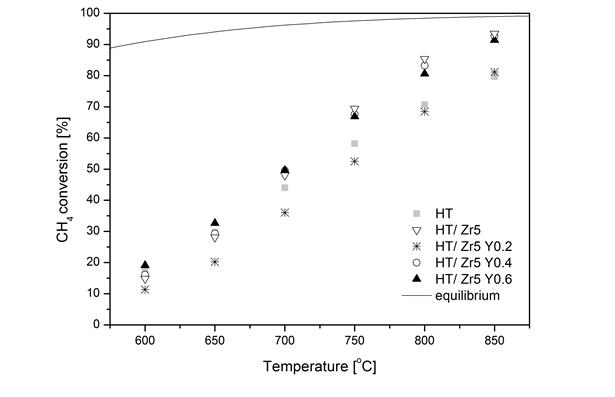
Fig. 1 CH4 conversion as a function of reaction temperature (DRM process CH4/CO2/Ar=1/1/8, GHSV=20,000h-1) of hydrotalcite catalysts modified with Zr and Y
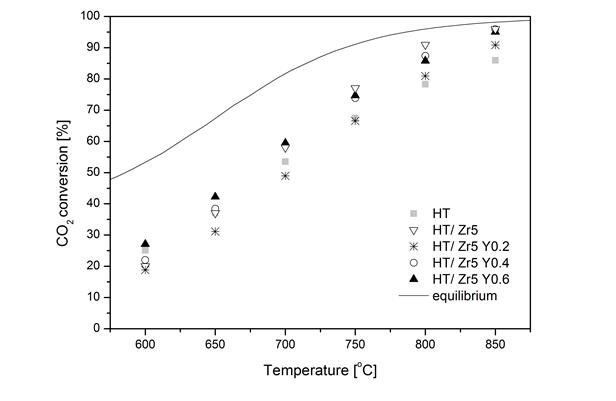
Fig. 2 CO2 conversion as a function of reaction temperature (DRM process CH4/CO2/Ar=1/1/8, GHSV=20,000h-1) of hydrotalcite catalysts modified with Zr and Y
4. Conclusions
All prepared catalysts were catalytically active in the DRM process. The presence of Zr and Y in Ni-containing hydrotalcite-derived catalysts resulted in a higher number of medium basic sites, which contributes to enhanced catalytic activities in DRM at low temperatures. The DRM tests show that the HT/Zr5 Y0.6 gives the highest CH4 and CO2 conversion, and the highest H2/CO ratio in the temperature range of 600oC to 700oC. At temperatures higher than 700oC the presence of yttrium did not increase the catalytic activity of the Zr-modified sample. The effect of the reverse water gas shift reaction, on the hydrogen production and the molar ratio H2/CO has been observed.
Acknowledgments
K. Świrk would like to acknowledge for financial support the French Embassy in Poland and InnoEnergy PhD School.
References
1. M. Rezaei et al., J Nat Gas Chem, 15 (2006) 327-334
2. A. S. A. A. Fatish et al., Appl Catal A, 364 (2009) 150-155
3. K. Mette et al., ChemCatChem, 6 (2014) 100-104
4. K. Asami et al., Catal Today 84, 27 (2003) 27-31
5. F. Legorreta-García et al., Bol Soc Esp Cerám V, 54 (2015) 119-123
6. Q. Wu et al., Fuel Process Technol, 89 (2008) 993-999
See more of this Group/Topical: Topical Conference: Advances in Fossil Energy R&D