496638
Computational Investigation of Liquid Maldistribution in Periodically Operated Structured Packed Beds
Soumendu Dasgupta, Department of Chemical Engineering, Indian Institute of Technology, Kharagpur, Kharagpur, India and Arnab Atta, Multiscale Computational Fluid Dynamics (mCFD) Laboratory, Department of Chemical Engineering, Indian Institute of Technology Kharagpur, Kharagpur 721302, India., Kharagpur, India
The non-linear hydrodynamics combined with multiscale transport processes engenders the
modeling of packed bed reactors (PBR) a challenging task, particularly in addressing the scale up
issues for its commercial application. Familiarized with the steady state hydrodynamics over the
past two decades, researchers are now extensively exploring the efficacy of unsteady state
operation of packed bed reactors in process intensification and prolong reactor service life.
Despite the proven advantages, implementation of periodic flow operation in commercial PBRs
is still far from reality, mainly due to process control safety. Although, the application of steady
state PBR for commercial purposes is well established, the design concept of periodic PBR needs
more attention, even heuristically, to understand the influence of all key parameters. With
enhanced capabilities of CFD methods, computational studies can not only complement various
facets of physical phenomena but also can help in understanding certain aspects that are
generally not attainable by experiments. Surprisingly, limited researches have attempted to
develop CFD based models for unsteady PBRs to understand the influence of operating
parameters. Moreover, none of these studies have addressed the effect of packing arrangements
on flow distribution during periodic operation. Additionally, hydrodynamics of periodic PBRs,
fed with non-Newtonian liquids, has rarely been addressed. Cyclic or periodic operation, dictates
the periodic toggling of a fluid phase at the inlet, between a low-level (base) and a high-level
(peak), typically referred to as the min-max flow operation. This further is termed as the on-off
flow when the base flow rate is set to zero.
In this article, we aim to develop a 3-D CFD model for periodic PBRs to understand the effect of
particle arrangements and various splits under min-max and on-off operation on flow
distribution. A CFD model is developed based on unit cell approach incorporating single phase
periodic flow to understand the intrinsic behavior of flow modulation in structured packings. To
elucidate the effect of non-Newtonian liquid, a basic power-law model is employed in our
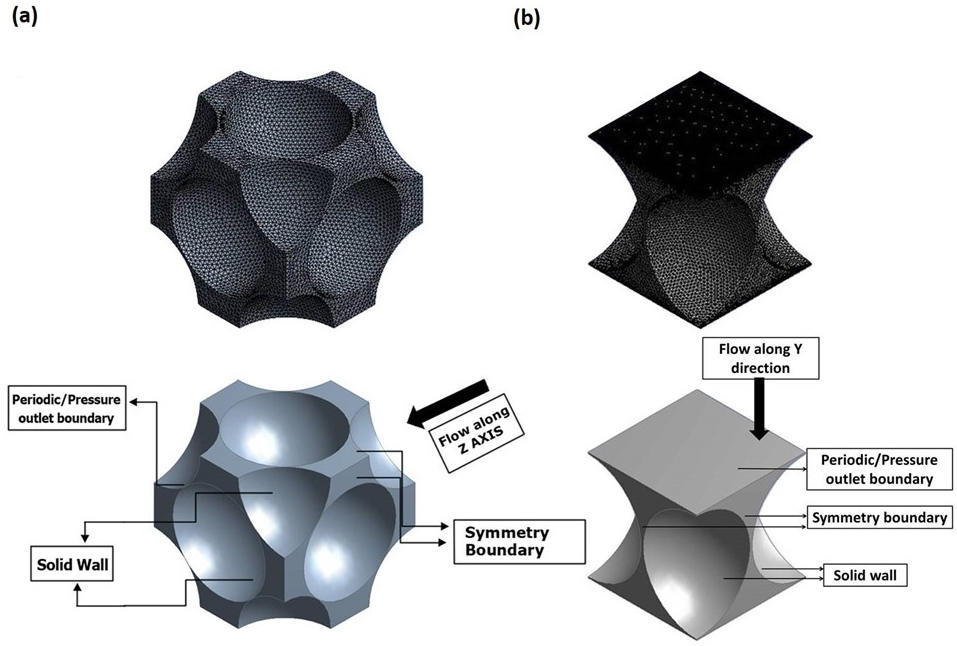
validated CFD model. To examine the effect of particle arrangements, face centered cubic (FCC)
and modified simple cubic (SC) packing orientations are investigated as shown in Fig. 1.
Figure 1: Schematic showing grids and boundary conditions of (a) FCC, and (b) modified
SC arrangements.
Moreover, three different
combinations of min-max and on-off operation are chosen under fast mode to identify the
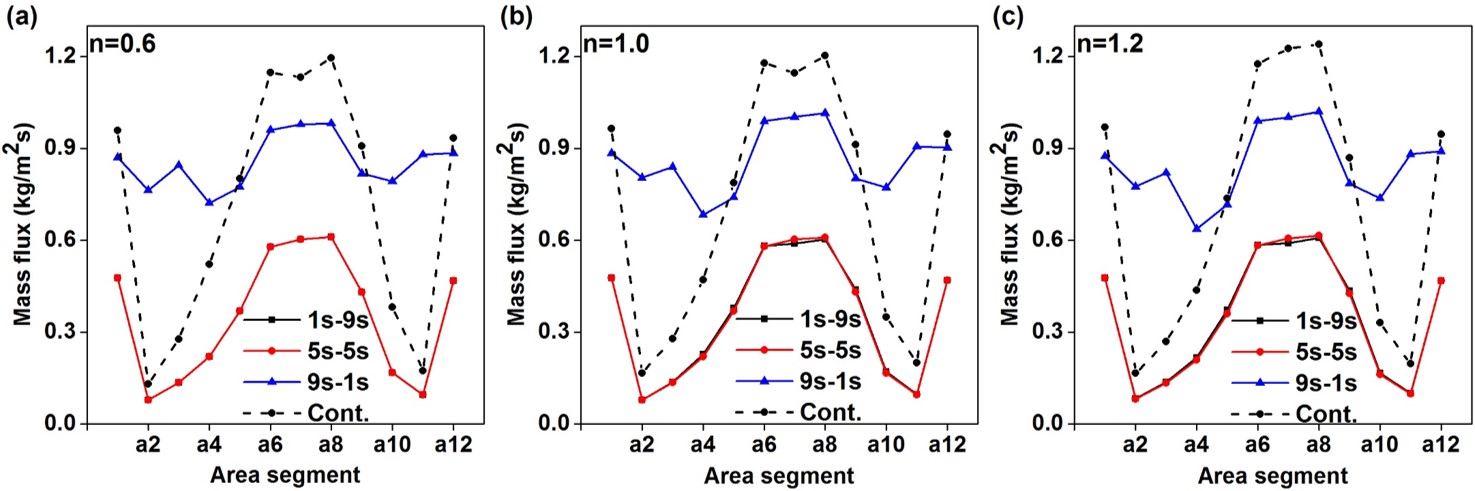
influence of flow splits. Liquid distribution is quantitatively examined at the mid-plane of the
geometries by dividing the plane into twelve area segments and then evaluating the mass flux
through each of the segments. An improved distribution is observed for periodic flow as
compared to continuous operation, which is even more pronounced for min-max operation. A
distribution coefficient, calculated using the standard deviation concept, indicates that the FCC
packing shows the best distribution for min-max operation with the split having maximum peak
flow duration as shown in Fig. 2. However, exactly opposite trend is observed in modified SC, where the split with
the lowest peak flow rate duration shows the best distribution among the three splits which was
even more pronounced for the min-max operation. FCC exhibits better liquid distribution than
the modified SC although having a higher pressure drop value due to its lower porosity.
Consequently, a comparitive analysis was conducted to determine the desired mode of periodic
operation with optimum split ratio that results in least maldistribution. This study will not only
find relevance to several packed bed applications but also indicate the periodic flow operation as
a viable process intensification technique.
Figure 2: Mass flux distribution at the mid-plane of FCC for different n values at t=10 s for (a) n=0.6, (b) n=1.0, and (c) n=1.2.