
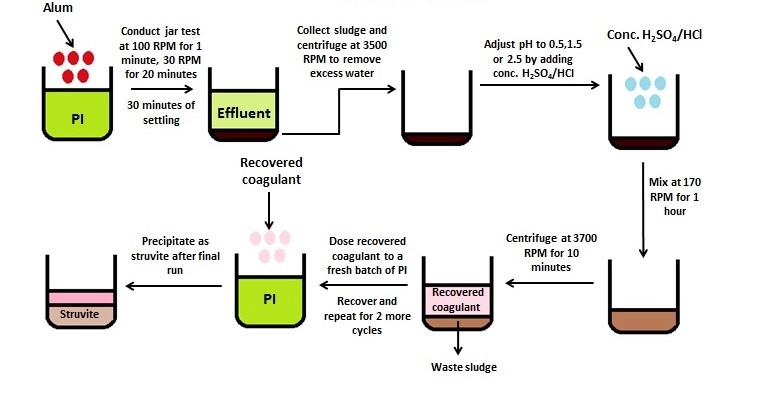
Coagulant recovery is an attractive option from both economic and environmental sustainability standpoints and has elicited the interest of researchers over the past 10 – 20 years. However, these studies focussed on recovery with minimal investigations of the recycled organics and nutrients. Therefore, in this work, method of recovery of alum coagulant from primary sludge originated from treated raw wastewater and its reuse potential have been investigated and assessed. The sludge was generated using alum as a coagulant in a standard jar test (100 RPM for 1 minute and 30 RPM for 20 minutes) from primary influent obtained from Pottersburg Water Pollution Control Plant. This sludge was later acidified with either HCl or H2SO4 to a pH of 0.5 – 2.5 to recover the aluminum (60 minutes of mixing at 170 RPM to solubilize the coagulant followed by 10 minutes of centrifugation at 3700 RPM for separation of the coagulant). Efficiencies increased with pH, varying from 82% - 90% (pH 0.5) to 70% - 78% (pH 1.5) to 39% - 60% (pH 2.5). There was no significant difference in the results using either HCl or H2SO4. In addition to that, acid treatment reduced the sludge volume by 80% which would alleviate the cost of sludge disposal. The cost of acid at $0.28/kg and taking into account the incremental aluminum recovery at pH 0.5 vs. 1.5, operating at a pH of 0.5 rather than a pH of 1.5 would not be justified. Given the marginal improvement in going from pH 1.5 to 0.5, on a cost performance basis, the optimum pH for aluminum recovery was chosen as 1.5 and all further experiments were conducted at this pH. The recovered coagulant was recycled twice for coagulation of fresh batches of primary influent and the water quality parameters (total suspended solids, phosphorous, nitrogen, and chemical oxygen demand) were determined. For the fresh alum, the removal efficiencies of total suspended solids, chemical oxygen demand, total phosphorous, and total nitrogen were 85%, 65%, 80% and 33%, respectively. For the recycled aluminum, removals of total suspended solids, chemical oxygen demand and total nitrogen were less affected with coagulant recycle, with removals decreasing by approximately 10 percentage points in each recycle. This efficiency implies that the recovered aluminum’s coagulation power is effective, thus reducing oxygen demand and biological sludge volumes. Phosphorous was the most sensitive parameter during coagulant recycling, due to the carryover of o-phosphate with the recovered coagulant and increased by 1 mg/L and 3 mg/L in the first and second cycles respectively. To mitigate the increasing phosphorous load, struvite precipitation was attempted by the addition of magnesium chloride and ammonium hydroxide in a molar ratio of 1:1:1. This proved to be ineffective as it precipitated the aluminum.
Graphical abstract
See more of this Group/Topical: Environmental Division