
One promising method for addressing the growing need for diverse, sustainable energy sources is bio-oil produced via the fast-pyrolysis of biomass. However, these bio-oils have high concentrations of oxygenated compounds, resulting in fuel quality issues1 that require catalytic hydrodeoxygenation (HDO), thereby reducing the overall oxygen content and improving fuel quality. Bimetallic, doped iron, catalysts have demonstrated synergistic behavior that contributes to a more cost-effective and longer-lasting HDO catalyst2-6. In order to improve the performance of such bimetallic iron catalysts, the oxidative deactivation mechanism that limits these catalysts must be determined.
While the addition of dopants to Fe catalysts exhibits an overall synergistic interaction, further investigation into the behavior of oxygen on a doped catalytic Fe grain is required to minimize the use of precious metals while maximizing its synergistic properties2,4,7. Here, we model the oxidative deactivation of a full catalytic Fe grain by exposure to O2 as well as taking into account both coverage and facet effects on the kinetic behavior. Additionally, as the application of external electric fields has demonstrated favorable effects on other catalytic processes, such as methane steam reforming, the effect of a range of electric fields were also investigated8-11. Such a realistic, multi-faceted model of a doped Fe grain is an effective tool for optimizing the use of precious metal dopants and taking advantage of the effect of an electric field. These realistic, predictive models help to bridge the gap between experiment and theory, streamlining research efforts and accelerating progress.
In order to build the multi-faceted catalytic Fe grain model, the adsorption of oxygen was calculated on both clean and doped Fe(100), Fe(110), and Fe(111) over a range of surface coverages. The effect of an electric field on oxygen adsorption on these three Fe facets was studied over a range of ±1.0 V/Å, examining each available adsorption site over a range of coverages. Surprisingly, we found that the undoped Fe(111) facet favors a high oxygen coverage even under low O2 exposure and all electric field strengths (see Figure 1). Results indicate that the undoped Fe(110) surface is the most strongly affected by the electric field over the coverage range, while the undoped Fe(100) surface is the least effected. As seen in Figure 1, the undoped Fe(100) and Fe(111) surfaces have the strongest adsorption energy, resulting in high oxygen coverage upon exposure to O2. Preliminary work on Pd doped Fe(100) with varying Pd concentration has shown that increasing the surface concentration of Pd significantly decreased the adsorption strength of oxygen, which is consistent with other studies on the adsorption of benzene and phenol on Fe doped surfaces12,13. These results suggest that the primary function of Pd is the disruption of oxide formation due to the aversion that oxygen has for Pd on the Pd/Fe(100) surfaces. Consequently, the degree of catalyst deactivation due to the formation of a surface oxide likely decreases with the addition of Pd to an Fe surface, thereby promoting HDO with minimal deactivation of the active Fe surface.
The three Fe facets studied here were then used to construct a model of a multi-faceted grain surface, incorporating the anisotropic effects of the surface orientation on kinetic characteristics14. Such a model accounts for the effect of pressure, temperature, electric field, dopants, and surface orientation on the adsorption/desorption and oxidative deactivation behavior. This doped Fe catalytic grain model can be used as an experimentally predictive, useful tool for optimizing methods in which HDO catalysts are designed to reduce oxidative deactivation while minimizing the use of costly precious metals.
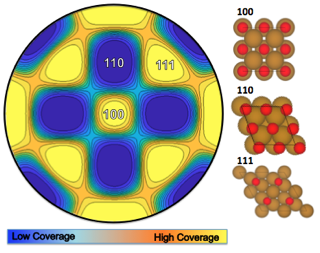
Figure 1: Equilibrium oxygen coverage on a multi-faceted catalytic iron grain at 500 K,1.5 Pa, and an electric field of -1.0 V/Å.
References:
1. Wang, H., Male, J. & Wang, Y. Recent Advances in Hydrotreating of Pyrolysis Bio-Oil and Its Oxygen-Containing Model Compounds. ACS Catal. 3, 1047–1070 (2013).
2. Hong, Y., Zhang, H., Sun, J., Ayman, K. M. & Hensley, A. Synergistic catalysis between Pd and Fe in gas phase hydrodeoxygenation of m-cresol. ACS Catalysis (2014). doi:10.1021/cs500578g
3. Nie, L., de Souza, P. M., Noronha, F. B. & An, W. Selective conversion of m-cresol to toluene over bimetallic Ni–Fe catalysts. Journal of Molecular … (2014). doi:10.1016/j.molcata.2013.09.029
4. Sun, J. et al. Carbon-supported bimetallic Pd–Fe catalysts for vapor-phase hydrodeoxygenation of guaiacol. Journal of Catalysis 306, 47–57 (2013).
5. Sitthisa, S., An, W. & Resasco, D. E. Selective conversion of furfural to methylfuran over silica-supported Ni Fe bimetallic catalysts. Journal of Catalysis (2011). doi:10.1016/j.jcat.2011.09.005
6. González-Borja, M. Á. & Resasco, D. E. Anisole and guaiacol hydrodeoxygenation over monolithic Pt–Sn catalysts. Energy & Fuels (2011). doi:10.1021/ef200728r
7. Hensley, A. J. R. et al. Enhanced Fe 2O 3Reducibility via Surface Modification with Pd: Characterizing the Synergy within Pd/Fe Catalysts for Hydrodeoxygenation Reactions. ACS Catal. 4, 3381–3392 (2014).
8. Che, F., Ha, S., McEwen, J. S., Hensley, A. J. & Zhang, R. Elucidating the field influence on the energetics of the methane steam reforming reaction: A density functional theory study. ‘Applied Catalysis B, Environmental’ (2016). doi:10.1016/j.apcatb.2016.04.026
9. Che, F., Gray, J. T., Ha, S. & McEwen, J.-S. Improving Ni Catalysts Using Electric Fields: A DFT and Experimental Study of the Methane Steam Reforming Reaction. ACS Catal. (2016). doi:10.1021/acscatal.6b02318
10. Che, F., Ha, S. & McEwen, J. S. Hydrogen Oxidation and Water Dissociation over an Oxygen-Enriched Ni/YSZ Electrode in the Presence of an Electric Field: A First Principles-Based Microkinetic …. Industrial & Engineering Chemistry … (2017). doi:10.1021/acs.iecr.6b04028
11. Che, F., Gray, J. T., Ha, S. & McEwen, J. S. Catalytic water dehydrogenation and formation on nickel: Dual path mechanism in high electric fields. Journal of Catalysis (2015). doi:10.1016/j.jcat.2015.09.010
12. Hensley, A. J. R., Zhang, R., Wang, Y. & McEwen, J.-S. Tailoring the Adsorption of Benzene on PdFe Surfaces: A Density Functional Theory Study. J. Phys. Chem. C 117, 24317–24328 (2013).
13. Hensley, A., Schneider, S., Wang, Y. & McEwen, J. S. Adsorption of aromatics on the (111) surface of PtM and PtM 3 (M= Fe, Ni) alloys. RSC Adv. (2015). doi:10.1039/C5RA13578H
14. McEwen, J. S., Gaspard, P., de Bocarmé, T. V. & Kruse, N. Oscillations and Bistability in the Catalytic Formation of Water on Rhodium in High Electric Fields. J. Phys. Chem. C 113, 17045–17058 (2009).
See more of this Group/Topical: Particle Technology Forum