
Fluoride content in potable water that is higher than the World Health Organization (WHO) limit of 1.5 mg L-1, can cause fluorosis [1]. As groundwater in several countries is affected by excess fluoride content, there is a great need for the treatment of fluoride contaminated water [2]. Several defluoridation techniques such as adsorption, ion exchange, coagulation-precipitation, and membrane process have been reported in the literature. However, adsorption technique is widely studied because of its economic viability, easy operation, low maintenance cost and efficiency of fluoride ion removal [3-5].
In this study, we have investigated the fluoride removal capacity of amine-functionalized cellulose nanofibers derived from modified electrospun cellulose acetate fibers under batch conditions. Electrospun cellulose acetate nanofibers were modified by the deacetylation process to get the cellulose fibers. Further, the surface of cellulose fibers was functionalized with amine functional groups using ethylenediamine to improve its binding capacity for fluoride ions. Thus prepared adsorbent was characterized with field emission scanning electron microscopy (FESEM), Fourier transform infrared spectrophotometer (FT-IR) and Brunauer-Emmett-Teller (BET) surface analyzer.
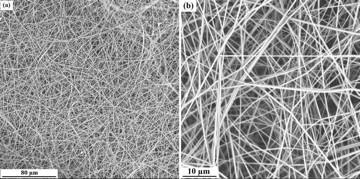
Figure 1: SEM images of electrospun cellulose acetate fibers at different magnifications
Batch adsorption experiments were performed as the function of contact time, the dosage of adsorbent, initial fluoride concentration, temperature, and pH. Langmuir, Freundlich, and Dubinin-Radushkevich isotherm models were applied to the equilibrium data and adsorption kinetics were tested by pseudo-first-order and pseudo-second-order kinetic models to determine the best-fit of sorption kinetics. To regenerate the adsorbent, desorption experiments were carried out for fluoride adsorbed nanofibers at various pH values by adding 0.1 M HCl or 0.1 M NaOH. Finally, the prepared adsorbent was successfully used for the field water sample collected from a nearby fluoride affected village.
References:
1. World Health Organization. Guidelines for drinking-water quality, First addendum to third addition, Vol. 1, Recommendations.-3rd ed.
2. Jagtap, S., Yenkie, M.K., Labhsetwar, N., and Rayalu, S. Fluoride in drinking water and defluoridation of water, Chem. Rev. 2012, 112, 2454-2466.
3. Meenakshi, Maheshwari, R.C. Fluoride in drinking water and its removal, J. Hazard. Mater. 2006, B137, 456-463.
4. Gupta, V.K., Ali, I., Saini, V.K. Defluoridation of wastewaters using waste carbon slurry, Water Res. 2007, 41, 3307-3316.
5. Chen, N., Zhang, Z., Feng, C., Li, M., Zhu, D., Chen, R., Sugiura, N. An excellent fluoride sorption behavior of ceramic adsorbent, J. Hazard. Mater. 2010, 183, 460-465.
See more of this Group/Topical: Separations Division